Tuesday, March 03, 2020

Lent 1A

Matthew 4:1-11

1Then Jesus was led up by the Spirit into the wilderness to be tempted by the devil. 2He fasted forty days and forty nights, and afterwards he was famished. 3The tempter came and said to him, "If you are the Son of God, command these stones to become loaves of bread." 4But he answered, "It is written,
    'One does not live by bread alone,
      but by every word that comes from the mouth of God.'"

      5Then the devil took him to the holy city and placed him on the pinnacle of the temple, 6saying to him, "If you are the Son of God, throw yourself down; for it is written,
    'He will command his angels concerning you,'
      and 'On their hands they will bear you up,
    so that you will not dash your foot against a stone.'"

7Jesus said to him, "Again it is written, 'Do not put the Lord your God to the test.'"
      8Again, the devil took him to a very high mountain and showed him all the kingdoms of the world and their splendor; 9and he said to him, "All these I will give you, if you will fall down and worship me." 10Jesus said to him, "Away with you, Satan! for it is written,
      'Worship the Lord your God, and serve only him.'"
11Then the devil left him, and suddenly angels came and waited on him.

Where we are: There are several ways to describe and organize the Christian year; one way begins by saying the church's year of grace just finished an approximately 3-month long section as we moved from Advent, with darker and shorter days into Christmas and through Epiphany, with more light and longer days, all of which emphasized Jesus as light for all, God as God of all creation and all people. That season also was about us as light to the world!

Last Wednesday was Ash Wednesday, the start of the season of Lent that's 40 days long—excluding Sundays. Lent was one of the church's earliest observances, apparently beginning with only a few days, gradually expanding into our current 40 days. There's no "right or wrong," but churches that observe the Three Days-Triduum of Maundy Thursday, Good Friday, and Easter, generally count Lent from Ash Wednesday through Wednesday in Holy Week; others go from Ash Wednesday through Holy Saturday evening.

"Lent" comes from an Old English word for spring and refers to days getting longer, similar to the music tempo Lento or Slow. As a time of repentance and overall slowing, last year Pastor Peg observed Lent is a kind of spring cleaning for each of us. If you don't slow down, dust and cobwebs will relocate themselves rather than leave! Lent brings a special opportunity for confession and repentance; more than anything it's a season to confidently live bathed in grace as we confess, repent, and move in a new, better, direction. Historically Lent was the time of preparation for baptism, with baptisms at the Easter Vigil on Easter Eve or very very early Easter Sunday morning.

We're in Matthew's gospel year. In Matthew's, Mark's, and Luke's lectionary years, the first Sunday in but not of Lent features Jesus' wilderness temptation. This temptation narrative is that important! Jesus goes from his baptism in the wilderness of Judea [Matthew 3:1] alongside the Jordan River [Matthew 3:5-6] into a deeper level of wilderness [Matthew 4:1]. Matthew 4:1 begins with the word "Then" that didn't get into our Sunday worship bulletin.

Then is immediately after Jesus' baptism. We need to remember Jesus did not receive our trinitarian baptism into his death and resurrection, yet his baptism by John still related to turning-around repentance and newness for the entire people of God and like ours, that baptism was identity-forming and affirming. A few weeks ago in the trinitarian theophany (demonstration, showing-forth/revealing of the three persons of the Trinity) of Jesus' baptism, God the Father declared Jesus Beloved Son.

Matthew's gospel emphasizes Jesus as the new liberator Moses and the new King David. Today Matthew brings us Jesus as the new Israel. Like Moses and like God's people Israel, Matthew's Jesus is called out of Egypt [Matthew 2:15] and goes through a wilderness testing time that necessitates his complete trust and reliance on God's gracious provision.

In his interactions with the tempter [devil, prosecuting attorney, etc.] Jesus quotes scripture he has learned being raised as an observant, synagogue-going Jew. Jesus quotes from the Pentateuch book of Deuteronomy with its guidelines and instruction for living faithfully in community; Deuteronomy is supremely about the neighborology word about the neighbor we often talk about, particularly during Luke's lectionary year.

Monday, February 24, 2020

Transfiguration 2020 year A

Matthew 17:1-9

1Six days later, Jesus took with him Peter and James and his brother John and led them up a high mountain, by themselves. 2And he was transfigured before them, and his face shone like the sun, and his clothes became dazzling white. 3Suddenly there appeared to them Moses and Elijah, talking with him. 4Then Peter said to Jesus, "Lord, it is good for us to be here; if you wish, I will make three dwellings here, one for you, one for Moses, and one for Elijah."

5While he was still speaking, suddenly a bright cloud overshadowed them, and from the cloud a voice said, "This is my Son, the Beloved; with him I am well pleased; listen to him!" 6When the disciples heard this, they fell to the ground and were overcome by fear. 7But Jesus came and touched them, saying, "Get up and do not be afraid." 8And when they looked up, they saw no one except Jesus himself alone.

9As they were coming down the mountain, Jesus ordered them, "Tell no one about the vision until after the Son of Man has been raised from the dead."

On Transfiguration we bury the alleluias! Lent begins on Ash Wednesday with ashes that remind us of our own death and mortality. Lent is 40 days, from Ash Wednesday through Wednesday in Holy Week, excluding Sundays that are "in but not of" Lent because each Sunday is a little Easter. Lent is a truly penitential season where many people discipline themselves in meaningful ways such as giving up a food they enjoy, a habit they don't want, taking on an activity to benefit others. No alleluias during Lent because of repentance and an overall low-key sensibility.

The western protestant church celebrates Transfiguration on the last Sunday after Epiphany. For Roman Catholic, Eastern Orthodox, and some Anglican churches, Transfiguration is on August 6th. Many Orthodox churches observe Transfiguration for an octave of eight days; the church long has noted particularly important festivals in octaves, so Transfiguration is that important! Some RC churches observe Transfiguration on the Second Sunday in Lent.

All three synoptic gospels – Mark, Matthew, and Luke – include similar accounts of the Transfiguration—metamorphosis in Greek.

One way for explaining the church's year of grace is to consider Advent through Transfiguration a big section that especially reveals God in Jesus as God of all, God for all, with the light of Christ reaching everywhere it shines.

Similar to Jesus' Baptism a few weeks ago, the Transfiguration famously brings us a Trinitarian theophany, a simultaneous revelation/showing forth of all three persons of the godhead.

Throughout OT and NT, we experience creation as the setting or venue for God's historical activity. In Judaism, mountains often were arenas of God's self-revelation.

Traditional and valid interpretations of this event include:

1. You can't stay on the mountaintop forever.
2. The party needs to end because you need to go back to the daily rhythm of life with its public witness out in the world.
3. You can't contain God or put "god in a box." Martin Luther talked about a domesticated god.
3. God is not a place god of one particular locale; God is God of all places, all people, everywhere.

Other ideas:

1. In Matthew 17:1, "Six days later" comes after Peter's confession of Jesus as the Christ of God, after Jesus' rebuke of Peter as satan; Transfiguration reveals Jesus full of light as Son of the Excellent Glory, as today's second reading 2 Peter 1:16-19 names God the Father in 1:17.

2. In Luke's account, they've just finished Succoth, the Feast of Booths – Tabernacles – Tents when people re-enacted God's protection during their wilderness wanderings in the exodus desert (Leviticus 23:39-43). Those temporary structures provided shelter from the elements yet people remained exposed to nature, so it's possible Peter, James, and John imagined offering hospitality and protection to Moses and Elijah because their memory of Succoth was so fresh.

3. Late Trappist monk Thomas Merton suggested not only Jesus was transformed, the disciples with him also received a transfiguration that helped them recognize the divine presence in all persons, in all creation.

Verse 17:5 During this literal seeing-with-their-eyes vision of Jesus full of brightness, dazzle, bling, and splendor ("glory," as Pastor Peg emphasized in her sermon) the voice from heaven commands not look at him, but Listen to him! In the Hebrew way of life, to listen is to hear is to obey. Alexander observed how calmly matter of fact the Father's announcement of Jesus' sonship is, without the type of unwelcome intrusiveness we get from too much current advertising.

Moses represents the Ten Words or Commandments of the Sinai Covenant; Elijah represents the voice of the prophets. Both appeared on the mountain with Jesus we know as the ultimate word of God, the definitive interpreter of The Law and the Prophets. Listen to Jesus! and don't listen to any other cultural, consumer, economic, ecclesiastical voices evokes the Barmen Declaration [1934] from the Confessing Church in Germany in the wake of the idolatry of nazi national socialism:

Barmen Declaration 8:11: "Jesus Christ, as he is attested to us in Holy Scripture, is the one Word of God whom we have to hear, and whom we have to trust and obey in life and in death."

• We can consider Baptism of Jesus and Transfiguration bookends for each other.

• We can pair the unknown mountain of Transfiguration and Calvary Mountain where Jesus was crucified, with both revealing an aspect of God's essence.

Monday, February 17, 2020

Epiphany 6A

Deuteronomy 30:11-20

11Surely, this commandment that I am commanding you today is not too hard for you, nor is it too far away. 12It is not in heaven, that you should say, "Who will go up to heaven for us, and get it for us so that we may hear it and observe it?" 13Neither is it beyond the sea, that you should say, "Who will cross to the other side of the sea for us, and get it for us so that we may hear it and observe it?" 14No, the word is very near to you; it is in your mouth and in your heart for you to observe.

15See, I have set before you today life and prosperity, death and adversity.

16If you obey the commandments of the Lord your God that I am commanding you today, by loving the Lord your God, walking in his ways, and observing his commandments, decrees, and ordinances, then you shall live and become numerous, and the Lord your God will bless you in the land that you are entering to possess.

17But if your heart turns away and you do not hear, but are led astray to bow down to other gods and serve them, 18I declare to you today that you shall perish; you shall not live long in the land that you are crossing the Jordan to enter and possess.

19I call heaven and earth to witness against you today that I have set before you life and death, blessings and curses. Choose life so that you and your descendants may live, 20loving the Lord your God, obeying him, and holding fast to him; for that means life to you and length of days, so that you may live in the land that the Lord swore to give to your ancestors, to Abraham, to Isaac, and to Jacob.

Matthew 5:21-24; 43-45

21"You have heard that it was said to those of ancient times, "You shall not murder'; and "whoever murders shall be liable to judgment.' 22But I say to you that if you are angry with a brother or sister, you will be liable to judgment; and if you insult a brother or sister, you will be liable to the council; and if you say, "You fool,' you will be liable to the hell of fire.

23So when you are offering your gift at the altar, if you remember that your brother or sister has something against you, 24leave your gift there before the altar and go; first be reconciled to your brother or sister, and then come and offer your gift.

43'You have heard that it was said, "You shall love your neighbor and hate your enemy." 44But I say to you, Love your enemies and pray for those who persecute you, 45so that you may be children of your Father in heaven; for he makes his sun rise on the evil and on the good, and sends rain on the righteous and on the unrighteous."

This is Matthew's gospel year in the Revised Common Lectionary (RCL) that gives us our Sunday scripture readings. The synoptic gospels Matthew, Mark, and Luke all view Jesus in a similar manner (syn=together, as in words like synthesis, synoptic, synergy, synod, synchrony; optic=eye, as in words like optical, optician, optometrist, optimistic, optimal), yet each gospel account has distinctive themes. Matthew especially presents Jesus as the new Liberator Moses, as the new King David. Matthew never lets up on justice and righteousness.

We're still in the season of Epiphany that especially emphasizes Jesus as light, savior, and reconciler of all creation, not solely for the Hebrew or Israelite people. Epiphany means revealing, showing forth, shining out. Last Sunday we talked about us as light to the world, us as salt of the earth. Yes, in John's gospel Jesus calls himself light of the world, but we're in Matthew where Jesus announces us as salt and light!

We can consider Jesus' Sermon on the Mount in Matthew (Sermon on the Plain in Luke) a spelling-out of the Ten Commandments. This would have been our third Sermon on the Mount week, but last Sunday we celebrated Jesus' Presentation in the Temple because February 2nd was a Sunday. With new members being received again today, we didn't program all four of the appointed scriptures, but after we heard the passage from Matthew in Sunday School I read part of the first lection and four verses before.

The Ten Words or Commandments of the Sinai Covenant [Exodus 20; Deuteronomy 5] God gave the people through Moses mirror God's nature and provide working papers for living together as community and out in the world beyond the gathered church. In our Deuteronomy reading, via Moses God insists the word of life is so close by it is in our heart and in our mouths; it is part of us. The NRSV translation says we can observe the word, but better ones say we can do God's word. In his Message translation, late Pastor Eugene Peterson says… Just Do It!!! Moses presents stark if-then contrasts of life/death // blessing/curse.

Matthew's gospel never lets up on justice and righteousness. God created us in the divine image, so God's attributes of justice and righteousness are among characteristics that reflect our divine nature. For us as people of God, justice and righteousness, love and forgiveness for all – including our enemies – permeate everything we are and everything we do. The commandments and the sermon on the mount are paths to shalom and wholeness for all creation. Everything is relational in both vertical (toward God) and horizontal (toward our neighbors) directions. Jesus calls us to treat everyone as a significant other, to practice the neighborology we especially talked about during Luke's lectionary year.

Monday, February 10, 2020

Epiphany 5A

Matthew 5:13-20

13"You are the salt of the earth; but if salt has lost its taste, how can its saltiness be restored? It is no longer good for anything, but is thrown out and trampled under foot.

14"You are the light of the world. A city built on a hill cannot be hid. 15No one after lighting a lamp puts it under the bushel basket, but on the lampstand, and it gives light to all in the house. 16In the same way, let your light shine before others, so that they may see your good works and give glory to your Father in heaven.

17"Do not think that I have come to abolish the law or the prophets; I have come not to abolish but to fulfill. 18For truly I tell you, until heaven and earth pass away, not one letter, not one stroke of a letter, will pass from the law until all is accomplished. 19Therefore, whoever breaks one of the least of these commandments, and teaches others to do the same, will be called least in the kingdom of heaven; but whoever does them and teaches them will be called great in the kingdom of heaven. 20For I tell you, unless your righteousness exceeds that of the scribes and Pharisees, you will never enter the kingdom of heaven.

On the first Sunday of Advent Matthew's lectionary year started again. Matthew is one of the three synoptic gospels that view Jesus in a somewhat similar manner. Matthew never lets up on justice and righteousness; Matthew particularly presents Jesus as the new liberator Moses, the new king David.

So far in Matthew: the first sentence announces a new genesis/new creation; genealogy that includes non-Jewish foreigners; Jesus' birth; visit of magi from the East; Holy Family's flight into Egypt where they become refugees from injustice and danger; Jesus' baptism in the Jordan River by his cousin John the Baptist; 40 days of wilderness desert solitude and temptations; Jesus calls disciples Peter, Andrew, James, and John.

Last Sunday was February 2nd, so we celebrated Presentation of Jesus in the Temple. Churches that didn't observe Presentation/Candlemas heard the familiar blessed are beatitudes that open Jesus' Sermon on the Mount as the New Moses.

We're still in the Ordinary Time season of Epiphany that emphasizes Jesus as light of the world, redeemer for all creation everywhere. Next Sunday will be the last Sunday after Epiphany, then it will be Transfiguration, followed by Lent's season opener Ash Wednesday. Today is about us as light of the world – people who radiate like a city on a hill! – and about us as salt of the earth.

Maybe you're heard Kari Jobe's song, We Are

Every secret, every shame
Every fear, every pain
Lives inside the dark
But that's not who we are
We are children of the day

We are the light of the world
We are the city on the hill
We are the light of the world
We gotta let the light shine
Let the light shine
Let the light shine.

By the way, I no longer link to videos because YouTube content changes so rapidly. You easily can find some good performances of "We Are."

This week continues Jesus' sermon on the mount he began by proclaiming attributes or characteristics of people who follow him. These qualities are gifts of grace rather than "be-attitudes" as some suggest, yet having them makes demands for our response—what we do because of who we are. In that sense, the beatitudes are how we are to be, how God calls and enables us to live. Unlike Luke, who has Jesus giving a similar talk on a plain or level place, as part of his "Jesus the new Moses" Matthew parallels Moses receiving the Ten Words of the Sinai Covenant by having Jesus preach on a hill. In real life, Jesus probably gave this or a very similar talk many times so it reached different audiences that could have been his twelve main followers, a mixed group of a few hundred women, men, and young people, a spontaneous gathering of ten or so curious people... flash mob, anyone? As we've discussed, we're welcome to speculate on anything scripture doesn't clearly state, and we sometimes need to be imaginative to contextualize scripture for our own lives.

Over the past few weeks we've talked about light. The song "We Are" calls us Children of the Day. We can parallel that with the OT "Children of Israel/Jacob" and the NT "Children of Abraham": offspring, descendants, people who carry a particular DNA and therefore those traits. We are stardust, we are golden...

Having talked about light over the past few weeks, we focused on salt. The word salary we get paid derives from salt. In some places and times, salt has been a form of currency you can exchange for desired goods or services. Like gold, salt is a fungible currency that has intrinsic value rather than value arbitrarily declared by the government (as happens with paper bank notes or federal reserve notes).

Salt is an easy and interesting topic. Salt adds some of its own flavor, but even more, salt brings out other flavors in the dishes we add it to. Making ice cream. Salting sidewalks to melt ice or so ice won't form. Similar to ways we use sodium chloride, the particular salt Jesus references, we can sprinkle or pour happiness, prayers, concern, gifts, recognition, services, and other graces to people and communities we encounter in ways we use salt. A whole lot at once might be overwhelming, so it's often wise to begin with a few shakes.

verse 20: ...unless your righteousness exceeds that of the scribes and Pharisees...

Though they often get a bad rap, in this context consider scribes and pharisees good leaders who wanted justice in the community, who tried to keep the commandments to the letter, did everything possible to make the world around them a better place.

Wednesday, February 05, 2020

Presentation–Candlemas

Luke 2:21-40

21After eight days had passed, it was time to circumcise the child; and he was called Jesus, the name given by the angel before he was conceived in the womb.

22When the time came for their purification according to the law of Moses, they brought him up to Jerusalem to present him to the Lord 23(as it is written in the law of the Lord, "Every firstborn male shall be designated as holy to the Lord"), 24and they offered a sacrifice according to what is stated in the law of the Lord, "a pair of turtledoves or two young pigeons."

25Now there was a man in Jerusalem whose name was Simeon; this man was righteous and devout, looking forward to the consolation of Israel, and the Holy Spirit rested on him. 26It had been revealed to him by the Holy Spirit that he would not see death before he had seen the Lord's Messiah. 27Guided by the Spirit, Simeon came into the temple; and when the parents brought in the child Jesus, to do for him what was customary under the law, 28Simeon took him in his arms and praised God, saying,

29"Master, now you are dismissing your servant in peace,
      according to your word;
30for my eyes have seen your salvation,
      31which you have prepared in the presence of all peoples,
32a light for revelation to the Gentiles
      and for glory to your people Israel."

33And the child's father and mother were amazed at what was being said about him. 34Then Simeon blessed them and said to his mother Mary, "This child is destined for the falling and the rising of many in Israel, and to be a sign that will be opposed 35so that the inner thoughts of many will be revealed—and a sword will pierce your own soul too."

36There was also a prophet, Anna the daughter of Phanuel, of the tribe of Asher. She was of a great age, having lived with her husband seven years after her marriage, 37then as a widow to the age of eighty-four. She never left the temple but worshiped there with fasting and prayer night and day. 38At that moment she came, and began to praise God and to speak about the child to all who were looking for the redemption of Jerusalem.

39When they had finished everything required by the law of the Lord, they returned to Galilee, to their own town of Nazareth. 40The child grew and became strong, filled with wisdom; and the favor of God was upon him.

February 2nd famously is Groundhog Day in this country. Other February 2nd events include the Presentation of Jesus and the Purification of Mary in the Jerusalem Temple. Today is Candlemas—a word similar to Christmas, but rather than Christ's Mass it's Candle's Mass, a day to bless candles for the coming year. In addition, today is St Brigid's Day, and Imbolc falls on approximately February 01, 02, or 03. Imbolc is one of the cross-quarter festivals in Celtic spirituality, in the nature practices of some pagans. Cross-quarter refers to the mid-point between seasons, and conveys a sense of special things happening in creation during those mid-points.

The church's year of grace still is in the season of Epiphany when we celebrate Jesus as light, redeemer, savior for all people everywhere, all creation; Candlemas is a specially festive day of light. Although on Advent 1 we began RCL (Revised Common Lectionary) year A that features Matthew's gospel, today for Presentation-Purification-Candlemas we hear from Luke.

Because it's also appointed for the First Sunday of Christmas in Luke's lectionary year C, so you may have heard it a few times, today's gospel reading brings us a very Jewish Jesus with his parents fulfilling the requirements of the ceremonial (sacrificial, ritual) religious law that Luke refers to as "Law of Moses." Please take note that in this passage law doesn't refer to the Sinai Covenant of the Ten Words or Commandments. Although all the gospels and everything about Jesus is about Jesus as light, savior, redeemer, of all the world, unlike Mark, Matthew, and John, Luke doesn't get very specific about that kind of universalism until the book of Acts, his volume 2. People often cite Acts 10:10-15 when Peter is told no food is off limits, but Acts generally expands into universal salvation as the narrative unfolds. However, here at the outset of Luke, we hear Simeon announcing "...salvation ... in the presence of all peoples, a light for revelation to the Gentiles and for glory to your people Israel."

Luke uniquely brings us three canticles or New Testament psalms; each of these has a particular place when we pray the Liturgy of the Hours / Divine Office / Canonical Hours.

• Luke 1:46-55 Magnificat – Mary's song in response to the angel's announcement she will become the mother of Jesus. This canticle belongs in Evening Prayer or Vespers, typically sung at nightfall. On Saturday, March 7th we'll sing Holden Evening Prayer because the LA Marathon will run past the church building on Sunday morning. Come to church at 5 for Vespers, followed by supper, bible study, and dessert bake-off!

• Luke 1:67-79 Benedictus – John the Baptist's father Zechariah's song in response to the news of his son's upcoming birth. We sing or chant this canticle at Morning Prayer, a variable format that generally combines elements of Lauds and Matins.

• Luke 2:29-32 Nunc Dimittis – Simeon's song in response to recognizing the presence of the savior of the world before him. Nunc Dimittis is the canticle for Compline or night prayer, and we sometimes sing or pray this canticle as we conclude the Eucharist. Martin Luther and John Calvin both include the Nunc Dimittis in at least one of their Eucharistic liturgies.

From the actual bible text we know the ages of some characters in scripture, but as Pastor Peg pointed out there's no mention of Simeon's age, but most artists illustrate him as an old man, probably because Anna really is quite old?

Tuesday, January 28, 2020

Epiphany 3A

Matthew 4:12-23

12Now when Jesus heard that John had been arrested, he withdrew to Galilee. 13He left Nazareth and made his home in Capernaum by the sea, in the territory of Zebulun and Naphtali, 14so that what had been spoken through the prophet Isaiah might be fulfilled: 15"Land of Zebulun, land of Naphtali, on the road by the sea, across the Jordan, Galilee of the Gentiles— 16the people who sat in darkness have seen a great light, and for those who sat in the region and shadow of death light has dawned."

17From that time Jesus began to proclaim, "Repent, for the kingdom of heaven has come near."

18As he walked by the Sea of Galilee, he saw two brothers, Simon, who is called Peter, and Andrew his brother, casting a net into the sea—for they were fishermen. 19And he said to them, "Follow me, and I will make you fish for people." 20Immediately they left their nets and followed him.

21As he went from there, he saw two other brothers, James son of Zebedee and his brother John, in the boat with their father Zebedee, mending their nets, and he called them. 22Immediately they left the boat and their father, and followed him. 23Jesus went throughout Galilee, teaching in their synagogues and proclaiming the good news of the kingdom and curing every disease and every sickness among the people.
The Season of Epiphany...

...is a short segment of Ordinary Time within the church's year of grace. This section or installment of ordinary (ordered, structured, arranged) time emphasizes Jesus as light, as revelation to all the world. Even a tiny bit of light reaches far beyond where it starts.

So far in Matthew:

Matthew begins his gospel as another Book of Beginnings, a new Genesis in Jesus Christ. Matthew emphasizes Jesus as the new Moses, as the new King David.

Geography / Locations:

Genealogy

• Jesus' birth in (1)Bethlehem;
• escape into (2)Egypt from Herod's decrees;
• moving to his childhood home in (3)Nazareth;
• now he's in (4)Capernaum.

Jesus' IPO:

Matthew, Mark, and Luke all bring us Jesus' temptations in the wilderness after his baptism. We hear and claim those scriptures every year on the First Sunday in Lent.

All four gospels have a different event for Jesus' first act of public ministry. Most likely all four happened around the same time and clearly only one could have been the really real first, but each gospel writer's choice says something about their emphasis.

• Mark 1:16-26: calling the brothers Zebedee followed by exorcising a demon in the synagogue
• Luke 4:16-21: announcing the Jubilee year in synagogue
• John 2:1-11: wedding at Cana, turning water into wine – a party!

• Today we have Jesus' first act of public ministry according to Matthew.

As 1st Isaiah describes it in the passage Matthew quotes, Galilee of the gentiles, meant non-Jewish, ethnic diversity. Capernaum was a backwater, working-class town, not a large standard metropolitan statistical area. Imperial Rome occupied Capernaum. Rome controlled land and sea; Rome controlled every aspect of the local economy, all of everyone's lives and livelihoods. Food was scarce; people didn't always have safe, clean water. In a workforce dominated by physical labor like fishing and construction, illness would prevent people from working, making them poorer still.

17From that time Jesus began to proclaim, "Repent, for the kingdom of heaven has come near." Jesus doesn't talk about people being in or people being out; he uses near-far language that's more here-and-now temporal then it is spacial.

Was this Jesus' very first encounter ever with the two pairs of brothers? Maybe? Probably? Jesus' presence was compelling and charismatic... and offered a different way of being, an alternate manner of living. Barbara basically was with those who say this probably was the first time the brothers Zebedee had seen Jesus; Charles suggested news of Jesus had started to circulate, so the Zebedee fam was curious and had some prior knowledge. Though Matthew records this as Jesus' first act of public ministry, because he's doing theology just as much as he's writing history, it's very possible Jesus had been itinerating for a week or so, and Matthew pulled out this particular story to demonstrate Jesus' power and appeal.

After calling the fishing brothers as his first act of public ministry, 23"Jesus went throughout Galilee, teaching in their synagogues and proclaiming the good news of the kingdom and curing every disease and every sickness among the people." Jesus announced the reign of heaven; he told them and he showed them.

We discussed aspects of careers, paid work, other meaningful activities and endeavors God calls us to. We acknowledged God's call never is only cognitive, but always contains a spiritual and intuitive dimension or dimensions.

Monday, January 20, 2020

Epiphany 2A

1 Corinthians 1:1-9

1Paul, called to be an apostle of Christ Jesus by the will of God, and our brother Sosthenes, 2To the church of God that is in Corinth, to those who are sanctified in Christ Jesus, called to be saints, together with all those who in every place call on the name of our Lord Jesus Christ, both their Lord and ours:

3Grace to you and peace from God our Father and the Lord Jesus Christ.

4I give thanks to my God always for you because of the grace of God that has been given you in Christ Jesus, 5for in every way you have been enriched in him, in speech and knowledge of every kind— 6just as the testimony of Christ has been strengthened among you— 7so that you are not lacking in any spiritual gift as you wait for the revealing of our Lord Jesus Christ.

8He will also strengthen you to the end, so that you may be blameless on the day of our Lord Jesus Christ. 9God is faithful; by him you were called into the fellowship of his Son, Jesus Christ our Lord.

Today's second reading is the salutation to the apostle Paul's first letter to the Church at Corinth. Just as someone might begin an email or letter sent via USPS (especially to someone you don't contact often), he begins with memories and gratitude, although later on in the epistle we hear about sin and dysfunction within the Corinthian assembly. Corinth was a trading crossroads, with two seaports, north and south. Like the Port of Los Angeles and the Port of Long Beach?

We're still in the season of Epiphany (revealing, uncovering, revelation, enlightening) when we emphasize the gospel for all creation and here scripture readings especially about the light of Christ shining everywhere. As he continues this epistle or letter beyond the introduction, Paul makes clear he wants people to use their gifts to illuminate God's presence wherever they go, so it contains the epiphany theme.

Throughout his epistles, Saul/Paul talks about function, roles, and behaviors of members of the body of Christ, of those baptized into Jesus' death and resurrection. Paul expects a solitary, isolated, individual will become part of the gathered body of Christ and assume one of many differentiated roles and positions appropriate to their gifts and experience; it never was about a solitary, isolated, individual becoming part of an undifferentiated blob. He wants each person to contribute to church and nearby community in ways related to their abilities and sense of call. God calls us out of the world, calls us into the body of Christ out of which God in the HS creates the church; then God continues our call by sending us out to bless and enlighten the surrounding world.

1 Corinthians 1:7 "So that you are not lacking in any spiritual gift..."

Although the New Revised Standard Version/NRSV we generally read from translates charisma as "spiritual gift," neither the word for spiritual nor the word for gift is in the original Greek. A charism or charisma is a "grace-thing."

In the church we often desire and want more "spiritual" attributes. In Galatians 5 lists some gifts from the Holy Spirit:

22 the fruit of the Spirit is love, joy, peace, patience, kindness, generosity, faithfulness, 23 gentleness, and self-control.

We sometimes separate less tangible gifts and functions and say things like, "Church Lady A has such a gift for prayer, Church Guy B has so much mercy and compassion" from what appear to be more material ones like "Church Lady C has such a gift for baking, Church Guy D is the best carpenter," but every contribution, every gift, each action well-used has a spiritual component or it doesn't fly very far. The team that prepares and serves our Sunday brunch has the hospitable attitude we recognize as godly or spiritual, and the actual food and nicely arranged dining room table are spiritual gifts, as well.

Evidence of God's life-bestowing Holy Spirit weaves throughout scripture, but for now, a pair of proof-texts:

Adam, the first human, is basically an inert lump of dirt until God breathes life into him:

Genesis 2:7 And the Lord God formed man of the dust of the ground, and breathed into his nostrils the breath of life; and man became a living being.

In Ezekiel God breathes life into the dry dead bones:

Ezekiel 37:5 Thus says the Lord God to these bones: I will cause breath to enter you, and you shall live.


Monday, January 13, 2020

Baptism of Jesus A

Matthew 3:13-17

13Then Jesus came from Galilee to John at the Jordan, to be baptized by him. 14John would have prevented him, saying, "I need to be baptized by you, and do you come to me?" 15But Jesus answered him, "Let it be so now; for it is proper for us in this way to fulfill all righteousness." Then he consented. 16And when Jesus had been baptized, just as he came up from the water, suddenly the heavens were opened to him and he saw the Spirit of God descending like a dove and alighting on him. 17And a voice from heaven said, "This is my Son, the Beloved, with whom I am well pleased."
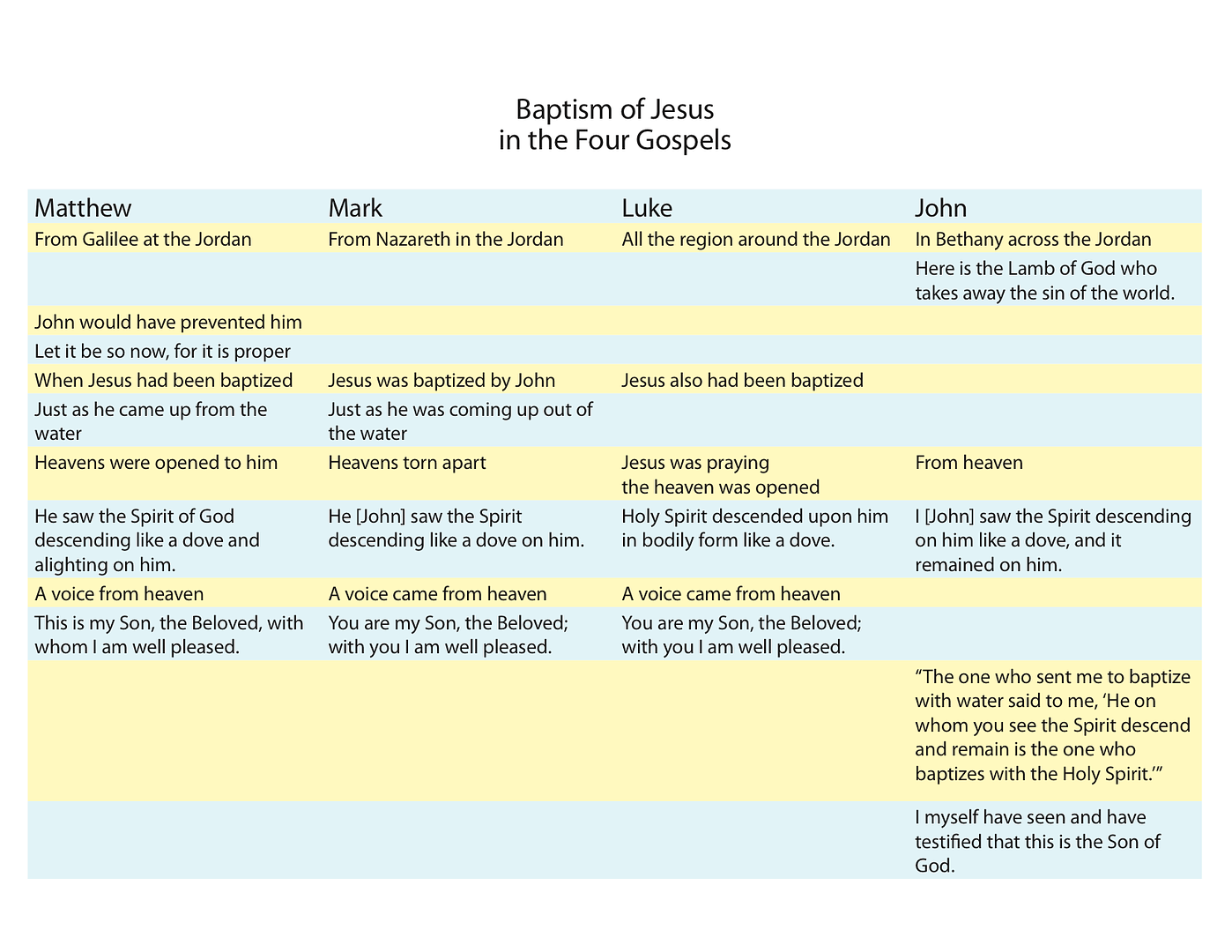
baptism of Jesus gospels chart

On the first Sunday of Advent, the church began a new year of grace; we've moved into the season of epiphany. Last week we discussed the "epi" (upon) and "phan" {revealing, revelation) roots of the word. The feast and the season of epiphany specifically brings us the revelation of Jesus as savior and lord for all the world. On the Day of Epiphany (or the nearest Sunday, as we observed last week on January 5th), we hear about the wise guys, star gazers, astrologers, Zoroastrians, ethnic and religious foreigners to Israel visiting Jesus, bringing gifts from the east. That event has become an icon of God's gracious universalism that in Jesus Christ redeems all people and all creation.

Today for Jesus' baptism by his cousin John the Baptist, we experience a trinitarian theophany, or revelation of the trinity with the voice of God the Father, the presence of Jesus God the Son, the familiar dove symbol or icon of God the Holy Spirit / Holy Ghost. For the meeting of heaven and earth at Jesus' baptism, Mark uses a word for a rip or tear that can't be mended. As Pastor Peg commented last year, the same word applies to the transfiguration and to the tearing of the temple veil at Jesus' crucifixion. With Jesus, all the earth, all creation, has access to God. Divisions between earth and heaven have been obliterated.

As you may have heard, the word and concept of Trinity is not in the bible, but scripture implies a Triune God—maybe especially in scenes like today's Baptism of Jesus and in the Transfiguration we'll celebrate to conclude the Epiphany season before Lent begins. Although Mark's gospel opens with "Jesus, Son of God," and toward the end the Roman centurion proclaims at Jesus' death "truly this was a Son of God," when the apostle Paul and when the gospels were written, people weren't pondering why the fully divine Jesus Christ would need to be baptized. Again, Jesus' baptism is theologically different from ours; today we'll only consider Jesus' baptism.

The Council of Nicaea that convened in the year 325 and gave us the Nicene Creed, the council of Chalcedon in 451 wrote the Definition of Chalcedon; both statements affirm Jesus' full humanity and complete divinity.

This visual chart relates to the class handout that includes baptism of Jesus texts from all four gospels. Synoptic gospels Matthew, Mark, and Luke describe Jesus being baptized (immersed or dunked); John's gospel strongly implies it. All four gospels tell us Jesus' cousin John was hanging out around the Jordan River. Especially from the Exodus out of slavery into the Promised Land, we know the Jordan as border and boundary between slavery in Egypt, exodus desert wanderings, and a new promise landed life of obedience, repentance, and grace in covenanted community. For Jesus, the Jordan was border and boundary between his more private life and his public life of obedience, grace, and keeping righteous covenant.

To me It's especially striking that people who probably had access to the Jerusalem Temple would venture down to the riverside to listen to John the crazy guy on the margins of polite society.

John the Baptist's baptism of repentance probably related to the entire nation of Israel as a new political, religious, and economic beginning. Contemporary twenty-first century Jews still have a practice of mikvah that's a cleansing bath or immersion. Jesus was not baptized a Christian! However, in these accounts of his baptism, God claimed and named Jesus as Son and as Beloved, just as God names and claims us in baptism as daughter, son, beloved; God also fills us with the Holy Spirit, just as the HS filled Jesus.

Hebrew scripture tells us Elijah will need to return before the Messiah arrives; next Sunday we'll look more closely at John the Baptist as the New Elijah, the link or hinge between the OT and NT; in several places, Jesus essentially announces "For me, John is Elijah." For his cousin Jesus, John the Baptist is very much Elijah the forerunner of the Messiah, end of the time of promise, start of the time of fulfillment. Next week in John's gospel we'll hear John the Baptist identifying Jesus as "the Lamb of God, who takes away the sins of the world."

Monday, January 06, 2020

Epiphany A

Matthew 2:1-12

1In the time of King Herod, after Jesus was born in Bethlehem of Judea, wise men from the East came to Jerusalem, 2asking, "Where is the child who has been born king of the Jews? For we observed his star at its rising, and have come to pay him homage." 3When King Herod heard this, he was frightened, and all Jerusalem with him; 4and calling together all the chief priests and scribes of the people, he inquired of them where the Messiah was to be born. 5They told him, "In Bethlehem of Judea; for so it has been written by the prophet:
6"And you, Bethlehem, in the land of Judah,
are by no means least among the rulers of Judah;
for from you shall come a ruler
who is to shepherd my people Israel.'"
7Then Herod secretly called for the wise men and learned from them the exact time when the star had appeared. 8Then he sent them to Bethlehem, saying, "Go and search diligently for the child; and when you have found him, bring me word so that I may also go and pay him homage."

9When they had heard the king, they set out; and there, ahead of them, went the star that they had seen at its rising, until it stopped over the place where the child was.

10When they saw that the star had stopped, they were overwhelmed with joy. 11On entering the house, they saw the child with Mary his mother; and they knelt down and paid him homage.

Then, opening their treasure chests, they offered him gifts of gold, frankincense, and myrrh. 12And having been warned in a dream not to return to Herod, they left for their own country by another road.

Today we're having an epiphany and we also move into a several weeks long season of epiphany. From "epi" = upon and "phan" = manifestation, revealing, revelation, illumination, uncovering, an epiphany is a shining out, showing forth. Related words include tiffany, fantasy, theophany.

The day and the season of epiphany (Sundays leading up to Transfiguration that's the Sunday before Ash Wednesday) especially emphasize the presence and persistence of light, particularly the light of Christ that illuminates all creation. The Bethlehem-born Jewish baby Jesus is redeemer of all, Lord of all, king and shepherd for all cultures, ethnicities, and religions. In the global north Epiphany arrives shortly after the winter solstice, making its symbolism of light especially meaning-filled. This scripture tells us about the star at "the rising," at daybreak, at dawning. With light that seeks out and illumines darkness, stars long have been a symbol for epiphany,

When the church welcomed a new year of grace on the first Sunday of Advent, we began the year of Matthew's gospel; aside from the great fifty days of Easter and a few isolated other days, our gospel readings will be from Matthew for the rest of this year until Advent 2020. Along with Mark and Luke, as one of the three synoptic gospel accounts that view [optic] Jesus' story in somewhat similar [syn] ways, Matthew also brings a distinctive perspective. As Sundays come around, we'll study more passages from Matthew, but briefly for today:

Matthew emphasizes Jesus as the new Moses and the new David. With the opening words "A Book of Beginnings" – biblios geneseos – the author(s) announce their intentions to bring us a new genesis, a new creation, in the birth, life, death, and resurrection of Jesus. Matthew's genealogy includes many ethnic and religious "others." Jesus' great commission at the end of Matthew [28:16-20] charges us to go into all the world, preach the gospel to all people.

The visit of "wise men from the east" is one of the stories unique to Matthew. Three gifts have turned into a tradition of three kings, yet the text doesn't specify. Their retinue would have included many male and female servants, possibly children, definitely camels, other animals. They could have been royalty of some kind; most likely they were members of the Zoroastrian religion, a middle-eastern way of life that preceded Islam.

Monday, December 23, 2019

Advent 4A

Isaiah 7:10-16

10Again the Lord spoke to Ahaz, saying, 11Ask a sign of the Lord your God; let it be deep as Sheol or high as heaven. 12But Ahaz said, I will not ask, and I will not put the Lord to the test. 13Then Isaiah said: "Hear then, O house of David! Is it too little for you to weary mortals, that you weary my God also? 14Therefore the Lord himself will give you a sign. Look, the young woman is with child and shall bear a son, and shall name him Immanuel. 15He shall eat curds and honey by the time he knows how to refuse the evil and choose the good. 16For before the child knows how to refuse the evil and choose the good, the land before whose two kings you are in dread will be deserted.

Three weeks ago the church greeted a new year of grace that's wide and high and inclusive. Today is the Fourth Sunday of the season of Advent—almost Christmas, the supreme festival of creation. From Latin words ad = to or toward or in the direction of AND venire = come, Advent looks toward the coming of God in our midst in Jesus of Nazareth, the baby in the Bethlehem manger. Our gospel readings this year mostly will be from Matthew, so we refer to this as Revised Common Lectionary (RCL) Year A, Matthew's year.

Although today I mostly want to go "off-lectionary" and discuss more of our individual Nativity practices, treats, food, customs, music, and memories, to round out Isaiah in Advent, we'll read the first lection.

The First Readings (OT) for all four Advent Sundays in Matthew's year are from the first part of the book of Isaiah, chapters 1-39 often referred to as First Isaiah, though the material in them comes from at least two different writers. We've described the frightening and precarious overall political, social, religious, and economic situation Isaiah of Jerusalem addressed. Long ago, the church identified...

14"Therefore the Lord himself will give you a sign. Look, the young woman is with child and shall bear a son, and shall name him Immanuel."

...as a Messianic text that anticipated the arrival of Emmanuel, Jesus, God-With-Us on earth. The librettist for Handel's Messiah chose this as one of his texts, as well, but Isaiah definitely did not have Christmas in mind. Most likely it's about his own soon to be born offspring. When we read scripture, our first question needs to be the historical when, where, who, why, what. But we also know scripture is a living perennial word! Every single verse in the entire bible won't apply to our here and now, but still we can ask about contextualizing (making alive in our current situation) God's Word into our own current when, where, who, why, and what.

More of our individual Nativity practices, treats, food, decorations, music, and memories. We talked about blue, the color of hope, as the main liturgical color for Advent, though churches that don't have blue paraments or vestments are welcome to continue using the more penitential purple we use during the more formally penitential season of Lent.

It's not exclusively or uniquely my opinion, but with Christmas being the church's major Trinitarian Festival of Creation (Easter of Redemption, Pentecost of Sanctification), gifts of food are especially appropriate for Christmas. Last week Charles described a fruitcake recipe he loves (some of the rest of us like fruitcake, too, but please make mine mostly cake with very little candied fruit). Not uniquely my opinion about gifts of food and homemade delicacies, because why else would home-baked cookies or a commercial close approximation be so popular this time of year? Food as gift also gives the recipient permission to indulge in unneeded calories. We talked about the ethnic Swedish delicacy lutefisk and again I forgot to mention Glögg.

We got a long playlist of secular and religious Christmas songs that included Silent Night, White Christmas, and one Steve heard only recently and instantly loved. Not quite specifically Christmas, but Phillip Phillip's Home...

The trouble it might drag you down
If you get lost, you can always be found
Just know you're not alone
'Cause I'm going to make this place your home

...always moves me. Most likely I associate it with Christmas because the first time I heard it was at a Blue Christmas service in Previous City.

Tuesday, December 17, 2019

Advent 3A

Isaiah 35:1-10

1The wilderness and the dry land shall be glad,
      the desert shall rejoice and blossom;
like the crocus 2it shall blossom abundantly,
      and rejoice with joy and singing.
The glory of Lebanon shall be given to it,
      the majesty of Carmel and Sharon.
They shall see the glory of the Lord,
      the majesty of our God.

3Strengthen the weak hands,
      and make firm the feeble knees.
4Say to those who are of a fearful heart,
      "Be strong, do not fear!
Here is your God.
      He will come with vengeance,
with terrible recompense.
      He will come and save you."

5Then the eyes of the blind shall be opened,
      and the ears of the deaf unstopped;
6then the lame shall leap like a deer,
      and the tongue of the speechless sing for joy.
For waters shall break forth in the wilderness,
      and streams in the desert;
7the burning sand shall become a pool,
      and the thirsty ground springs of water;
the haunt of jackals shall become a swamp,
      the grass shall become reeds and rushes.

8A highway shall be there,
      and it shall be called the Holy Way;
the unclean shall not travel on it,
      but it shall be for God's people;
      no traveler, not even fools, shall go astray.
9No lion shall be there,
      nor shall any ravenous beast come up on it;
they shall not be found there,
      but the redeemed shall walk there.

10And the ransomed of the Lord shall return,
      and come to Zion with singing;
everlasting joy shall be upon their heads;
      they shall obtain joy and gladness,
      and sorrow and sighing shall flee away.

Gaudete! Rejoice! And don't stop rejoicing!

Gaudete, Latin for "rejoice," is a traditional name for the third Sunday of Advent. We've discussed the blue of hope being the new color for Advent. When churches have them, rose vestments and paraments are a tradition that replaces blue for the third Sunday of Advent and the Fourth Sunday in Lent. Both those Sundays feature scripture readings with a slightly more upbeat mood than the other Sundays of those seasons.

Two weeks ago on the first Sunday of Advent, the church began a New Year of grace. We've talked about signs, symbols, and colors that point to meanings beyond the apparent surface. Just as we can read a label or sign or poster that tells about a product or a location or an event (but that isn't the product, event, or place itself), we can interpret colors and symbols. Although we still need to heed John the Baptist's call to repent, to turn around in a direction different from where we've been going to get ready for God in our midst, more than anything, Advent is a time of hope-filled expectant waiting for Jesus' arrival in our midst. Is waiting for something not extremely counter-cultural in a world that wants everything yesterday? Surprise that I didn't say it on Sunday, but in Spanish esperar and its cognates have all three meanings of wait, expect, hope.

For this third Sunday of Advent we continue Old Testament/Hebrew Bible readings from the first part of the long book of Isaiah. We sometimes refer to the primary author of this first section that comprises chapters 1 through 39 as Isaiah of Jerusalem, though style and content indicate at least one additional author. As we observed last week, these inspired words came into the southern kingdom at a time of political, economic, and cultural violence and uncertainty. Against God's constant counsel "do not fear," everyone had plenty of reasons to be frightened. Like last week's Isaiah 11:1-9, this week we receive pure promise, sheer proclamation of grace, mercy, healing, and a shalom-filled future. This announcement is gospel. It is good news!

Like last week's scripture, today's word of life reveals the previousness of God—the truth that God always goes before us before leading us there, the fact God always waits for us (just as we imagine waiting for God to show up during Advent).

Water Is Life!

As the global north moves closer and closer to winter solstice with its longest night and shortest day, Isaiah's visions of water in the wilderness, abundant blooms in the desert, tell us in spite of surface evidence, God heals, redeems, and restores all creation—not solely human creatures. Not long ago Southern California experienced a relatively rare spring super bloom that happened because drought of historical proportions and rain of historical proportions converged.

Living in a fire zone, we know some seeds need to be seared by fire in order to bloom. We've seen in person – or at least in pictures – verdant (I still think verdant means green?) new life sprouting across the expanse of a burn scar. Some flower bulbs cannot bloom until they've first experienced winter. Especially in colder environments where people may have a chilly outbuilding or basement, it's possible to force bloom flower bulbs including daffodils, amaryllis, jonquils, tulips, crocuses, hyacinth, grape hyacinth, iris, narcissus. Those bulbs contain everything necessary for new life within them! That is, they contain almost all the essentials for new life. Everything except winter. Humans create winter for them, so then they can burst into life and flower.

These creation-centered texts are about the natural creation itself, and also form a metaphor for the course of our human lives with its spiritual, physical, social, and intellectual growth. In addition, we can look at them as "signs" that point beyond their apparent surface for parallels in the built environment: houses, office buildings, shopping malls, all constructed to current earthquake and fire codes; well-maintained streets, roads, airports that lead from one place to another, that carry vehicles and permit exchange between parties; waterways that need care in order to serve the greater good. In other words, we can read these texts and most of scripture on comprehensive spiritual, social, and structural levels.


Tuesday, December 10, 2019

Advent 2A

Isaiah 11:1-9

1A shoot shall come out from the stump of Jesse,
      and a branch shall grow out of his roots.
2The spirit of the Lord shall rest on him,
      the spirit of wisdom and understanding,
      the spirit of counsel and might,
      the spirit of knowledge and the fear of the Lord.

3His delight shall be in the fear of the Lord.
He shall not judge by what his eyes see,
      or decide by what his ears hear;
4but with righteousness he shall judge the poor,
      and decide with equity for the meek of the earth;
he shall strike the earth with the rod of his mouth,
      and with the breath of his lips he shall kill the wicked.
5Righteousness shall be the belt around his waist,
      and faithfulness the belt around his loins.

6The wolf shall live with the lamb,
      the leopard shall lie down with the kid,
the calf and the lion and the fatling together,
      and a little child shall lead them.
7The cow and the bear shall graze,
      their young shall lie down together;
      and the lion shall eat straw like the ox.

8The nursing child shall play over the hole of the asp,
      and the weaned child shall put its hand on the adder's den.
9They will not hurt or destroy
      on all my holy mountain;
for the earth will be full of the knowledge of the Lord
      as the waters cover the sea.

The second Sunday of Advent! Last week on the first Sunday of Advent we began a New Year of Grace. People who enjoy that type of detail will appreciate knowing Advent always begins on the Sunday closest to St. Andrew's Day that always falls on November 30. Advent comes from the Latin ad-(toward, in the direction of) and venire (coming, arrival). We anticipate, we hope for and trust God for Jesus' arrival in our midst.

Except during the great fifty days of Easter, gospel readings during this new year of grace are from Matthew; last week I did a short overview of Matthew's style and content—we'll be hearing lots more! During Matthew's Revised Common Lectionary (RCL) year A, all of the first readings during the Sundays of Advent are from Isaiah.

Last week we discussed signs, symbols, and colors. Back in the olden days of two or three decades ago, the liturgical color for Advent was purple, the color of royalty and of penitence. Although there's definitely a strong advent emphasis on turning around into the direction of God's gracious leading—after all, the gospel reading on this second advent Sunday traditionally is Jesus' cousin John the Baptist telling everyone the time for God's arrival is now, and therefore now is the time to repent. However, hope has become an even greater advent accent, with blue paraments, vestments, and sanctuary appointments. Churches that don't have blue continue using purple or violet. Rose or dusty pink is usual on the third Sunday of Advent, the Sunday of Joy or Gaudete / rejoice in Latin.

In our conversation about colors and symbols, we heard about some class favorites (Barbara always has red advent wreath candles), and realized though here at church we're using one of the common name series for each advent wreath candles – Hope / Peace / Joy / Love – there are other possibilities. Angels, John the Baptist, Mary, Shepherds also are a popular group.

During this Advent 2019, all of the first readings are from Isaiah. With today being Lessons & Carols, we're hearing a lot of scripture. Here in Sunday School, we'll look at Isaiah 11:1-9 the lectionary formally assigns for Advent 2. Speaking of and hearing about (touching, smelling, tasting, too) signs and symbols, notice creation is central with earth sprouting new growth, animals behaving in uncharacteristic ways. The entire witness of scripture consistently interlinks natural, political, economic, and social endeavors in the fractured world of the first creation, in the transformed world of the new creation.

Although eventually we need to contextualize it for our current place and time, when we read scripture we first ask about the original setting. Isaiah of Jerusalem (sometimes referred to as First Isaiah, or the person who wrote down most of the words of Isaiah chapters 1 through 39) lived in uncertain, scary times, with mighty Assyria looming nearby, but notice how this entire reading proclaims, announces, promises grace, newness, healing, gospel. Yes, we must repent, we must obey, but what a gift first to hear and trust it won't always be like this, we will know the fullness of shalom, and it mostly will come about by God's action, intervention, and presence.

Since the birth of Jesus of Nazareth the church has claimed some of the book of Isaiah and words of other Hebrew Bible prophets as Messianic, meaning they point to and easily can be interpreted in a Christological manner. "Jesse" in Isaiah 11:1 refers to King David's father Jesse; in the genealogy that opens his gospel, Matthew lists Jesse and David as ancestors of Jesus.

We've all loved the amazement of a green sprig or sprout growing out of what looks like a truly dead tree stump. There's actual life there? Most people who've been city dwellers have noticed verdant (I think that means green?) life pushing its way through streets and sidewalks, sometimes into an existing crack, sometimes even making a way for itself by itself and actually rupturing baked earth or cured concrete.

Related to this as a messianic text, Isaiah 11:4b "…he shall strike the earth with the rod of his mouth, and with the breath of his lips he shall kill the wicked" (easily!) can be interpreted as the Word of God that creates, redeems, and sanctifies, the word that is incarnate, embodied in Jesus of Nazareth. The title of one of Hebrew bible scholar Walter Brueggemann's books is The Word that Redescribes the World—draws it over, gives it a makeover, re-creates creation, and redeems it.

Thursday, December 05, 2019

Advent 1A

Isaiah 2:2-5

1The word that Isaiah son of Amoz saw concerning Judah and Jerusalem.

2In days to come
      the mountain of the Lord's house
shall be established as the highest of the mountains,
      and shall be raised above the hills;
all the nations shall stream to it.
      3Many peoples shall come and say,
"Come, let us go up to the mountain of the Lord,
      to the house of the God of Jacob;
that he may teach us his ways
      and that we may walk in his paths."
For out of Zion shall go forth instruction,
      and the word of the Lord from Jerusalem.
4He shall judge between the nations,
      and shall arbitrate for many peoples;
they shall beat their swords into plowshares,
      and their spears into pruning hooks;
nation shall not lift up sword against nation,
      neither shall they learn war any more.
5O house of Jacob, come,
      let us walk in the light of the Lord!

The first Sunday of advent opens wide a new year of grace.

The first advent, ad-venire, coming, or arrival of Jesus of Nazareth happened in Roman occupied territory after 700 years of enemies—Assyria, Babylon, Persia, Greece, Syria, Rome. During this Advent 2019 we anticipate the infant Jesus' arrival into occupied territory—occupied by... consumerism? military? Wall Street/the DOW and the NASDAQ? social media? religion of excessive sports?

This new year does not begin with scriptural creation accounts! All three lectionary new years open with a splash of apocalyptic, signaling the end of the world as we've known it. Apocalyptic is a revealing, uncovering, with signs and wonders in the natural world, creation. Not all that different from an epiphany! Today's apocalypse is a strangely interesting parable from Matthew 24. All of this lectionary year A features the Gospel according to Matthew for most of the gospel readings.

Blue, the color of hope, is the contemporary liturgical color for advent. Advent is a season of hope, and a time of repentance in the face of God's loving, mercy-filled judgment. Churches that don't have blue paraments still can use purple that's now mostly for the more intentionally penitential season of Lent that leads to the great fifty days of Easter. As Pastor Peg pointed out, in many ways Advent through Epiphany (ending with Transfiguration) is one long season of light.

During Matthew's Revised Common Lectionary (RCL) year A, the first readings for all four Sundays of Advent are from 1st Isaiah, Isaiah of Jerusalem, "the pre-exilic Isaiah," though all of chapters 1 through 39 are not from the same author.

8th century contemporaries Isaiah of Jerusalem (2:2-4, today's reading) and Micah 4:1-3 both include this passage.

All three Isaiah prophets bring us a wide world view with universalism that insists Yahweh is God of all, God for all. No more us and them!

Paradox in this passage is Zion was not the highest mountain, "the nations" were not caravanning to Jerusalem and Mount Zion. Also, God's people were not unique in considering their capital city the center of the world.

Isaiah 2:1"The word Isaiah ... saw." A visible word! Hebrew here is dabar that denotes both speech and action. Visible words? How about us? Sacraments, visions, dreams, paintings... advertising art!

Isaiah 2:3 "God of Jacob" – Genesis 28:13-15, Jacob's dream, Jacob's ladder: land, offspring, God's constant, abiding presence, homecoming.

Wednesday, December 04, 2019

RCL Year A • Matthew

Matthew: Revised Common Lectionary Year A

Happy New Year!


Every year on the first Sunday of Advent the church begins a new year of grace; gospel scriptures for this year are mostly from Matthew.

Along with Luke and Mark, Matthew is one of the three synoptic gospels that view Jesus with a similar perspective, despite each one having a markedly different personality.

• syn=together, as in synthesis, synod, synagogue, synopsis, synergy, synonym, syntax

• optic=related to eyes or vision, as in optician, optical, optometrist, optimistic, optimum

I often refer to the gospel according to John that almost didn't make the canonical cut as the "outlier, rogue" gospel. Because Mark is so short, during his lectionary Year B we get a lot John interspersed. During the great 50 days of Easter, all three lectionary years feature John's gospel.

Date

circa 80 - 90

Author

No indication of "Matthew" as author until the second century, but for discussion purposes we can assume followers of the apostle and tax collector Matthew similar to the way we consider the gospel according to John authored by the community that surrounded John the beloved disciple.

Sources

Matthew contains 90% of the verses in Mark, the earliest canonical gospel. (Luke contains about 50% of Mark.) Matthew and Luke both contain parallel, sometimes identical passages not found in Mark. Scholars still speculate there might have been a no longer extant written collection of Jesus' sayings, sometimes referred to as "Q", from the first word of the German Quelle—river or source. Matthew's community may have had a third written "M" source.

Language

Semitic Greek, or possibly Aramaic, the vernacular Hebrew Jesus spoke. Not really certain.

Opening

Book of Beginnings, Book of Origins = biblios geneseos – Matthew presents a new Genesis, a New Creation as he tells the story of Jesus of Nazareth's birth, life, death, resurrection, and ascension.

Setting

Greek-speaking Jewish Christians in Antioch in Syria, where they first called Jesus' followers Christian – Acts 11:28. That particular Antioch's now part of present-day Turkey. There's also an Antioch, Ohio, USA.

World View – Content

• Salvation (integrity, wholeness, shalom) for all the world, for everyone everywhere

• Matthew never ever lets up on justice and righteousness.

• Kingdom of Heaven rather than Kingdom of God

• Concern about fulfilling Hebrew Bible prophecies and predictions

• New Abraham, New David

Matthew's genealogy goes back to Abraham, in whom all nations would be blessed. Matthew's Jesus is Son of Abraham, whose deep mercy and love bless all people everywhere. Matthew's Jesus is Son of David, not a temporary, short-term monarch like the old David, but this new David reigns forever, for all eternity, his love including and embracing all creation.

• Angel's visit to Jesus' stepfather Joseph; Joseph's dream to flee to Egypt. (Luke tells us more about Mary.)

• Visit of the Magi at Epiphany – ethnic foreigners from a different religion reveal God for the world. Scripture does not say how many kings there were, but tradition has it at three because the text lists three gifts.

• New Moses

Flight into Egypt – Jesus as refugee
New Exodus with Jesus as freedom-giver, liberator
Five discourses that parallel the Torah/Pentateuch or Five Books of Moses. The gospel as a new Torah. Sermon on the Mount explicates existing ten commandments/ten words God gave the people through Moses at Mount Sinai

• As with Luke, some parables are unique to Matthew:
• weeds among the tares of wheat
• the treasure
• the pearl
• the net
• the unforgiving servant
• the laborers in the vineyard
• the two sons
• the ten virgins
The only gospel that uses the word "ecclesia," and brings us some ecclesiology related to church order and structure. Ecclesia is the Roman city council, New England town meeting. Ecclesiastical is the word about the church.

Before Jesus' resurrection Matthew calls God's people "Israelites"; after the resurrection he calls them Jews.

Great Commission – Gospel/Good News for the world