Sunday, May 05, 2024

Easter 6B

Psalm 98:7
Let the sea thunder and roar with all its creatures
the world and all that dwell in it! Psalm 98:7


John 15:9-17

9 As the Father has loved me, so I have loved you; abide in my love. 10 If you keep my commandments, you will abide in my love, just as I have kept my Father's commandments and abide in his love. 11 I have said these things to you so that my joy may be in you, and that your joy may be complete. 12 This is my commandment, that you love one another as I have loved you. 13 No one has greater love than this, to lay down one's life for one's friends.

14 You are my friends if you do what I command you. 15 I do not call you servants any longer, because the servant does not know what the master is doing; but I have called you friends, because I have made known to you everything that I have heard from my Father.

16 You did not choose me but I chose you. And I appointed you to go and bear fruit, fruit that will last, so that the Father will give you whatever you ask him in my name. 17 I am giving you these commands so that you may love one another.

The Sixth Sunday of Easter

I really really really like my blog on this scripture from three years ago when Covid felt more threatening and we still were being extra careful to consider our neighbors. I couldn't do as well today; please check it out for:

• A poem by Jeff Shrowder

• Observations about client-patron expectations vs the intimacy of friendship

• Love etymology with some C.S. Lewis

• Obedience, freedom, and community

• A quote about freedom from MLK

• Reflections on the overall Covid-pandemic situation

Saturday, April 27, 2024

Easter 5B

Live at the Amen Jubilee on Easter 5 cover
John 15:1-8

1 "I am the true vine, and my Father is the vinegrower. 2 He removes every branch in me that bears no fruit. Every branch that bears fruit he prunes to make it bear more fruit. 3 You have already been cleansed by the word that I have spoken to you. 4 Abide in me as I abide in you. Just as the branch cannot bear fruit by itself unless it abides in the vine, neither can you unless you abide in me.

5 I am the vine, you are the branches. Those who abide in me and I in them bear much fruit, because apart from me you can do nothing. 6 Whoever does not abide in me is thrown away like a branch and withers; such branches are gathered, thrown into the fire, and burned. 7 If you abide in me, and my words abide in you, ask for whatever you wish, and it will be done for you. 8 My Father is glorified by this, that you bear much fruit and become my disciples.

The Four Gospels

Despite each having some unique content and a particular perspective, synoptic gospels Matthew, Mark, and Luke all bring us law and gospel—God's holy demands and God's merciful, loving grace. We roughly can place the synoptics in the Torah/Pentateuch and Prophets traditions of the Old Testament.

John is very much about the here and now of the Reign of Heaven on Earth. In John, Jesus first act of public ministry is a wedding feast, a party! With a focus on God's ongoing presence and on the commandments, especially encapsulated in the charge to love, John's community offers ways to live faithfully and fruitfully with speech and action, rather than the articulation of law and gospel we find in the synoptics. To continue the OT parallel, we can locate the Gospel according to John in the tradition of the Wisdom literature.


I Am the Vine

The fifth Sunday of Easter is the 29the day of Easter, so we still can wish people "Happy Easter," yet as the church's year of grace eases into the Season of Pentecost, Time of the Church, today's I Am the Vine – You are the Branches passage comes from Jesus' farewell discourse on Maundy Thursday, after he washed the disciples' feet, before his death and resurrection. But we are hearing it during the Great Fifty Days of Easter, after we've experienced Jesus death and resurrection.

This is the seventh and last of Jesus' I Am declarations where Jesus places himself within YHWH/God's Old Testament identity I Am—pure being. unmediated presence. Scholars identify two sources used by John's community: Signs and I Am (and suggest there may have been a third).

Jesus lived and served in a somewhat agrarian setting, so he often used farm images and parallels. Today? Grapevines! Most Californians get the importance of soil, sunshine, shade, and pruning in vineyards-grapes-harvest. We understand how critical time, temperature, cask, and added ingredients are to wine production. Methods of wine transport and storage, too! In addition, grape vines are one of the seven agricultural gifts of the promised land, and we find God's people as branches of the vine in the Old Testament scriptures.

In this trinitarian passage, God the Father is vine planter and grower, Jesus the Son is the vine itself, the people of God in the power of the Holy Spirit are branches of the vine—Jesus tells us to abide in him in order to bear fruit. How do we abide? By obeying, especially by loving God, neighbor, and self. Although we primarily abide in Jesus the vine, we remain interconnected with all the other branches.


Where we Live: Vine and Branches

Do we always abide in Jesus, or do we sometimes settle deeply into family, social, cultural, and church traditions, customs, and habits? As people of history and people with histories, we need to stay connected with our pasts, with the identity-forming histories and practices of communities and groups we belong to. We also need to contextualize the gospel so newcomers will relate Jesus to their own geography and history.

But what do we make most important? For starters, Jesus commanded us to take, bless, break, and give bread, to bless and share the cup of the fruit of the vine(!), to baptize. But do we insist on a particular type of bread, brand of wine or grape juice? Does the baptismal venue need to be the same every time?

Does Strawberry Festival always need to be on the Second Sunday in June? Do we even need an annual Strawberry Festival?

Our own knowledge of grape-growing and wine-making gives excellent counsel regarding Jesus' reminder on this Fifth Sunday of Easter to stay connected to him and to each other.
Amen Jubilee CD back with playlist

Saturday, April 20, 2024

Easter 4B

1 John 3:21
Beloved, if our hearts do not condemn us,
we have confidence before God.
1 John 3:21

1 John 3:16-24

16 We know love by this, that he laid down his life for us—and we ought to lay down our lives for the brothers and sisters. 17 How does God's love abide in anyone who has the world's goods and sees a brother or sister in need and yet refuses help?

18 Little children, let us love not in word or speech but in deed and truth. 19 And by this we will know that we are from the truth and will reassure our hearts before him 20 whenever our hearts condemn us, for God is greater than our hearts, and he knows everything. 21 Beloved, if our hearts do not condemn us, we have boldness before God, 22 and we receive from God whatever we ask, because we obey the commandments and do what pleases God.

23 And this is God's commandment, that we should believe in the name of God's Son Jesus Christ and love one another, just as he has commanded us. 24 All who obey his commandments abide in him, and he abides in them. And by this we know that he abides in us, by the Spirit that he has given us.

1 John 3:17
If anyone has the world's goods
and sees his brother in need,
yet closes his heart against him,
how does God's love abide in him?
1 John 3:17

Saturday, April 13, 2024

Easter 3B

fish on mosaic background
They gave him a piece of broiled fish. Luke 24:42

Luke 24:36b-48

36 While they were talking about this, Jesus himself stood among them and said to them, "Peace be with you." 37 They were startled and terrified, and thought that they were seeing a ghost. 38 He said to them, "Why are you frightened, and why do doubts arise in your hearts? 39 Look at my hands and my feet; see that it is I myself. Touch me and see; for a ghost does not have flesh and bones as you see that I have." 40 And when he had said this, he showed them his hands and his feet.

41 While in their joy they were disbelieving and still wondering, he said to them, "Have you anything here to eat?" 42 They gave him a piece of broiled fish, [and of a honeycomb] 43 and he took it and ate in their presence.

44 Then he said to them, "These are my words that I spoke to you while I was still with you—that everything written about me in the law of Moses, the prophets, and the psalms must be fulfilled." 45 Then he opened their minds to understand the scriptures, 46 and he said to them, "Thus it is written, that the Messiah is to suffer and to rise from the dead on the third day, 47 and that repentance and forgiveness of sins is to be proclaimed in his name to all nations, beginning from Jerusalem. 48 You are witnesses of these things.

Easter

• As the day after the Sabbath, the Day of Resurrection is both the eighth day of the old week and the first day of a new week. As the first day of a new week, Easter is the beginning of a new creation. The third Sunday of Easter is the fifteenth day of the fifty days of Easter.

• The new creation contains evidence of old, deadly pasts. Today Jesus proves his humanity by displaying his hands and feet. On this side of Easter we often find ourselves in the "Yes, already!" of resurrection and the "No, not yet!" of Holy Saturday, that apparently motionless time between Good Friday and Easter Sunday

Though we often refer to Jesus' post-resurrection appearances, he wasn't a ghost, an apparition, a stained glass likeness, or a digital rendering. Just as when he lived on land from infancy through childhood into adulthood and onto his death and burial, after being raised to new life Jesus had a substantial body. People who met Jesus after the resurrection touched flesh and blood and bone; in the Creed we confess, "I believe in the resurrection of the body."


Bread, Fish, Fellowship

Throughout Jesus' ministry we meet Jesus eating with friends, strangers, and outcasts; his first act of public ministry in John's gospel is turning plain water into finest wine at a wedding party. In the upper room of Maundy Thursday Jesus says the cup is his life blood, the bread is his body.

The meal in Emmaus is about the presence of the risen Lord in word and sacrament; it sometimes is considered the first Eucharist because unlike the Lord's Supper founding meal of Maundy Thursday, Eucharist is a meal with the Risen Christ in the midst of a fully redeemed creation.

In this broiled fish incident and before this on Emmaus Road, Jesus twice identifying Moses, prophets, and psalms with his own life recalls the Exodus story of the God who sees the suffering of enslaved people and calls Moses to liberate them, along with later prophets who called people back to faithful obedience.

Like Jesus of Nazareth, the Christ of God, we read both Hebrew Bible /Old Testament and New Covenant /New Testament scriptures through the lens of Jesus' birth, life, death, resurrection, and ascension.


Where We Live

So… Jesus again shares a meal with friends, in a culturally congruent way, of course:

"While in their joy they disbelieved and still wondered, Jesus said to them, 'Have you anything here to eat?' They gave him a piece of broiled fish, and he took it and ate in their presence." vv. 41-43

Most English bibles translate verse 43 to say Jesus took the fish and ate it in their presence, but more recent scholarship says they all ate the fish together.

Jesus' first followers fished for a living! Fish was a more abundant and therefore less expensive protein source than sheep or goats. They may not have had stationary BBQ pits as we do on beaches and other places, but I love to imagine there were dedicated areas in their meeting spaces where people cooked food they brought to share.

This also is about Christ with us whenever we welcome strangers to our table as Jesus did. Welcoming others often opens our eyes so we recognize Jesus—sometimes in retrospect, like the travelers on the Emmaus Road. As in Emmaus, at times we will find ourselves hosted and made comfortable by people we imagined were our guests.

The Christ of God and Christianity always are incarnate (embodied, enfleshed) and contextualized into right here and right now. With the current plethora of spoken languages, cultures, and cuisines (these days isn't almost everything almost everywhere some kind of culinary fusion?), contextualizing all aspects of our service to others can be a fun creative challenge.

Sunday, April 07, 2024

Easter 2B

Psalm 133:1
Lo, how wonderful it is, how pleasant,
for God's people to live together in harmony.
Psalm 133:1

Acts 4:32-35

32 Now the whole group of those who believed were of one heart and soul, and no one claimed private ownership of any possessions, but everything they owned was held in common. 33 With great power the apostles gave their testimony to the resurrection of the Lord Jesus, and great grace was upon them all. 34 There was not a needy person among them, for as many as owned lands or houses sold them and brought the proceeds of what was sold. 35 They laid it at the apostles' feet, and it was distributed to each as any had need.

The second Sunday of Easter concludes Bright Week, the first day of the New Creation—celebrated as a single day. For a long time the church has commemorated especially important festivals in octaves of eight days.

Easter is 50 Days – 7 x 7, a week of weeks. The Day of Pentecost is the 50th day of Easter.

Every year on Easter 2, we hear the account of Jesus bestowing the Holy Spirit on Easter evening from John 20:19-31.

This conversation is about our calling:
Acts 1

6 When they therefore were come together, they asked of him, saying, Lord, wilt thou at this time restore again the kingdom to Israel?
7 And Jesus said unto them, It is not for you to know the times or the seasons, which the Father hath put in his own power.
8 But ye shall receive power, after that the Holy Ghost is come upon you: and ye shall be witnesses unto me both in Jerusalem, and in all Judaea, and in Samaria, and unto the uttermost part of the earth.

During these Sundays of Easter our first readings from the Acts of the Apostles show the style and substance of the post-resurrection, post-pentecost church. The approximately forty days between Jesus' resurrection and his ascension are especially important for us because Jesus calls and in the power of the Holy Spirit enables us to be his crucified and risen presence in the world after his ascension. Jesus doesn't ask us to do anything he hasn't already done!

Thursday, March 28, 2024

Maundy Thursday 2024

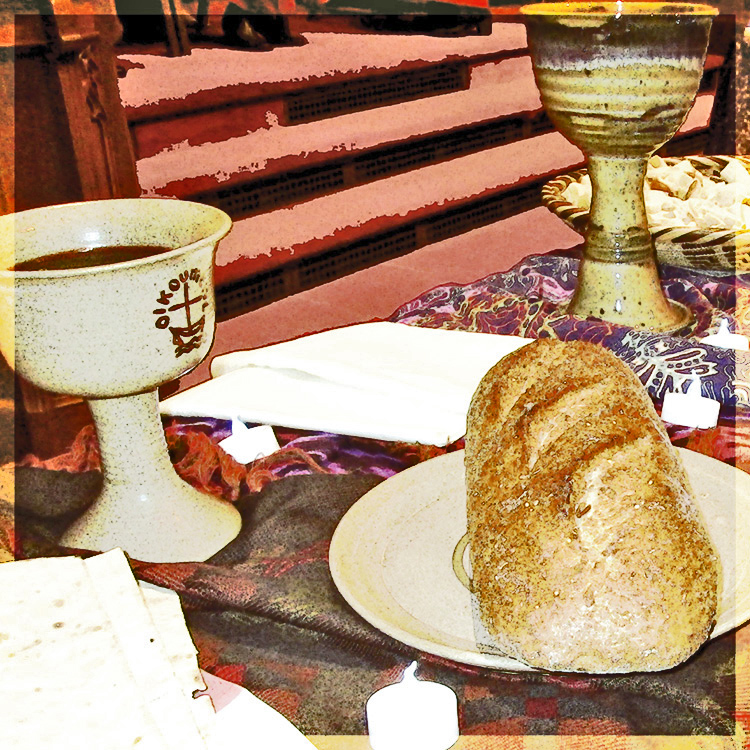
bread cup eucharist lord's supper holy communion
Lent into Easter

How was your Lent?

Did you participate in weekday or weeknight services and/or soup suppers? Did you grow from a special devotional or scripture study on your own or as a family? Did you extend any extra service to nearby neighbors or within your extended community?

What do you especially hope for during the Great Fifty Days of Easter and beyond?


Passover / Easter

The Council of Nicaea (325) that gave us the Nicene Creed calendared Easter for the first Sunday after the first full moon after the vernal equinox.This year Easter is early, Passover is late. These great festivals of freedom and liberation focus on remembering God's acts of deliverance from death. Seder participants recount the Exodus narrative of Israel's wayfaring from slavery into the gift of the promised land with symbolic fresh food that no longer depends upon empire—they sometimes call it "eating history." After Lent ends, Christians retell and re-enact their experience of death and resurrection with the Triduum or Three Days: One Liturgy in Three Acts.


Triduum – Three Days

• Maundy – Mandate or Command – Thursday

The Three Days is a single liturgy in three acts. It begins with Maundy Thursday worship that concludes without a benediction; Maundy Thursday worship often ends with the worship space stripped and in darkness as everyone leaves quietly. Historical Lenten practice waits until Maundy Thursday to pronounce absolution or forgiveness to the gathered assembly that confessed their sins on Ash Wednesday.


• Good Friday

Good Friday, the day of Jesus' death, is Act II. Although the Revised Common Lectionary specifies scripture readings for Friday, many churches' traditions include other scriptures such as noon through 3 pm with Jesus' seven last words or statements, reading or singing one of the full scriptural passion narratives in the evening, or something else.


• Holy Saturday

The day nothing apparently happens is the day everything actually happens. Theology of the cross especially lifts up this day before Easter when we almost hang suspended in time anticipating gifts of rebirth, of spring, of new life.


• Easter / Resurrection

Easter is fifty days, a week of weeks! The Day of Pentecost is the fiftieth day of Easter. The Three Days/Triduum liturgy concludes by celebrating Jesus' resurrection. Very late Saturday afternoon, Saturday evening, or extremely early Sunday morning the Vigil of Easter revisits the meta-narratives of creation and of deliverance from death to life in the Exodus and Passion/Easter stories. Many churches and communities offer a Sunrise Service; the regularly scheduled worship at the usual time frequently features brass, often percussion, and a glorious choir. In this Covid-influenced time of smaller gatherings and reduced musical and other resources, congregational singing usually is the best of the entire year.

1 Corinthians 11:23-26

23 For I received from the Lord what I also handed on to you, that the Lord Jesus on the night when he was betrayed took a loaf of bread, 24 and when he had given thanks, he broke it and said, "This is my body that is for you. Do this in remembrance of me."

25 In the same way he took the cup also, after supper, saying, "This cup is the new covenant in my blood. Do this, as often as you drink it, in remembrance of me." 26 For as often as you eat this bread and drink the cup, you proclaim the Lord’s death until he comes.

In words, in actions, and with food, God's people Israel remembered their passage from slavery into freedom; when the church obeys Jesus by breaking bread and pouring out wine, part of the liturgical action includes retelling the story of God's people from creation through redemption in order to make it part of our own history.

So it's not only about our Savior for each of us, for everyone gathered in person or virtually; remembering becomes about all of us throughout the history of the cosmos. We recollect how God has been with us and led us, how even those hard days didn't last forever…For the apostle Paul, the gospel is death and resurrection, though notice the founding narrative from Corinthians mentions only Jesus' death.

Today is Thursday; tomorrow's Friday—Sunday's coming!
Psalm 116:12-13; 17-19

What shall I render to the Lord
For all his benefits toward me?
I will take the cup of salvation,
And call upon the name of the Lord.
I will offer the sacrifice of thanksgiving,
And will call upon the name of the Lord.
I will pay my vows to the Lord
Now in the presence of all his people,
In the courts of the Lord's house,
In the midst of you, O Jerusalem.


Friday, March 22, 2024

Lent 6B Palm Sunday

Palm Sunday Palm branches
Mark 11:1-11

1 When they were approaching Jerusalem, at Bethphage and Bethany, near the Mount of Olives, Jesus sent two of his disciples 2 and said to them, "Go into the village ahead of you, and immediately as you enter it you will find tied there a [donkey] colt that has never been ridden; untie it and bring it. 3 If anyone says to you, 'Why are you doing this?' just say this: 'The Lord needs it and will send it back here immediately.'"

4 They went away and found a colt tied near a door, outside in the street. As they were untying it, 5 some of the bystanders said to them, "What are you doing, untying the colt?" 6 They told them what Jesus had said, and they allowed them to take it.

7 Then they brought the colt to Jesus and threw their cloaks on it, and he sat on it. 8 Many people spread their cloaks on the road, and others spread leafy branches that they had cut in the fields.

9 Then those who went ahead and those who followed were shouting,
"Hosanna!
Blessed is the one who comes in the name of the Lord!
10 Blessed is the coming kingdom of our ancestor David!
Hosanna in the highest heaven!"
11 Then Jesus entered Jerusalem and went into the temple, and when he had looked around at everything, as it was already late, he went out to Bethany with the twelve.

Palm Sunday

You will find Palm Sunday in:

Luke 19:28-40

Matthew 21:1-11

John 12:12-15

The gospels record Jesus' genealogy, birth, life, death, resurrection, and ascension; they also present carefully crafted theology. Events of the days before Easter that we call Holy Week or Passion Week occupy a large portion of Mark's gospel with its focus on Jesus' identity and purpose.

Many churches observe both Palm Sunday and Jesus' Passion on the sixth Sunday in Lent. For churches that celebrate the Triduum-Three Day liturgy of Maundy Thursday, Good Friday, and Easter, Lent concludes Wednesday of Holy Week at sundown or at midnight.

In Mark, Jesus' journey to Jerusalem and the cross is relentless. Every year on the Sixth Sunday in Lent we re-enact his entrance into the city riding a young donkey and surrounded by excited onlookers waving leafy (palm?) branches. (Luke doesn't mention palms or hosannas.)


Context

Jerusalem was the center of religion, commerce, and politics. Jerusalem was the center of Roman imperial rule. Jerusalem was the destination of the Savior's trial, conviction, death, and resurrection.

Many of Jesus' actions were upside down versions of those of conventional political, religious, and economic leaders—"The Establishment." Jesus rides into the geographical center of power on a donkey.

Jesus riding a donkey echoes Zechariah 9:9 that some scholars consider a messianic prediction. Matthew 21:5 and John 12:15 quote Zechariah; Mark and Luke probably knew the Zechariah text.

Does riding a small equine subvert the image of a conquering military general on an armored steed? Possibly. But there was a tradition of a military victor riding a donkey in order to present himself as a servant of the common people.


Illustration

In a recent video on his Liturgy website, Bosco Peters outlines the probable historical Palm Sunday scenario of Roman armies entering Jerusalem from the west in order to control colossal crowds of Passover visitors. He describes Jesus coming in from the opposite direction – the east – on a donkey as a political cartoon, as a mocking parody of Pontius Pilate's military actions. The sarcasm of a kid's tricycle (against Vladimir Putin's armies, maybe?) would be our cultural donkey equivalent.

Bosco reminds us "Jesus is a holy fool," and asks if we'll join Pontius Pilate's procession of Power, Might, and Fear? Or Jesus' procession of Fun, Laughter, and Caring?

Jerusalem was the center of Roman imperial rule. Jerusalem was the destination of the Savior's trial, conviction, crucifixion, death—and resurrection.

Lent 2024 leafy

Saturday, March 16, 2024

Lent 5B

Jeremiah 31 New Covenant
I will make a new covenant
with the house of Israel and the house of Judah.

I will put my law within them,
and I will write it on their hearts;
and I will be their God,
and they shall be my people.

No longer shall they teach each other,
or say to each other,
"Know the Lord," for they shall all know me,
from the least of them to the greatest, says the Lord;

for I will forgive their iniquity,
and remember their sin no more.
Jeremiah 31:31,33,34

John 12:20-33
This was during what we call Passion Week or Holy Week:
• after Mary anointed Jesus at Lazarus' home. [12:1-8]
• after "the chief priests planned to put Lazarus to death, as well." [12:10-11]
• after Jesus' final entry into Jerusalem surrounded by hosannas and palm fronds [12:12-15]

20 Now among those who went up to worship at the festival were some Greeks. 21 They came to Philip, who was from Bethsaida in Galilee, and said to him, "Sir, we wish to see Jesus." 22 Philip went and told Andrew, then Andrew and Philip went and told Jesus. 23 Jesus answered them, "The hour has come for the Son of Man to be glorified. 24 Very truly, I tell you, unless a grain of wheat falls into the earth and dies, it remains just a single grain, but if it dies it bears much fruit."

25 Those who love their life lose it, and those who hate their life in this world will keep it for eternal life. 26 Whoever serves me must follow me, and where I am, there will my servant be also. Whoever serves me, the Father will honor.

27 "Now my soul is troubled. And what should I say: 'Father, save me from this hour'? No, it is for this reason that I have come to this hour. 28 Father, glorify your name." Then a voice came from heaven, "I have glorified it, and I will glorify it again."

29 The crowd standing there heard it and said that it was thunder. Others said, "An angel has spoken to him." 30 Jesus answered, "This voice has come for your sake, not for mine. 31 Now is the judgment of this world; now the ruler of this world will be driven out. 32 And I, when I am lifted up from the earth, will draw all people to myself." 33 He said this to indicate the kind of death he was to die.

First and Second Readings

The readings from Jeremiah and Hebrews compliment each other and the passage from John's gospel, so you may want to study them separately.

Jeremiah 31:31-34

Hebrews 5:5-10


The Fifth Sunday in Lent

On the Fifth Sunday in but not of Lent, we continue to follow Jesus to the cross. Early in Holy Week-Passion Week; the Savior and his retinue have reached Jerusalem; next week on the sixth Sunday in Lent, the church begins Holy Week, often halfway through the liturgy.

This scripture describes Jesus dying on the scandal of a tree. Jesus promises to draw all to himself: the tree of death – the cross – paradoxically becomes the new tree of life. In the Garden of Eden, "Out of the ground the Lord God made to grow every tree that is pleasant to the sight and good for food, the tree of life also in the midst of the garden, and the tree of the knowledge of good and evil." Genesis 2:9

And I, when I am lifted up from the earth, will draw all people to myself. John 12:32

In a reference to the healing snake lifted up in the Exodus wilderness from Numbers 21:8-9, we hear about Jesus lifted up—on the cross, lifted up from the empty tomb, lifted up in the Ascension. Earlier in this gospel:

• And just as Moses lifted up the serpent in the wilderness, so must the Son of Man be lifted up, that whoever believes in him may have eternal life. John 3:14-15

• So Jesus said, "When you have lifted up the Son of Man, then you will realize that I am he…" John 8:28a

"I Am the snake" could be Jesus' eighth "I Am" statement!

They came to Philip, who was from Bethsaida in Galilee, and said to him, "Sir, we wish to see Jesus." John 12:21

We see the Glory of God as we "see Jesus," the Human One, lifted up on the cross. We see the fulness of the glory of God's presence in the weakness, vulnerability and defenselessness of Jesus dying on the cross.

The Apostle Paul determined to preach only Christ crucified, lifted up in glory on the cross: 1 Corinthians 2:2
Psalm 51:12
Restore unto me
the joy of thy salvation;
and uphold me
with thy free spirit.
Psalm 51:12

Saturday, March 09, 2024

Lent 4B

Ephesians 2:8
For by grace you have been
saved through faith;
and that not of yourselves,
it is the gift of God.
Ephesians 2:8

Ephesians 1:20-23

20 God put this power to work in Christ when God raised him from the dead and seated him at his right hand in the heavenly places, 21 far above all rule and authority and power and dominion and above every name that is named, not only in this age but also in the age to come. 22 And God has put all things under his feet and has made him the head over all things for the church, 23 which is his body, the fullness of him who fills all in all.

Ephesians 2:1-10

1 You were dead through the trespasses and sins 2 in which you once lived, following the course of this world, following the ruler of the power of the air, the spirit that is now at work among those who are disobedient. 3 All of us once lived among them in the passions of our flesh, following the desires of flesh and senses, and we were by nature children of wrath, like everyone else.

4 But God, who is rich in mercy, out of the great love with which he loved us 5 even when we were dead through our trespasses, made us alive together with Christ –by grace you have been saved– 6 and raised us up with him and seated us with him in the heavenly places in Christ Jesus, 7 so that in the ages to come God might show the immeasurable riches of grace in kindness toward us in Christ Jesus.

8 For by grace you have been saved through faith, and this is not your own doing; it is the gift of God– 9 not the result of works, so that no one may boast. 10For we are what he has made us, created in Christ Jesus for good works, which God prepared beforehand to be our way of life.


Lent 4: Laetare, "Rejoice"

As we accompany Jesus to Jerusalem, to the cross, and to the day of resurrection, during Lent we've been spring cleaning and decluttering our lives, though most of us have been concentrating on only a couple of aspects, such as spirituality and service.

Thursday was halfway through Lent! This midway Sunday has several traditional names and practices. In the North American church, Laetare – "Rejoice" – probably is best known. Each Sunday in Advent and Lent has a designation taken from the opening of the Latin Introit or entrance prayer.

Rejoice, Jerusalem, and gather round, all who love her.
Be joyful, all who were in sorrow;
exult and be satisfied at her consoling breast.
Isaiah 66:10-11
I rejoiced when they said unto me:
let us go into the house of the Lord.
Psalm 122:1


Instead of somber penitential purple, the liturgical color for vestments and paraments is lighter, brighter rose that also can be used on Advent 3. The Fourth Sunday in Lent is a special day for those planning to be baptized at the Easter Vigil; in addition, it's sometimes called Refreshment Sunday, and it's Mother's Day in the United Kingdom and some other countries.


Scriptures during Lent

• On Lent 1 we considered Genesis 9:8-17 – God's covenant or unilateral promise with Noah.

• For Lent 2 it was Genesis 17:1-16 – God's covenant with Abram / Abraham.

• Last week on Lent 3 we reflected on the Exodus 20:1--17 – Ten Words (Decalogue) – the Sinai covenant.

In today's words to the Church at Ephesus, like God's promises to Noah and similar to God being the primary actor in the Abrahamic and Sinai Covenants, God's act of redemption in Jesus Christ is strongly covenantal and the language of Ephesians expresses that reality well. In the wake of considering specific biblical covenants on the last three Sundays, this passage logically continues the reality of God's grace-filled covenants or agreements with humanity and with all creation.


Today's Reading and Context

Although in general the theology of Ephesians piggybacks on Paul's undisputed letters, some of the vocabulary and sentence structure is quite un-Pauline. However, scholars have observed it goes in a direction Paul might have taken and almost definitely would have approved. Also, in alignment with the epistles to the churches at Rome, Philippi, and Galatia, insisting on our being redeemed by God's grace at no cost to us makes Ephesians very Pauline and extremely Reformation central.

Like literally every prominent city then and now, Ephesus was a commercial crossroads, facilitating exchanges and influences of ideas, merchandise, commodities, food, culture, and people. Ephesus famously had a temple to the goddess Diana—although Diana was the main deity out of thousands! Ephesus is part of present-day Turkey.


Grace Alone

Chapter 2 starts out by acknowledging we were dead. Throughout this passage, "dead" is nekros, where we get words like necrology, necromancer, necrologist. All the explanations related to "in which you once lived" "once lived among them" aren't zoë or bios or psyche life; they're peripatetic, going about our daily walk, our routine, our everyday lifestyles. However, in 2:5, "even when we were dead through our trespasses, made us alive together with Christ" in a word that contains the zoë / life root, God makes us alive, quickens us! You may know the version of the Apostles Creed with "the quick and the dead." In 2:6 God raised us up with him and seated us with him in the heavenly places in Christ Jesus.

We are seated with Christ at God's right hand! Seated means claimed or assumed authority, similar to when someone runs or stands for elective office and if they win, they've obtained the job, so then they're seated or incumbent. We refer to a sitting president. The church board or session takes their places by being seated and then governing as representatives of those who elected them when they ran or stood for office.

What do you make of our being seated with Jesus Christ?

In these Ephesians verses, all the words about God's activity are grace and gift—grace alone through faith alone a gift of God. With its emphasis on salvation and the Savior as gifts of grace, this text is strongly Reformation Central, yet it concludes by reminding us God has created us to do good works. God even already prepared those good works that help transform the world to be our way of life, our daily walking about, (peripatetic) routine, our lifestyle. Theologian of grace Martin Luther insisted he loved good works so much he'd like to be called the Doctor of Good Works.

Saturday, March 02, 2024

Lent 3B

Psalm 19:8
The precepts of the Lord are right,
rejoicing the heart.
Psalm 19:8

Exodus 20:1-5a, 7-17

1 Then God spoke all these words: 2 I am the Lord your God, who brought you out of the land of Egypt, out of the house of slavery; 3 you shall have no other gods before me.

4 You shall not make for yourself an idol, whether in the form of anything that is in heaven above, or that is on the earth beneath, or that is in the water under the earth. 5 You shall not bow down to them or worship them...
7 You shall not make wrongful use of the name of the Lord your God, for the Lord will not acquit anyone who misuses God's name.

8 Remember the sabbath day, and keep it holy. 9 Six days you shall labor and do all your work. 10 But the seventh day is a sabbath to the Lord your God; you shall not do any work—you, your son or your daughter, your male or female slave, your livestock, or the alien resident in your towns. 11 For in six days the Lord made heaven and earth, the sea, and all that is in them, but rested the seventh day; therefore the Lord blessed the sabbath day and consecrated it.

12 Honor your father and your mother, so that your days may be long in the land that the Lord your God is giving you.
13 You shall not murder.
14 You shall not commit adultery.
15 You shall not steal.
16 You shall not bear false witness against your neighbor.
17 You shall not covet your neighbor's house; you shall not covet your neighbor's wife, or male or female slave, or ox, or donkey, or anything that belongs to your neighbor.


Covenant

This third Sunday in but not of Lent brings us halfway to Holy Week.

On Lent 1 and Lent 2 we discussed the readings from Mark's gospel; the first readings those Sundays were biblical covenants:

• Lent 1: Genesis 9:8-17 – God's covenant with Noah (it's actually God's unilateral promise)

• Lent 2: Genesis 17:1-16 – God's covenant with Abram / Abraham

For this third Sunday the lectionary brings us another covenant.

• Lent 3: Exodus 20:1--17 – Ten Words of the Sinai covenant, sometimes referred to as the Ten Commandments or the Decalogue (Ten Words).

Covenant comes from co and venire – a coming together agreement. The bible is full of covenants between God and creation, though just how many is up for dispute. All biblical covenants are covenants of grace; in many ways creation itself is a covenant.

Biblical Covenant notes from the Fourth Sunday in Lent, 2019.


Chronology Leading to the Ten Words

• Exodus 12: the Egyptian Pharaoh finally tells Moses, "Take all your people and get out of here right now."
• Exodus 13: celebrating Passover; God leads the people by going before them in a cloud by day, fire by night.
• Exodus 14: Israelites cross the Red Sea on dry ground.
• Exodus 15: Song of Moses; Song and dance of Miriam
• They arrive in the Desert of Shur. A fresh tree branch sweetens the bitter waters at Marah – nature healing nature.
• Then to Elim with its 12 springs and 70 palms.
• Exodus 16: another desert / wilderness of Sin, between Elim and Sinai.
• Bread from heaven, quails from the sky. Manna = "what is it!" probably coriander/cilantro seeds
...Sabbath-keeping
...Israel receives sustaining food as gift; then they know God is Lord.
• Exodus 17: another desert – Rephidim. God provides water from the rock for the thirsty people, "that the people may drink."
• Exodus 18: choosing elders / judges to help Moses
• Exodus 19: Israel reaches the Sinai desert in the shadow of Mount Sinai.

Sabbath-keeping is a specific commandment, yet the Israelites already had been observing Sabbath before God formally gave them the Ten Words via Moses.


These Are The Words

The Commandments /Sinai Covenant text in Exodus begins by telling us "God spoke all these words: I am the Lord your God, who brought you out of the land of Egypt..." Therefore. This God is worthy of trust, worth obeying.

God's ongoing presence and redemptive actions set up Israel to trust God's supply, to convince them this was a God worthy of obedience. Because God would provide the essentials they needed, there was no need to yearn for or covet anything they didn't have. Like all biblical precepts, counsels, laws, ordinances, counsels, and decrees, these commandments became a gift of grace.

Almost every time the Apostle Paul refers to law, he means ceremonial, ritual, sacrificial law and not the commandments. However, when magisterial Reformers Martin Luther and John Calvin talked about the uses of the law, they meant the commandments. Their third use of the law is about the neighbor, about the other, about neighborology. The Ten Commandments literally are the working papers for life in covenantal community they'd need to maintain their freedom when they reached the land of promise.

"A Christian is a perfectly free lord of all, subject to none. A Christian is a perfectly dutiful servant of all, subject of all, subject to all." Martin Luther, On Christian Liberty


Sabbath

This Exodus passage charges us to keep Sabbath because God rested on the seventh day of creation. Deuteronomy 5 says we need sabbath resting, ceasing from social expectations, to temporarily quit working, earning, etc., because "You no longer are slaves—God brought you out of slavery into freedom, therefore—you shall keep Sabbath."

Just as God kept Sabbath rest on the seventh day of creation, because now you are free people (as God is free) and no longer beholden to any empire, you can take a time out. Both rationales remind us God created humanity in the divine image – imago dei – so keeping Sabbath is part of rocking that reality and a way to participate in God's own holiness.

Lent 2024 greenery

Saturday, February 24, 2024

Lent 2B

Psalm 22:27
All the ends of the world shall remember
and turn unto the Lord:
all the kindreds of the nations
shall worship before thee.
Psalm 22:27

Mark 8:31-37

31 Then Jesus began to teach them that the Son of Man must undergo great suffering, and be rejected by the elders, the chief priests, and the scribes, and be killed, and after three days rise again. 32 He said all this quite openly. And Peter took him aside and began to rebuke him. 33 But turning and looking at his disciples, he rebuked Peter and said, "Get behind me, Satan! For you are setting your mind not on divine things but on human things."

34 Jesus called the crowd with his disciples, and said to them, "If any want to become my followers, let them deny themselves and take up their cross and follow me. 35 For those who want to save their life will lose it, and those who lose their life for my sake, and for the sake of the gospel, will save it. 36 For what will it profit them to gain the whole world and forfeit their life? 37 Indeed, what can they give in return for their life?"

Overview of Mark's Gospel

Currents / Recently in Mark

An Old English word for the season of Spring, Lent refers to lengthening days in the Northern Hemisphere. Lent is a season of repentance and re-orientation; Lent is a season of awareness that we receive life as a gift of God's grace and mercy, a season freely to offer grace, mercy, and life to others.

Today's reading concludes the first half of Mark's gospel. It comes before the Transfiguration event we studied two weeks ago in Mark 9:2-9.

For some reason the Revised Common Lectionary didn't include Mark 8:27-29 with Peter's confession of Jesus as the Christ (also prior to Transfiguration). Although it comes immediately before today's gospel, we'll hear it next autumn toward the end of the season of Pentecost.

• 8:27-28 Jesus asks his disciples, "who do you say that I am?" "Some say…" "But who do you say I am? 8:29 Peter answers, "Thou art the Christ."

Although it's important to listen to and consider what other people say, like Peter, ultimately each of us needs to talk and walk our own testimony of Jesus' identity.


Today's Gospel Reading

Today's scripture portion opens with Mark 8:31 that's sometimes referred to as Jesus' first passion prediction of the three in Mark's gospel. Notice that Jesus not only predicts his death; he also foretells his resurrection to new life after his death. Jesus then teaches his disciples about the way of the cross, about paradoxically losing their lives in order to gain life.

verse 31: "…and be rejected by the elders, the chief priests, and the scribes, and be killed, and after three days rise again." In our parlance that would be church leaders of every level and type and persuasion, seminary professors, The Ecclesiastical Establishment.

In verses 35, 36, 37 life is "psych" that we know from a wide range of English words. Psych implies psychological, emotional, volitional, relational, and every aspect of our humanity—similar to heart in Hebrew. This isn't the God-infused Zoë–life that brings us the name Zoë, nor is it the biologically basic bios. As with most events in Jesus' ministry that made it into the gospel accounts, this teaching probably wasn't a one-time occurrence; most likely Jesus repeated it on several occasions so his disciples heard it more than once.

Jesus talks about taking up the cross and following him—about giving up our own druthers and preferences to help take care of the needs of our neighbors. Jesus' cross becomes our cross. For most of us, service to the neighbor begins where we find ourselves here and now.

Jesus original context was the Roman empire that occupied his homeland and controlled every facet of existence. His ministry of love, healing, and compassion, his nonviolent resistance to religious, political, and economic powers was contrary to Rome's values and ultimately led him to the cross.


Where We Live – #Resist

As twenty-first disciples of Jesus baptized into his death and resurrection, our contemporary context is Jesus' current setting: We are what we eat: in the Lord's Supper we receive Jesus Christ the Bread of Life, Jesus Christ, the Cup of Salvation. We are the Body of the crucified and risen Christ; Jesus' cross of service to neighbor becomes ours cross of service as we give up our druthers.

Some interpretations of this text have ignored his charge to lose our lives for the sake of the gospel, for the possibility of God's reign in our midst. Sidelining our preferences and following Jesus means to recognize, to name, and to resist planetary and human suffering that happens because of neglect, indifference, empire, and exploitation. Denying and following means to embody God's love, mercy, compassion, and justice in the face of hatred, discrimination, injustice, and every dehumanizing force. In the contemporary vernacular, it means to #resist everything that results in death, desecration, destruction, and marginalization, etc. God calls us to act in ways that translate words into actions into results.

As Pastor Eugene Peterson says in his translation of today's responsive psalm, "from now on God has the last word – down-and-outers sit at God's table and eat their fill." Does that sound like Jesus? Does it sound like us?


Seven Marks

Martin Luther listed seven marks of the presence of the church—please take note of the seventh:

• the proclaimed word
• baptism
• Holy Communion / Lord's Supper
• keys and confession
• ordered ministry
• prayer—including the liturgy
• the cross, "suffering and persecution"


Lent 2B 2006

Sermon-Reflection from 2006 on the First (Genesis 17:1-7) and Second (Romans 4:13, 16) readings for Lent 2B
Spring Lent Cross

Saturday, February 17, 2024

Lent 1B

peaceable Kingdom by Edward Hicks
Peaceable Kingdom by Edward Hicks, circa 1846


Overview of Mark's Gospel

Mark 1:9-15

9 In those days Jesus came from Nazareth of Galilee and was baptized by John in the Jordan. 10 And just as he was coming up out of the water, he saw the heavens torn apart and the Spirit descending like a dove on him.
11 And a voice came from heaven, "You are my Son, the Beloved; with you I am well pleased."

12 And the Spirit immediately drove him out into the wilderness. 13 Jesus was in the wilderness forty days, tempted by Satan; and he was with the wild beasts; and the angels waited on him.

14 Now after John was arrested, Jesus came to Galilee, proclaiming the good news of God, 15 and saying, "The time is fulfilled, and the kingdom of God has come near; repent, and believe in the good news."

Days Lengthen…

…in the global North. Lent comes from old English for spring with its gradually longer days. The slow music tempo, Lento, comes from the same root. During Lent we slow down, breathe, often take on spiritual and direct service practices and projects, sometimes "give up" a pleasure like chocolate, desserts, or social media. Lenten liturgical colors of purple and lavender reflect that seriousness.

There's an individualistic aspect to Lent because if the micro-level doesn't function well, how can the whole be healthy? However, Lent especially emphasizes our position within the gathered people of God, as persons baptized into the body of the crucified and risen Jesus Christ. Lent is a season of preparation for baptism or renewal of baptism at the Easter Vigil.

Lent was one of the church's first set-apart seasons that probably began not long after Jesus' death and resurrection, possibly as only a several days long observance. Currently Lent goes from Ash Wednesday through Wednesday in Holy Week for churches that celebrate the liturgy of the Three Days or Triduum (Maundy Thursday – Good Friday – Resurrection Sunday); for those that don't, Lent usually is from Ash Wednesday through Holy Saturday evening.


The First Sunday in Lent

Every year the gospel reading on the first Sunday in Lent is Jesus' post-baptismal wilderness testing. Sunday "in but not of Lent" because every Sunday is a festival of resurrection, although we buried the alleluias last Sunday on Transfiguration. After his baptism, the Holy Spirit takes Jesus from wilderness alongside the Jordan river into deeper, denser wilds. Matthew and Luke detail the challenges to Jesus' identity before he returns to begin his public ministry, but Mark describes all forty days with one verse of twenty-one words in Greek.

Matthew 4:1-11

Mark 1:9-15

Luke 4:1-13


Baptism, Identity, Resistance

The world has seen an endless series of political and economic empires that oppress persons, impoverish society, bankrupt creation. The Roman Empire is the context for Jesus and his disciples.

For this year of Mark, the lectionary peeps included Jesus' baptism before telling about his approximately one month in the wilderness—because the wilderness testings in Mark are only two verses long, one that announces the Spirit catapulted him there, a second that says what happened there? Possibly, but (even realizing Jesus' baptism was not trinitarian as ours is) Lent also emphasizes and somewhat tests our baptismal identities.

Martin Luther says in baptism we renounce the unholy trinity of sin, death, and devil to live bathed in grace for the sake of the world. As we follow Jesus, our baptism calls and enables us to resist empire in a multitude of ways.


Today's Gospel Account

Mark's story of Jesus is renowned for the word immediately, its brevity, and its non-stop action. On Epiphany 4 we experienced Jesus' first act of public ministry when he expelled an unclean spirit from a synagogue visitor to set the style for what comes next. Jesus in Mark confronts, engages, and disarms religious, political, social, cultural, economic (make your own list) powers and forces.

Mark's Jesus is right in line with Colossians 2:15, He disarmed the rulers and authorities and made a public example of them, triumphing over them in it.

• Some Baptismal theology in Colossians 2:8-15.

• How does a person resist empire, corruption, deceit, poverty, and death? Can an entity such as a church, a school, or a manufacturer resist?

• How do you interpret Jesus in Mark 9:29 telling us "this kind [of demon] can come out by nothing but prayer and fasting." Political prisoners refusing to eat? Communities of faith fasting for a cause?

• What can we make of the death on Friday of Russian dissident Alexei Navalny? Will his life of resistance and hope make a difference for Russia and for the world?


More for Lent 1

The first reading for today, Genesis 9:8-17, describes God's covenant with Noah, his sons, their descendants, and with "every living thing." It says every living thing three times! Although we refer to this as a covenant, a covenant has two parties, but God alone makes this agreement, which makes it a Promise by God rather than a covenant between God and humanity. Surprisingly, Genesis 9:15-16 tells us the rainbow is a sign so God will remember. As twenty-first century people we often use rainbows with their full range of colors as icons or symbols of inclusiveness.

Mark 1:13 says Jesus was "with the wild beasts." Richard Bauckham, in The Bible and Ecology: Rediscovering the Community of Creation points out that elsewhere in Mark's gospel "being with" is language of love and it conveys close friendship.

Bauckham suggests portraying Jesus where the wild things are evokes the Peaceable Kingdom in Isaiah 11:1-9. This vision of messianic peace or shalom encompasses all creation, with humans and animals living together in harmony. It belongs to the many ways God's reign comes near in Jesus—and in us, Jesus' present-day disciples.

Psalm 25:6
Remember, O Lord, they tender mercies
and thy lovingkindnesses
for they have been ever of old.
Psalm 25:6

Saturday, February 10, 2024

Transfiguration 2024

Mark 9:7
This is my Son, the Beloved. Listen to him!
Mark 9:7

Mark 9:2-10

2 Six days later, Jesus took with him Peter and James and John, and led them up a high mountain apart, by themselves. And he was transfigured before them, 3 and his clothes became dazzling white, such as no one on earth could bleach them.

4 And there appeared to them Elijah with Moses, who were talking with Jesus. 5 Then Peter said to Jesus, "Rabbi, it is good for us to be here; let us make three dwellings, one for you, one for Moses, and one for Elijah." 6 He did not know what to say, for they were terrified. 7 Then a cloud overshadowed them, and from the cloud there came a voice, "This is my Son, the Beloved; listen to him!" 8 Suddenly when they looked around, they saw no one with them any more, but only Jesus.

9 As they were coming down the mountain, Jesus ordered them to tell no one about what they had seen, until after the Son of Man had risen from the dead. 10 So they kept the matter to themselves, questioning what this rising from the dead could mean.

Up Until Now

All three synoptic gospels narrate the Transfiguration:

Mark 9:2-10
Matthew 17:1-9
Luke 9:28-36

John's gospel doesn't include the Transfiguration. Do you have any ideas why?

In Mark, Matthew, and Luke, the same events lead to the Transfiguration:

• Feeding a multitude with a few loaves and fishes
• Peter confesses Jesus of Nazareth as Messiah, the Christ of God.
• Jesus' first passion prediction that he must suffer, die, be buried, and be raised
• Jesus charges us to follow him and to take up his cross.


East and West

Jesus' nativity and his transfiguration bookend the first major portion of the church year. In Christmas or the Incarnation, the divine enters the human condition. At the Transfiguration, James, John, and Peter share divine glory with Jesus, who also is fully human. Transfiguration in Greek is metamorphosis. Similar to Jesus' Baptism in early January, the Transfiguration famously brings us a Trinitarian theophany, a simultaneous revelation of all three persons of the godhead. The light show on the mountain (traditionally Mount Tabor or Mount Meron, though scripture doesn't specify) continues the epiphany theme of light.

This final Sunday of the Epiphany season is Transfiguration only in Western protestant churches; Eastern Orthodox, some Roman Catholic, and some Anglican churches celebrate Transfiguration on August 6th. Many Orthodox churches observe Transfiguration for an octave of eight days—Transfiguration is that important! The Roman Catholic calendar also schedules Transfiguration on the Second Sunday in Lent.

Eastern culture in general hasn't become as captive to Enlightenment rationalizing as have most people in the West. They easily acknowledge there's not a logical human or scientific explanation to every miraculous happening, for every revelation of Divinity in scripture or in our daily lives. Those in the global East routinely sit and live more easily with mystery and paradox than most in the global West do.


The Only Word: Barmen Declaration

Moses (representing the law) and Elijah (representing the prophets) appeared on the mountain with Jesus, the ultimate Word of God, the definitive interpreter of the Law and the Prophets.

Despite all the brightness and resplendent bling, the voice out of a cloud doesn't suggest we "look at him," but it commands us listen to him! Mark 9:7

Listen to jesus, not to Moses or to Elijah, who didn't quite get everything right all the time. In a biblical lifestyle, to listen is to hear is to obey.

Listen to Jesus! and don't heed any other cultural, consumer, economic, ecclesiastical voices evokes the Theological Declaration of Barmen [1934] from the Confessing Church in Germany in the wake of the idolatry of nazi national socialism.

Barmen Declaration text and background
Jesus Christ, as he is attested to us in Holy Scripture, is the one Word of God whom we have to hear, and whom we have to trust and obey in life and in death.

We reject the false doctrine that there could be areas of our life in which we would not belong to Jesus Christ but to other lords, areas in which we would not need justification and sanctification through him.


Christmas is Over; Lent begins

Opinions and practices differ as to whether the Christmas season ends at the Day of Epiphany, at Jesus' Baptism, or at his Presentation in the Temple. But with cleaning more sumptuous ingredients out of cupboards and pantries to make Shrove Tuesday pancakes, along with its parallel Fat Tuesday/Mardi Gras, and with Ash Wednesday three days away (Valentine's Day day this year), without a doubt Transfiguration concludes seasons that formally magnify Jesus as God incarnate and Jesus as light to the world.

Advent traditions and scriptures still have a sense of repentance, yet Advent currently places more emphasis on preparation, expectation, and hope. However, Lent remains a penitential season and a time of service to others. Because of that, on Transfiguration we bury the alleluias because we usually don't sing or pray "alleluia" during Lent.

Today we looked at Jesus' transfiguration. A quote from Nelson Mandela: "We were born to make manifest the glory of God within us."

shrove Tuesday pancakes
2 Corinthians 4:5
We proclaim Jesus Christ as Lord
and ourselves as your slaves
for Jesus' sake.
2 Corinthians 4:5

Friday, February 02, 2024

Epiphany 5B

Psalm 147:4
God counts the stars
and gives each star a name.
Psalm 147:4

Mark 1:29-34

29 As soon as they left the synagogue, they entered the house of Simon and Andrew, with James and John. 30 Now Simon's mother-in-law was in bed with a fever, and they told Jesus about her at once. 31 He came and took her by the hand and lifted her up. Then the fever left her, and she began to serve them.

32 That evening, at sundown, they brought to Jesus all who were sick or possessed with demons. 33 And the whole city was gathered around the door. 34 And he cured many who were sick with various diseases, and cast out many demons; and he would not permit the demons to speak, because they knew him.

Overview of Mark's Gospel


Epiphany Continues

With this season of Epiphany, the church's year of grace is in a short segment of ordinary time. Light is THE Epiphany symbol; we know how far into the dark a tiny candle shines. Scripture readings for epiphany include stories of God's call to people who lived long before us, yet related to places and ministries God calls us to so our light can shine. Evangelism – reaching out to those around us with the Good News of Jesus Christ – is another focus of the epiphany season.


Healing – Resurrection

Today's gospel reading brings Mark's ongoing focus on resurrection and service. Mark uses the word for "raised up" we find in 1:31 sixteen times in his gospel; it means resurrection to new life. The theme of new life from death pervades both Old and New Testaments.

When today's reading begins it still is the Sabbath, and they've moved from the synagogue to the home of Simon (later renamed Peter) and Andrew. Despite its being Sabbath, Jesus heals. Simon's mother in law needed to be healed, and God's time is right now.

As night falls, Shabbat concludes, and another week begins. At that time they brought "all" who needed healing to Jesus and the "whole city" gathered around the door. Mark's gospel has a particularly cosmic scope! In this passage we get not an unclean spirit as in last week's exorcism, but a demon (the Greek word here is demon) that also knew Jesus.


Service

Verse 31, after the fever left her, Simon's mother in law began to serve them.

Service is the second prominent biblical current in this passage. Diakonia/deacon with related nouns and verbs weaves a path through the New Testament; this includes Jesus' declaration he is with us as "one who serves."

The nascent church didn't first ordain the Ministers of Word and Sacrament that people sometimes think of as the church's primary ministers; in the power of the Holy Spirit of Pentecost, the church first ordained the servant class of deacons we read about in Acts 6:1-6.


Deacon

Diaconal towel and basin ministry replicates Jesus's act of foot washing that many churches demonstrate during Maundy Thursday worship. As Ministers of Word and Service, deacons draw on Jesus' model that reflects God's own servant nature.

By first ordaining deacons, the newly-birthed church signaled that the church is supposed to look like people who serve. Of course, that includes Ministers of Word and Sacrament when they're out in the world, although the Minister of Word and Sacrament's primary stance is facing the church, very often in the calling or relationship of pastor.

This is somewhat generic, because God baptizes everyone into places and ministries of direct and indirect service where our light can shine; God calls all of us to spread the Word of life from death in a wide range of ways; God calls everyone to share the sacramental holy ordinariness of creation.


Next Sunday

For Western Protestant churches, the Epiphany season concludes next Sunday with the Feast of the Transfiguration. Roman Catholic, Eastern Orthodox, and some churches in the Anglican tradition celebrate Transfiguration on August 6th, often for an octave of eight days. Lent, the season of lengthening, longer days that initiates spring in the northern hemisphere begins in ten days with Ash Wednesday on February 14th. Valentine's Day.

God's word runs swiftly.
Psalm 147:15