Friday, May 26, 2023

The Day of Pentecost 2023

Pentecost banner trio
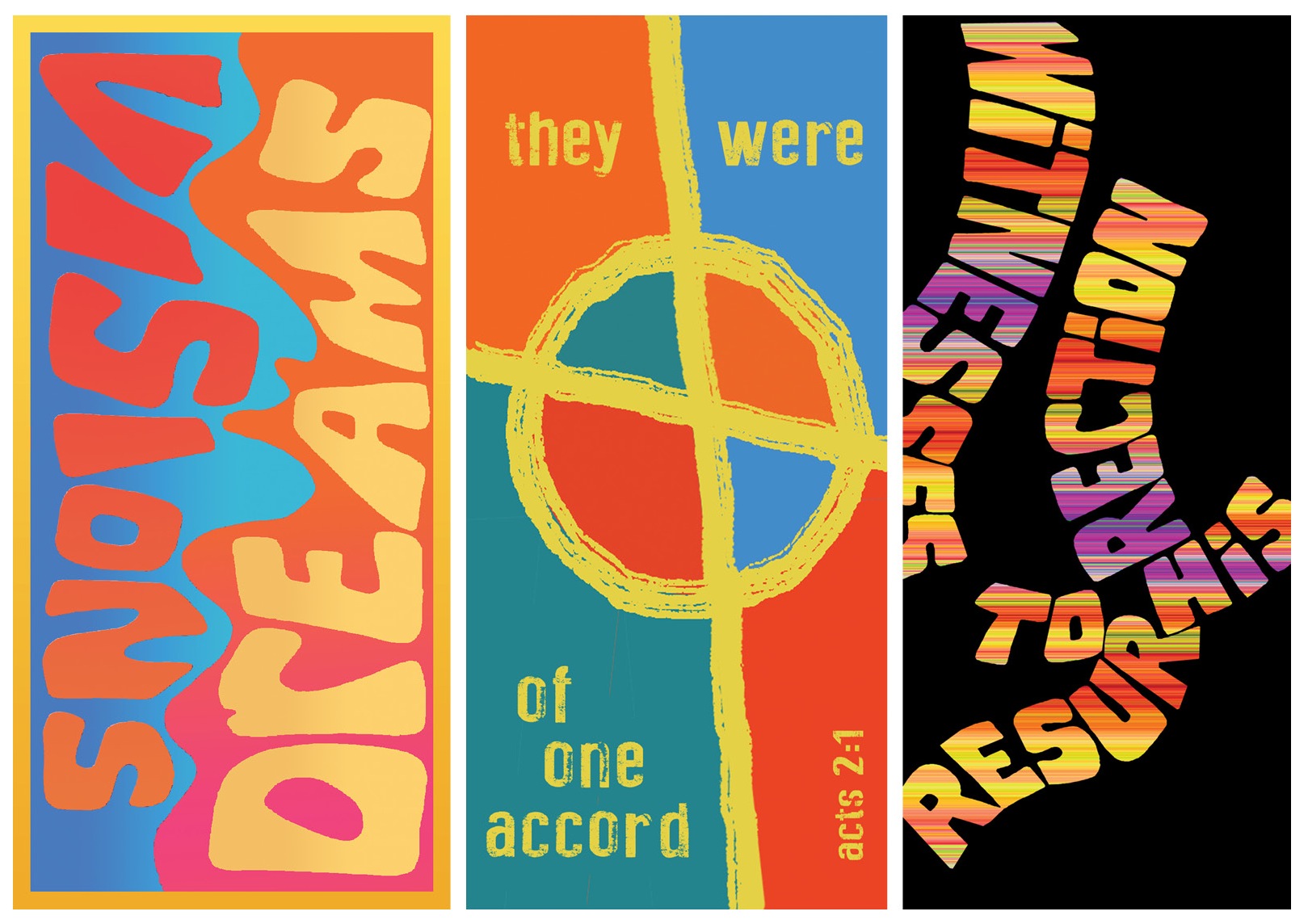
Three from a group of six Pentecost banners I designed a while back:

• Visions / Dreams – Acts 2:17
• They were of one accord – Acts 2:1
• Witnesses to his resurrection – Acts 1:22

1 Corinthians 12:1, 4-13

1 Now concerning spiritual gifts, brothers and sisters, I do not want you to be unaware.

4 Now there are varieties of gifts, but the same Spirit, 5 and there are varieties of ministries. but the same Lord, 6 and there are varieties of activities, but it is the same God who activates all of them in all persons.
7 To each is given the manifestation of the Spirit for the common good.

8 To one is given through the Spirit the word of wisdom and to another the word of knowledge according to the same Spirit, 9 to another faith by the same Spirit, to another gifts of healing by the one Spirit, 10 to another the working of powerful deeds, to another prophecy, to another the discernment of spirits, to another various kinds of tongues, to another the interpretation of tongues.

11 One and the same Spirit works all these things, distributing to each one individually just as the Spirit chooses.

12 For even as the body is one and has many members, and all the members of the body, though many, are one body, so also is Christ.
13 For by one Spirit we were all baptized into one body—Jews or Greeks, slaves or free—and we were all made to drink of one Spirit.

The Day of Pentecost

On the fiftieth day of Easter, the third great trinitarian festival of Pentecost particularly celebrates the reign of the Holy Spirit in the world, not simply within the church for a wide slice of a calendar year.

For all Sundays during the Great Fifty Days, the first reading is from the Acts of the Apostles. Today's Acts 2:1-21 narrates a now familiar vibrant, colorful, windy, fiery Spirit-filled happening in an upper room. Was it the same venue as on Maundy Thursday, or the same place where John's gospel tells us Jesus bestowed the Holy Spirit on Easter evening? To my knowledge, no one knows.

During Pentecost worship many churches have people read portions of the lection in different languages to help bring to life Luke's description of the far-reaching ethnic, linguistic, and stylistic diversity of the event.

The gospel reading is John 20:19-23, Jesus directly granting his followers the Spirit of presence, peace, and comfort. Every year on the second Sunday of Easter the gospel reading is John 20:19-31; this year I wrote about 1 Peter 1:1-9, but here are a couple of fairly recent reflections on the Johannine text:

• Easter 2B – 2021

• Easter 2A – 2020


Corinthians

Rich, opulent, and worldly, the city of Corinth famously was the site of Aphrodite's temple; Corinth also was a crossroads for international travel and commerce. The church at Corinth was full of competition, jealousy, arrogance, and self-important individuals. The two letters to the Corinthians are among the apostle Paul's seven undisputed epistles: 1 Corinthians is long and fairly continuous; 2 Corinthians is more of a collage or pastiche of separate communications.

• 1 Corinthians 11:23-25 is the earliest report of the "founding meal" of the Lord's Supper. 1 Corinthians 10 and 11 contain one bread, one body, worthy reception cautions and instructions related to Holy Communion.
• The love chapter 1 Corinthians 13 picks up on the quality of love Jesus charges us with in the gospel we received from John's community.
• The cross of Jesus Christ is central to our proclaimed and enacted theology, but so is the resurrection.


Today's Second Reading…

…on gifts of the Spirit with their diversity and variety sets the standard for our life and ministry while we move into (many more) Sundays in Ordinary Time. As apostle-pastor-theologian Paul writes to the Corinthians, either Unity in Diversity or Unity and Diversity could be the buzz-phrase for this scripture—but never uniformity. In his Message translation of verse 7, late pastor Eugene Peterson succinctly describes the purpose of all God's gifts: "everyone gets in on it; everyone benefits." Because of this, humanity flourishes, and so does all creation.

Every ability God graces us with is a gift in the Spirit and of the Spirit, so that would include skills like carpentry, cooking, music, accounting, caregiving, and farming. Today's Pauline list (the apostle Paul LOVES to make lists!) is about ones that can't easily be measured or quantified rather than more tangible, physical abilities, but none of those gifts is free-floating; every gift of grace is embodied.

Whether more spiritual or tending toward the practical; our gifts benefit the commonwealth or common-weal of the gathered community of the body of Christ and the world outside the doors of our homes, workplaces, and churches. In the spirit of pentecost, no class, cultural, education, ethnic, or other boundaries interfere.
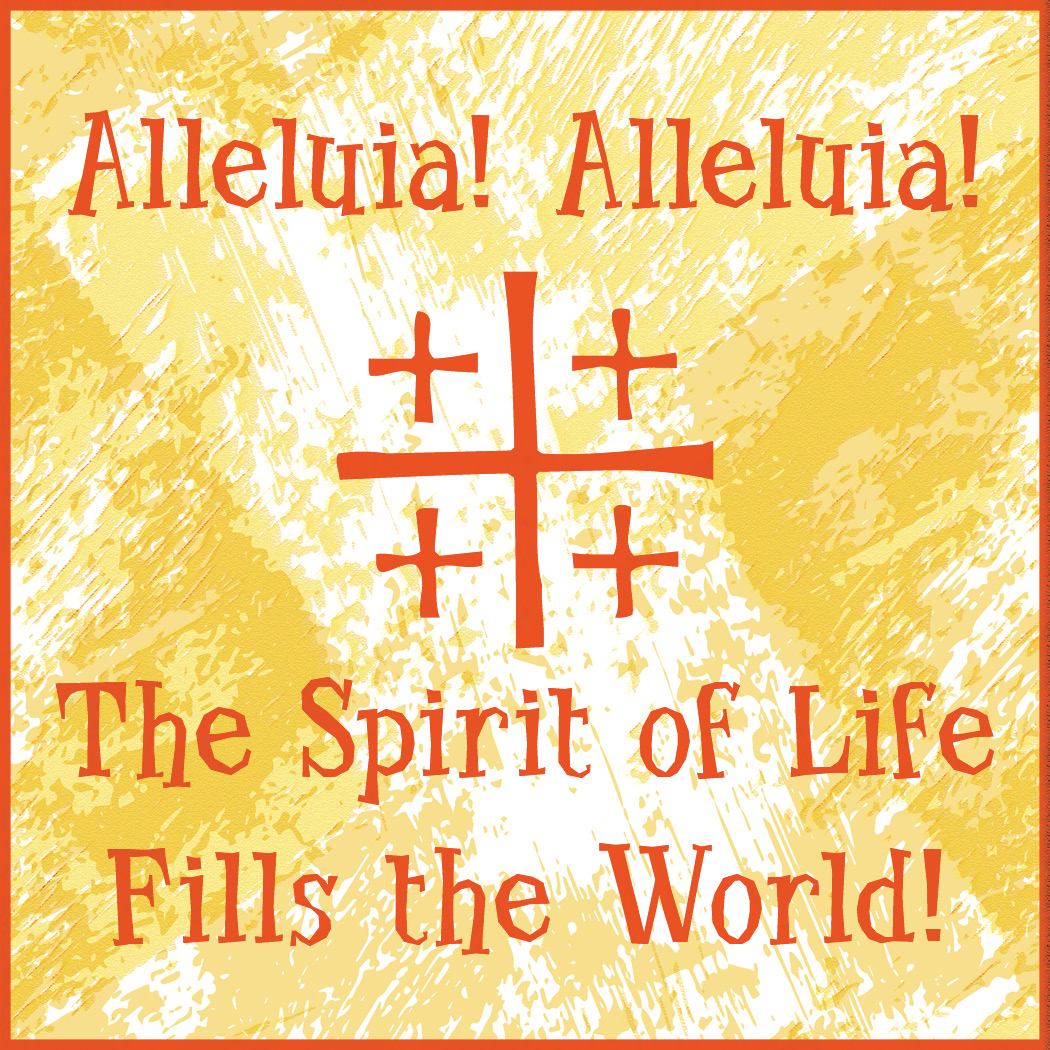
alleluia the spirit of life fills the world

Saturday, May 20, 2023

Ascension • Easter 7A

Psalm 47:5,6,7
God is gone up with a shout,
the Lord with the sound of a trumpet.
Sing praises to God, sing praises:
sing praises unto our King, sing praises.
For God is the King of all the earth:
sing ye praises!
Psalm 47:5,6,7
Luke 24:44-53

44 Then Jesus said to them, "These are my words that I spoke to you while I was still with you—that everything written about me in the law of Moses, the prophets, and the psalms must be fulfilled." 45 Then he opened their minds to understand the scriptures, 46 and he said to them, "Thus it is written, that the Messiah is to suffer and to rise from the dead on the third day, 47 and that repentance and forgiveness of sins is to be proclaimed in his name to all nations, beginning from Jerusalem. 48 You are witnesses of these things. 49 And see, I am sending upon you what my Father promised; so stay here in the city until you have been clothed with power from on high."

50 Then he led them out as far as Bethany, and, lifting up his hands, he blessed them. 51 While he was blessing them, he withdrew from them and was carried up into heaven. 52 And they worshiped him, and returned to Jerusalem with great joy; 53 and they were continually in the temple blessing God.

Ascension–Easter 7

The 40th day of Easter, always a Thursday, is the feast of the Ascension. Because most people don't go to church on Thursdays, today for Easter 7 or Day 43 we're hearing about the Ascension.

In easy theological terms ascension, ascendancy, ascent mean reign, rule, power, sovereignty, authority, stewardship. Not domination as people sometimes misinterpret dominion in Genesis 2, but caretaking and responsiveness to the needs of all our neighbors—human, flora, fauna, land, waterways, sky… everything that encompasses creation. Unlike in human governments and organizations, Jesus' authority has no checks and balances. It is supreme. It is absolute.

The Heidelberg Catechism tells us we move from Christmas / Incarnation, "with the mystery of spirit in flesh" to Jesus' Ascension, "with the mystery of flesh in Spirit."

The Easter season is a week of weeks, the biblical number of 7 times 7. Next Sunday on the 50th day of Easter we'll celebrate the Day of Pentecost, the church's third great Trinitarian festival. The pentecostal gift of the Holy Spirit enables the church to do the "greater works" Jesus promised as John 14:12 records. We then move into the green and growing season of Pentecost, a l-o-o-o-n-n-g segment of Ordinary Time when the church really comes into its own.


Until Now

During the season of Easter we've experienced Jesus' gift of the Holy Spirit on Easter evening from John's gospel; twice in the gospel we received from John's community we've revisited the upper room of Maundy Thursday with Jesus' commandment to love along with his promise of the Holy Spirit (advocate, paraclete, counselor) of comfort and truth.

Three weeks ago on Easter 4, we heard about the apostles' preaching and teaching. It's no longer Jesus as teacher and preacher! We see them gather for prayer in the kind of community that's a true common unity of koinonia where everyone has enough, no one possesses too much or too little. Their meeting includes "breaking of bread," that likely meant regular meals (potlucks, anyone?) as well as the Bread of Life and Cup of Salvation of the Lord's Supper.


Luke–Acts

As we prepare for the season of Pentecost and six months' focus on our lives as Jesus' presence in the world, let's consider the pair Ascension passages from Luke: in the gospel that bears his name, and in the Acts of the Apostles.

• Luke 24:49 "…I am sending upon you what my Father promised; so stay here in the city until you have been clothed with power from on high."

• Acts 1:5 "…for John baptized with water, but you will be baptized with the Holy Spirit not many days from now."

• Acts 1:6 When they had come together, they asked him, "Lord, is this the time when you will restore the kingdom to Israel?" 1:7-8 He replied, "It is not for you to know the times or periods that the Father has set by his own authority. But you will receive power when the Holy Spirit has come upon you; and you will be my witnesses in Jerusalem, in all Judea and Samaria, and to the ends of the earth."

When the disciples ask the resurrected Jesus if now he'd finally restore the (Davidic, probably) kingdom to Israel, he replies, "the question is wrong," and tells them to wait. They will receive power (the Greek is our "dynamite") and then they'll be his witnesses everywhere. You won't get reclaimed splendors like the Davidic monarchy or a recycled Jerusalem temple! You'll receive the Holy Spirit so you can live as Jesus' presence in the world; from now on, the world will discover Jesus within the church. In other words, Jesus' disciples (that's us!) will be the ones to restore God's reign of love, justice, mercy, and shalom on earth.


Where We Live

Jesus promises us baptism or literal immersion in the Holy Spirit of life; Jesus promises our lives will witness to him, but we don't do this on our own, by ourselves; we accomplish it with the power of God's life with us and within us. In the global reach of the Holy Spirit of Pentecost, we become Jesus' presence on earth and begin restoring God's reign over all creation, as the HS empowers us to walk the talk!

What does it mean to be Jesus' witnesses? Think of courtroom testimony.

The Heidelberg Catechism asks, "Why is the son of God called Jesus, meaning Savior?" Then, "Why is the son of God called Christ, meaning anointed?" And then: "But why are you called a Christian?" Answer: "Because by faith I share in Christ's anointing, and I am anointed to reign over all creation for all eternity."

His disciples ask Jesus, "is this the time when you will restore the kingdom to Israel?" Jesus essentially informs them their question is wrong and replies, "you will receive power when the Holy Spirit has come upon you; and you will be my witnesses in Jerusalem, in all Judea and Samaria, and to the ends of the earth."

In the power, discernment, and reach of the Holy Spirit of Pentecost, we becomes Jesus' presence on earth and begin restoring God's reign over all creation. Just as Jesus was anointed a Servant Sovereign or King, the Holy Spirit anoints and empowers us to walk the talk in the image of our servant God.

Friday, May 12, 2023

Easter 6A

colorful quilts
John 14:15-21

15 "If you love me, you will keep my commandments. 16 And I will ask the Father, and he will give you another advocate, to be with you forever. 17 This is the Spirit of truth, whom the world cannot receive, because it neither sees him nor knows him. You know him, because he abides with you, and he will be in you.

18 "I will not leave you orphaned; I am coming to you. 19 In a little while the world will no longer see me, but you will see me; because I live, you also will live. 20 On that day you will know that I am in my Father, and you in me, and I in you.

21 They who have my commandments and keep them are those who love me; and those who love me will be loved by my Father, and I will love them and reveal myself to them."

John's Gospel

Although John doesn't have a year in the Revised Common Lectionary, every year during Easter most of the gospel readings come from John. John is the gospel of God's abiding presence in Jesus Christ. This good news we received from the community gathered around Jesus' beloved disciple John offers ways for us to live faithfully and fruitfully with speech and action that make a difference in the world through the gift of the Holy Spirit we receive in baptism.


The Sixth Sunday of Easter

This sixth Sunday of Easter is day 36 of 50 of the Great Fifty Days of Easter. The third of the church's great trinitarian festivals, the Day of Pentecost, is the fiftieth day of Easter.

• Chapters 13 through 17 of John sometimes are called the Farewell Discourses.

We're well into the season of Easter, but today's gospel account happens in the upper room of Maundy Thursday after Jesus washed the disciples' feet! In this passage, Jesus promises to send "another advocate." Jesus says anyone who loves him will keep the commandments; Jesus promises to love and reveal himself to those who love him. In today's text Jesus promises the gift of the Holy Spirit, but on the second Sunday of Easter four weeks ago John's gospel told us about Jesus bestowing the Holy Spirit on the evening of the first Easter Day: John 20:19-23


Have You Heard this Story?

When Grandma couldn't get to church one Sunday, she asked her granddaughter to listen carefully and tell her what the pastor preached. When granddaughter got home, grandma asked what the pastor talked about. Grandkid replied, "Don't worry! You will get your quilt!"


Paraclete / Advocate

John 14:16 "I will ask the Father, and he will give you another advocate, to be with you forever."

Jesus promises to send the advocate or paraclete, a word for the Holy Spirit that's unique to John. Para means beside, next to, alongside. Clesis /clete means call, called. Paraclete in Greek is the same as advocate in Latin: ad means beside; vocare means call, called.

Jesus was the original called-along-side, so he promises to send "another," additional one.

Paraclete / advocate has a legal dimension as public defender, defense attorney. Just as here and now, in Jesus' day if you went to trial and didn't have your own attorney, the court would appoint one. Beyond the legal definition, paraclete is about general comfort, protection, counsel, and guidance—all wrapped up in God's presence the way a cozy quilt or comforter wraps us up.


Relating. Accompanying.

Translations/interpretations include comforter, helper, advocate, counselor, solicitor, attorney… The Message reads "another friend." Friend implies unranked equality, intimacy, a relationship in which one person knows what the other one does. Common English Bible [CEB] says companion, someone we break bread with. Ever notice what a leveling experience sharing a meal or a snack with a person is? How it's often the start of real friendship?

Like a keyboard accompaniment to a vocal or instrumental solo or choir anthem, the Holy Spirit accompanies us. Similar to breaking bread along side a companion (with+bread=com+panion).

• The Comforter will stay with us forever: what does comforter and forever mean for us?

• As people who receive the Holy Spirit at baptism, God calls us to comfort, help, advocate for others. What are some ways that happens? How can we be a cozy blanket or quilt without hovering too closely and smothering the person?


John 17, 18, 19: Worlds and Orphans

Two different New Testament words typically get translated as "world." Here in John 14:17, 19 world/cosmos means this planet, a physical space; it also can refer to people, institutions, and structures that do not know or obey God. John 14:18 – when Jesus promises not to leave us orphans, the Greek is the same as our word for orphan. Orphan is another legal term: a minor without living parents, or someone whose parents have abandoned them.

• What does Jesus promise not to abandon us feel like to you?


Keeping the Commandments

Today's scripture begins and ends with love, commandments, and obedience. The fulfillment of God's promises depends on God's free, unearned gifts of grace; they also depend on our obedience.

John 14:15 If you love me, you will keep my commandments.

verses 15, 21 love, love, loved, love = agape, the word for love the NT uses for God's unconditional love. verse 21 appear, make manifest, reveal = same as epiphany

• What does Jesus mean when he tells us he and the Father will love and reveal themselves to those who love him?

• "If you love me…" What is the connection between love and obedience?


You Will Get Your Quilt

We could call today's gospel reading, "You will get your quilt!" Jesus promises to send the paraclete to journey alongside us. Translations include comforter, advocate, counselor, solicitor, attorney… all wrapped up in the assurance of God's presence in the same way a cozy quilt, comforter, or blanket wraps us up.

Friday, May 05, 2023

Easter 5A

1 Peter 2:9 chosen royal holy
1 Peter 2:1-10

1 Rid yourselves, therefore, of all malice, and all guile, insincerity, envy, and all slander.

2 Like newborn infants, long for the pure, spiritual milk, so that by it you may grow into salvation— 3 if indeed you have tasted that the Lord is good. 4 Come to him, a living stone, though rejected by mortals yet chosen and precious in God's sight, and 5 like living stones, let yourselves be built into a spiritual house, to be a holy priesthood, to offer spiritual sacrifices acceptable to God through Jesus Christ.

6 For it stands in scripture: "See, I am laying in Zion a stone, a cornerstone chosen and precious; and whoever believes in him will not be put to shame." 7 To you then who believe, he is precious; but for those who do not believe, "The stone that the builders rejected has become the very head of the corner," 8 and "A stone that makes them stumble, and a rock that makes them fall." They stumble because they disobey the word, as they were destined to do.

9 But you are a chosen people, a royal priesthood, a holy nation, God's own people, in order that you may proclaim the mighty acts of him who called you out of darkness into his marvelous light. 10 Once you were not a people, but now you are God's people; once you had not received mercy, but now you have received mercy.

1 Peter and 2 Peter

Although the historical Peter, the guy originally called Simon that Jesus renamed Peter or Rock (Rocky!) definitely did not write the pair of letters or epistles 1 Peter and 2 Peter, I enjoyed writing this sentence because today's scripture passage says so much about rocks and stones.

By the way, 2 Peter was one of the seven books Martin Luther considered "leftovers" that in his opinion didn't belong in the New Testament canon.


Virtual and Live on Easter 5

Easter is 50 days, a week of weeks, 7 times 7. Today is the fifth Sunday of Easter, the 29th day— so Happy Easter, even as this year of grace inclines toward the Day of Pentecost, that's also the fiftieth day of Easter.

Many if not most churches have continued virtual Sunday worship the COVID pandemic forced people to initiate, though almost all have returned to in-person worship in some form, almost all somewhat modified from their former usual.


Rocks. Stones.

Scripture uses many pictures, similes, and metaphors for our relationship with God and for the lifestyle God calls us to. Stones, rocks, bricks, granite, adobe, concrete, and related building materials convey a sense of hard, heavy, solid, and safe. Some actually are quite porous (marble that I'm familiar with), others really are impenetrable. Whether natural stone or composited from natural elements, we sense stability, permanence, of something that won't easily decay.

Building foundations usually are made of these dense materials. This is earthquake country! How does initial construction and possible retrofitting affect how we experience the world around us when the ground beneath us and around us shakes? We can parallel insecurity during an earthquake with insecurities during times our society, family, finances, jobs, income, kitchen and household basics (remember when?)—everything literally is shaky.

The world still remembers the January 12, 2010 M7.0 Haiti earthquake that left the country in shambles; three months later, the M7.2 April 4th Sierra el Mayor / Easter EQ south of the international border in Baja California caused only minor property and construction damage. Contractors in USA and Mexico use rebar that reliably reinforces building materials that to some degree are stable and secure by themselves, but won't endure without added strengthening.

Like living stones, let yourselves be built into a spiritual house, to be a holy priesthood, to offer spiritual sacrifices acceptable to God through Jesus Christ.
1 Peter 2:5

A large sense of this passage from 1 Peter is about our spiritual strengthening—spiritual rebar? Like Jesus Christ, we need to be firmly situated where God has placed us, but we can't stay stable and secure very long without reinforcement from the Holy Spirit and from Spirit-filled, Spirit-led community.

• 1 Peter 2:4 Jesus, a living stone
• 1 Peter 2:5 us, like living stones

What does it mean for us as individuals and for us together as a community of faith to be "living stones"? How about writing a poem?


Chosen – Royal – Holy – God's Own

But you are a chosen people, a royal priesthood, a holy nation, God's own people.
1 Peter 2:9

Verses 9 and 10 of 1 Peter often are called a baptismal hymn as they highlight aspects of our baptismal identity. What a time to consider this scripture, with the coronation of King Charles III this weekend!

What are your word associations and/or definitions? I've suggested some approximations; you may have additions or enhancements:

• chosen – select, picked, desired
• royal – noble, esteemed, privileged
• priest – mediator, go-between
• holy – sanctified, set apart, sacred, consecrated
• nation – ethnicity, people, tribe, generation, population

How do you relate to your individual and corporate identity and call as God's own people? KJV reads peculiar people; in an echo of a distinctive Old Testament title for God's people, some translations call us God's special possession.

Friday, April 28, 2023

Easter 4A

Acts 2 Pentecostal activities
teaching and fellowship
breaking of bread and awe

Acts 2:42-43
Acts 2:41 -47

41 they gladly received the word Peter preached and three thousand were baptized on that day!

42 They devoted themselves to the apostles' teaching and fellowship, to the breaking of bread and the prayers. 43 Awe came upon everyone, because many wonders and signs were being done by the apostles. 44 All who believed were together and had all things in common; 45 they would sell their possessions and goods and distribute the proceeds to all, as any had need.

46 Day by day, as they spent much time together in the temple, they broke bread at home and ate their food with glad and generous hearts, 47 praising God and having the goodwill of all the people. And day by day the Lord added to their number those who were being saved.

Season and Day

A week of weeks, 7x7, Easter fills about 1/7 of the calendar year. The fiftieth day of Easter is the Day of Pentecost, the third of the church's Trinitarian festivals. At Pentecost we hear about people assembled in Jerusalem for the Jewish Pentecost to celebrate the wheat harvest along with God's gift of the Ten Words of the Sinai Covenant.

Every year the Fourth Sunday (day 22) of Easter is Good Shepherd Sunday with Psalm 23 as its centerpiece. We sing and hear at least one or two settings of Psalm 23, the Shepherd Psalm. Do you have a favorite hymn version, maybe a hymn-based or freeform anthem?


Luke Volume 2: Acts

During the rest of the church's year of grace the first reading comes from the Old Testament, but for Sundays of Easter, it's from the Acts of the Apostles. That's particularly apt because Acts brings us the paradigm-upending, life-transforming activities of the newly birthed church. Hearing from Acts every Sunday also is a bit ironic because the lectionary hasn't yet given us the Day of Pentecost account from Acts 2 that describes the Holy Spirit filling the world accompanied by sensory signs of wind and fire.

Luke's gospel emphasizes the Holy Spirit, carefully places everything in history, focuses on women and other marginalized populations, loves prayer, is really big on sharing meals. In his Acts of the Apostles, Luke continues in the same direction.

The lectionary selection formally begins by describing the Christian community, but it follows 2:41 that tells about the baptism of 3,000 people! This happens after Peter's sermon in Acts 2:14-41. Working Preacher's tagline insists, Good Preaching Changes Lives. You can describe what follows as a blueprint for ways to live out our baptism—how, then, shall we live baptized?

You know some of it: work for justice; defy empire; be God's shalom; practice resurrection. Be kind to planet earth. Be radically hospitable and love without reservation. Praise and thank God, because anything we do is the work of the HS and not our own.


Content and Context

You know about the distinction between real and ideal? Most scholars assume Acts records some events as they really happened and includes others that could show up when the Holy Spirit shows up. The title of one of Jürgen Moltmann's books is The Church in the Power of the Spirit [link to my blog and review]. The church – that's us! – still lives, breathes, serves, and hopes in the power of the pentecostal spirit of life, the spirit of resurrection.

"They devoted themselves to the apostles' teaching and fellowship, to the breaking of bread and the prayers. Awe came upon everyone…" Acts 2:42-43

Reading and interpreting scripture, gathering with others, food, and prayer. Most scholars agree "breaking of bread" refers to the Lord's Supper, probably in what looks to us like a home church. But without a doubt it also means routinely sharing vittles so no one has too much or too little, everyone has enough.

2:44 "all who believed were together and had all things in common."

Common ownership of goods and assets, selling stuff to provide for those in need may seem way out there beyond ideal. Even if we've done some anthropology field work or ministered in non-mainstream settings, most of us still tend to interpret scripture from a contemporary western viewpoint. However, in some rural communities and in many less-developed countries, fluid ownership of everything – "what's mine is yours as long as I don't need it right now and you do" – isn't uncommon.

Related to the real and the ideal, later in Acts Luke writes about discord, persecution, disagreements, fractured relationships, things not going well. All in all, he presents not only an ideal, but wisely brings up real situations that need resolution.

Koinonia is the Greek word often translated as fellowship, and our multiple meaning English word "common" comes from koinonia: routine, mundane, commonplace, ordinary (also with meanings of well-arranged, organized), jointly held… a common-wealth.


Where We Live

teaching – fellowship – breaking of bread – prayers – awe – all things in common

How well does today's reading describe church as you've experienced it?

• In your current context?
• Other churches you've attended or where you've been involved?
• Churches you've read about?
• The church you dream of?
• The church you're going to plant and establish?

Saturday, April 22, 2023

Easter 3A

broken bread, cup of tea, blue checked cloth
Luke 24:13-35

13 Now on that same day two of them were going to a village called Emmaus, about seven miles from Jerusalem, 14 and talking with each other about all these things that had happened. 15 While they were talking and discussing, Jesus himself came near and went with them, 16 but their eyes were kept from recognizing him. 17 And he said to them, "What are you discussing with each other while you walk along?" They stood still, looking sad.

18 Then one of them, whose name was Cleopas, answered him, "Are you the only stranger in Jerusalem who does not know the things that have taken place there in these days?" 19 He asked them, "What things?" They replied, "The things about Jesus of Nazareth, who was a prophet mighty in deed and word before God and all the people, 20 and how our chief priests and leaders handed him over to be condemned to death and crucified him. 21 But we had hoped that he was the one to redeem Israel. Yes, and besides all this, it is now the third day since these things took place.

22 "Moreover, some women of our group astounded us. They were at the tomb early this morning, 23 and when they did not find his body there they came back and told us that they had indeed seen a vision of angels who said that he was alive. 24 Some of those who were with us went to the tomb and found it just as the women had said, but they did not see him."

25 Then he said to them, "Oh, how foolish you are and how slow of heart to believe all that the prophets have declared! 26 Was it not necessary that the Messiah should suffer these things and then enter into his glory?" 27 Then beginning with Moses and all the prophets, he interpreted to them the things about himself in all the scriptures.

28 As they came near the village to which they were going, he walked ahead as if he were going on. 29 But they urged him strongly, saying, "Stay with us, because it is almost evening and the day is now nearly over." So he went in to stay with them.

30 When he was at the table with them, he took bread, blessed and broke it, and gave it to them. 31 Then their eyes were opened, and they recognized him, and he vanished from their sight. 32 They said to each other, "Were not our hearts burning within us while he was talking to us on the road, while he was opening the scriptures to us?"

33 That same hour they got up and returned to Jerusalem, and they found the eleven and their companions gathered together. 34 They were saying, "The Lord has risen indeed, and he has appeared to Simon!" 35 Then they told what had happened on the road and how he had been made known to them in the breaking of the bread.

The 15th Day of Easter

Although this is Matthew's lectionary year and for Sundays during the Great Fifty Days of Easter the gospel reading usually comes from John, today it's Luke's Emmaus Road. Every year this stunning story is the appointed gospel for Easter evening, but on Easter this year I blogged about the first reading: the extravagant feast of fat things, the end of death, and the efficacy of God's Word from Isaiah 25:6-9


Emmaus Road

People have observed that Jesus in Luke's gospel always is on his way to a meal, at a meal, or leaving a meal.

On Earth Day weekend during Earth Month we hear about invitation, welcome, and food amidst ordinary activities. It's also one of countless times people didn't recognize Jesus when he first showed up. This time they didn't know it was Jesus, even though the wayfarers had just been talking about an empty tomb and suspicions that therefore, Jesus must be alive. Because the Sunday evening travelers hadn't seen Jesus themselves, were hopes they'd held for the redemption of Israel null and void?


Earth Month, Earth Day

The wellbeing and future of planet earth has reached a point of crisis in the pictogram's sense of both danger and opportunity. A half century and counting after the first Earth Day in 1970, creation is in serious peril. Species survival and the interconnected ability to feed everyone are major concerns.

Everyone needs nutrition; almost as much, everyone needs a companion to break bread with, if only along the way from where we've been to where we're headed. And sharing a meal can be a socially, culturally, humanly leveling experience. Regional dishes and national specialties are strong identity markers! What ones belong to you? To your family of origin? The country where you were born or other places you've lived? With table fellowship a keynote of his gospel, Luke counsels travelers to eat whatever their hosts provide [10:7-8]. Don't be fussy; partake of the food that's part of their hospitality—and also a slice of their culture.

What can we make of this resurrection evening account of walking, talking, wondering, meeting, and recognizing? How can we connect it with Earth Day?


What Happens After

What happened after? After the stranger who became their host broke the bread. After they knew it was Jesus because … they'd been there when he blessed, broke, and gave the bread to all those crowds on those wonderful occasions? Because they'd been in the upper room on Maundy Thursday?

When they reached Jerusalem, Cleopas and his unnamed companion told the eleven about their encounter with the risen Jesus Christ and how they recognized him because he blessed, broke, and gave them bread.

What happens to us after? After sharing a meal or a snack at our home or at someone else's? After catching a street taco or a bowl of pho to savor together? After we gather at the communion table?

The stranger they later identified as the risen Jesus Christ placed himself within the whole history of God's people, just as we do when we interpret scripture and celebrate the Lord Jesus' Supper. Our eucharistic liturgy with its narratives and actions are somewhat formal and quite ritualized, but it's the model for our being and acting after we leave the gathered assembly. After? We continue to place ourselves – in word and action – within the long history of all God's people.


Where We Live

Luke's volume 2, The Acts of Jesus' First Apostles vividly describes a newly birthed church alive with the fire and society-transforming power of the Spirit of Pentecost. We're two millennia beyond those years, and like God's people of every time and place, we get to become part of and tell the rest of the story.

As eucharistic people, we offer and return gifts of the earth to their Creator. Without a healthy planet, there's nothing to offer. Without a healthy planet, we won't have sacraments.

And the loaf can't benefit anyone until, unless, it's been broken in some way. The cup needs to be spilled, emptied to bring life. When we gather at the Communion Table we retell the history of God's people from the first creation through our hope for a fully restored new creation. Jesus hosts us at the Table of Grace where crumbs and fragments of broken bread, drops and splashes of fruit of the vine nourish and bring us together to become one body in Christ.

Regional dishes and national cuisines are strong identity markers. Cleopas and friend identified Jesus by the broken bread and poured out cup. Does Holy Communion mark our identity as God's? Will the world recognize us as the body of Christ because of broken and poured-out lives after and into another millennium?

Isaiah's Feast of Fat Things describes a finished New Creation; Luke's Emmaus Road is along the way. Let's follow this year's Earth Day hashtag, Invest in Our Planet and welcome God's promised New Creation.

Come, Lord Jesus!

The grace of the Lord Jesus be with all the saints. Amen!

bread loaf and cups
Earth Day 2023 Invest In Our Planet

Saturday, April 15, 2023

Easter 2A

1 Peter L8 rejoice with unutterable and exalted joy
1 Peter 1:1-9

1 Peter, an apostle of Jesus Christ,

To those who reside as aliens, scattered [NRSVUE: to the exiles of the dispersion] throughout Pontus, Galatia, Cappadocia, Asia, and Bithynia, who are chosen 2 according to the foreknowledge of God the Father, by the sanctifying work of the Spirit, unto obedience and sprinkling with Jesus' blood: May grace and peace be multiplied to you in the fullest measure.

3 Blessed be the God and Father of our Lord Jesus Christ, who according to his great mercy has caused us to be born again to a living hope through the resurrection of Jesus Christ from the dead, 4 to obtain an inheritance which is imperishable and undefiled and will not fade away, reserved in heaven for you, 5 who are protected by the power of God through faith for a salvation ready to be revealed in the last time.

6 In this you greatly rejoice, even though now for a little while, if necessary, you have been distressed by various temptations, 7 so that the genuineness of your faith, being more precious than gold which perishes, even though tested by fire, may be found to result in praise and glory and honor at the revelation of Jesus Christ;

8 and though you have not seen him, you love him, and though you do not see him now, but believe in him, you greatly rejoice with joy inexpressible and full of glory, 9 obtaining as the outcome of your faith the salvation of your lives. …

Easter

The day of resurrection is the day after the Sabbath (Shabbat never changed from Saturday; Sunday is the main worship day for most Christians because of Jesus' resurrection); the day after Shabbat is the first day of a new week. The day of resurrection is the eighth day of the old week. This eighth day initiates a new creation, and therefore is a new first day of creation.

Easter is a season of 50 days, 7 times 7, a weeks of weeks. "7" is the number of perfection in Hebrew numerology. In many words, the prefix "pent" means 50: pentagram, pentagon, pentangle, pentameter. The Day of Pentecost is the 50th day of Easter. This year the day of Pentecost will be on May 28. Where will you be then?

Especially Orthodox churches celebrate the seven days from Easter Sunday through Easter Saturday as Bright Week, and consider the entire week a single day, the first day of the new creation. Bright Week also is the 8th day of [the old] creation. We sometimes talk about Eighth Day Theology.

Some baptismal fonts have 8 sides (octagon) to help demonstrate our baptism into the new creation, our baptism as a new creation In Jesus Christ's death and resurrection.

It's important to remember the new creation is not pristine; it carries scars from our old, deadly pasts. Today's gospel reading in John 20:19-31 shows us Jesus' scars. It also recounts Jesus' bestowing the gift of the Holy Spirit and the office of the keys—binding and loosing (retaining and forgiving sin) in the gospels of Matthew and Luke.


1 Peter and 2 Peter Authorship

The pair of letters or epistles 1 Peter and 2 Peter definitely were not written by Peter the Apostle, and most likely the same individual didn't write both. Despite many Old Testament quotes and allusions the actual apostle Peter would have known, 1 Peter and 2 Peter were written to mostly gentile churches who wouldn't have been familiar with them, though some Christians in the massive geographical area these round robin communications may have reached probably were diasporic Jews.

Because of textual references, casual readers long have insisted 1 Peter and 2 Peter were written to "a persecuted church," though scholars now say there's no historical evidence of systemic, targeted persecution of individual Christians or groups by any official entity. However, people apparently were being harassed and mistreated because of their trust in the risen Christ and their resistance to empire. How about us? How about people around us?

Claiming authorship then was very different from now; there weren't any copyrights, trademarks, or other legal protections for creative or inventive output. Using someone else's name was a compliment, and a famous person would be more likely to get readers than an unknown would.


Today's Second Reading

During the Great Fifty Days of Easter, the first reading comes from the Acts of the Apostles instead of from the Old Testament. Today's features a sermon by the historical Peter recorded in Acts 2:22-32.

This letter addresses recipients as aliens, exiles, as a diaspora, people far from home, yet chosen and sanctified for the obedience that implies faithfully keeping Torah. Love of God and neighbor, justice and inclusion for everyone would defy what Paul of Tarsus and his cohorts would refer to as the powers of this world. Covenantal obedience would resist the dehumanizing violence of empire and in the wake of his life, death, and resurrection, it would affirm Jesus as Lord, as the letter's author does. In any case, whatever their geographic or religious origin, those who received this letter had been "born again" or reborn into God's family. What about us?


Birth. Inheritance.

In God's mercy we have been born again, birthed a second time. through Jesus' resurrection from death. The apostle Paul tells us the good news of the gospel is death and resurrection, and next week's scripture from 1 Peter 1:23 announces we have been born again through God's living and enduring word. I love that the NRSV says born "anew" because it reminds us our old identity and ways of being and acting are gone as creatures reborn of Water, Spirit, and Word.

We do nothing to achieve our first birth. Our second birth also is by grace and not by our own choice. We only need to live into birth.

Like birth we cannot enact, we only need to claim and receive an inheritance. Over the next few weeks we'll be hearing about a lot of outreach and direct action in the Acts of the Early Apostles. We'll observe how the freedom of knowing life as gift over, beyond, and in spite of anything they could do gave those early apostles confidence and effectiveness they otherwise wouldn't have possessed. How about us?


Where We Live

Those of us who receive this letter along with Luke's Acts as twenty-first century apostles may marvel again at the boldness and world-changing power of the nascent church's testimony in words and action. Despite being written later than Acts, our readings from 1 Peter make a fabulous coupling with it to help us consider our presence and ministries (outreach and direct action?) as Jesus' representatives.

Although technically the world has basked in the reign of the Holy Spirit of Pentecost for two millennia, every year we revisit stories of Jesus and his original disciples to literally inspire us into possibilities God gives us as new creations in Christ, called and sent as the obedient presence of the (crucified and) risen Jesus Christ into a devastated world and a desecrated creation.

Can we, do we, greatly rejoice with joy inexpressible and full of glory, or as my illustration says, rejoice with unutterable and exalted joy?

Saturday, April 08, 2023

Five Minute Friday :: Own

flower with segullah in Hebrew
• Five Minute Friday :: Own Linkup

Although I contacted the domain host and the person I talked with did his best to update my desert spirit's fire blog on the CMS, it still doesn't load correctly and there seems to be zero way to contact blogger directly. If the blog didn't date from July 2002 I might give up and start another, but I don't want to lose all that content and I really really like the blogger interface, so migrating to another CMS with the same name isn't an option. Therefore… I'm playing here on my scripture blog again and I'll replicate everything on desert spirit's fire.

Own

When we own something, it belongs to us. Some ownership of an item or object, a success or a failure, is a clear choice—when you purchase something, for example. Sometimes we need to own a circumstance or outcome that happened because of many factors, so that particular owning is a bit complicated.

…if you will indeed obey my voice and keep my covenant, then you shall be my special treasure or possession – segullah – סְ×’ֻלָּ×” – among all the peoples, for all the earth is mine; and you shall be to me a kingdom of priests and a holy nation. Exodus 19:5-6

Just as God claimed Israel as God's own during their desert trek toward the Land of Promise, in baptism God owns and possesses us. We belong to God! God chooses us, claims us, and charges us to be part of the reign of heaven on earth. As the PCUSA's Sixth Great End of the Church expresses it, "The exhibition of the reign of heaven to the world." That means the world sees heaven when they observe us! It's both gift and response ("responsibility") because God's promises have a condition.

Almost immediately before giving them the ten words (or commandments) that describe how God's people are to live out their relationships with God, known and nearby neighbors, and with strangers (sojourners, aliens, foreigners in scriptural terms), God tells them if they obey and keep covenant, then God will treasure them, "own" them, in a particular way.

Yes, God loves each of us and all creation unconditionally. But keeping Torah and keeping our baptismal covenants carry the distinctive responsibility of owning them by acting for the good of friends, neighbors, newcomers, strangers, frenemies, and even enemies to help create a flourishing common-wealth.

# # #
five minute friday own
five minute friday button

Easter Evening 2023

Easter Resurrection 2023
Isaiah 25:6-9

6 And in this mountain shall the Lord of hosts make unto all people a feast of fat things, a feast of wines on the lees, of fat things full of marrow, of wines on the lees well refined.

7 And God will destroy in this mountain the face of the covering cast over all people, and the vail that is spread over all nations.

8 God will swallow up death in victory; and the Lord God will wipe away tears from off all faces; and the rebuke of the people shall God take away from off all the earth: for the Lord hath spoken it.

9 And it shall be said in that day, Lo, this is our God; we have waited for God who will save us: this is the Lord; we have waited; we will be glad and rejoice in God's salvation. KJV, alt.

Resurrection

Whether at a close to Saturday midnight Easter Vigil, a sunrise service, the regular Sunday morning hour, or easing into afternoon or early Easter Sunday evening, as Act III, the first Eucharist of Easter concludes the three act liturgy of the Triduum or Three Days. Easter isn't simply a isolated special day; Easter is fifty days, a week of weeks, and occupies about one-seventh of the year. It's that important!


Today's First Reading I

Sometimes referred to as an example of apocalyptic writing, Isaiah 25:6-9 is the Hebrew scripture reading for Easter Evening every year. We find it amidst writings mostly from Isaiah of Jerusalem (pre-exilic First Isaiah, chapters 1-39), yet chapters 24 through 27 probably come from at least a century afterwards. Despite all of Isaiah rocking a considerable sense of hope with salvation for all creation, this passage may have been written from Babylon during the exile, or probably even later, during restoration of the city of Jerusalem, rebuilding the temple, and rediscovery of Torah.

These imaginative words remind us the God of Israel is God of all people, a God on the side of everyone. All Saints Day pairs this extravagant banquet with Jesus raising dead Lazarus [John 11:1-44].


Today's First Reading II

In the northern hemisphere we've cycled from browning autumn root crops, leaves falling from trees and decaying to enrich the ground, shorter days, longer nights into an apparently quiet, still, and silent winter that in many aspects feels similar to the stillness and quiet near-silence of the desertscape's surface.

Wintry days lengthened as earth produced tender green sprouts, tulips, crocus, and spring agricultural crops (my header collage illustrates a few, although peach trees are only in bloom now, peach and other pit fruit will arrive fairly soon) all remind us of God's gift of the agricultural cycle, God's gift of land.

The vail – KJV, "veil" in modern English – or shroud of death becomes a festal tablecloth as God prepares and serves a bountiful spread of a covenant meal shared by God and people. That eschatological feast – as we called our extravagant potlucks in divinity school – will be God's sign that death and dying are no more.

God will swallow up death and the shroud of death – coverings that hide the light of life, anything that lessens our joy – into God's own being. God will obliterate all the different kinds of death. Did you know the pall that covers the casket at a Christian funeral is a baptismal garment signifying death and resurrection?


Where We Live

But the church has celebrated the Day of Resurrection for two millennia; most readers of this blog have observed a few decades of Easters. We look around us and still see, still experience hatred, poverty and injustice. Illness, death, and dying. Grief. Tears.

Although agriculture's seasons of tilling, planting, growing, and harvesting keep cycling continuously, our theology tells us Easter, the event of Jesus Christ's resurrection, that eighth day that's also the first day of the new creation, marked the end of death and dying. Jesus' death and resurrection concluded ongoing cycles of poverty, illness, injustice.

Despite the dawn of the new creation on the day of resurrection two thousand years ago, God's renewed, restored natural creation and righteous society has only begun. It still waits – and hopes – for us to help finish it. Theology of the cross emphasizes Saturday, the interstitial time of winter-like quiet when apparently nothing happens yet everything happens. But God calls us to live as fully alive, resurrected, and redeemed people of the cross.

In the Acts of the Apostles [Acts 1:4-8] when the risen Jesus' followers ask him if now he'll finally restore the reign of heaven to earth, Jesus basically tells them "the question is wrong," and to wait until they've received the gift of the Spirit because then they'll be his witnesses in word and action. In the power of the Spirit they'll be the ones to bring heaven to earth.

On the third day, the third act of the Triduum aligns and unites nature and history, but wait! Filled with the Spirit of the Day of Pentecost that's the fiftieth day of Easter, like Jesus' original disciples, we become agents of the justice, inclusion, and freedom of a finished new creation. Amen? Amen!

Saturday, April 01, 2023

Five Minute Friday :: Break

bread and cup
• Five Minute Friday :: Break Linkup

I knew I knew where to plug in the new IP address on my desert spirit's fire blog, but evidently not. I'll phone the domain place and this time I'll Five Minute Friday here on my scripture blog and copy-paste over there later.

News break. Breaking day. Day break. Water main break. Lunch break. Break dancing. A break in the routine. Break a bone. Relationship breakup. Break bread. Don't break your promises. God doesn't! I want to write about all of those!

Our host Kate begged for a break in school shootings (others, too) that have become routine.

What's my focus this time?

For I received from the Lord what I also handed on to you, that the Lord Jesus on the night when he was betrayed took a loaf of bread, and when he had given thanks, he broke it and said, "This is my body that is broken for you. Do this in remembrance of me."

In the same way he took the cup also, after supper, saying, "This cup is the new covenant in my blood. Do this, as often as you drink it, in remembrance of me."

For as often as you eat this bread and drink the cup, you proclaim the Lord's death until he comes. 1 Corinthians 11:23-26

As Jesus breaks bread and blesses wine, he tells us to "do this—in remembrance of me."

Bless and break bread, pour out wine? "Do this" blood of the new covenant announcement?

Re-membering means re-collecting pieces and putting them back together to restore a broken whole that weaves together past and present.

When the church obeys Jesus by breaking bread and pouring out wine in his memory, part of the liturgical action includes retelling the story of God's people from creation through redemption in order to make it part of our own history. This remembering becomes about all of us throughout the history of the cosmos. We recollect how God has led us, how even those hard days didn't last forever… we again trust God whose final answer always is resurrection from death that breaks lives, shatters dreams, looks as if it annuls promises.

Do we need bread and wine to remember Jesus? Well, throughout the records of Jesus' life we find Jesus feeding strangers and feasting with friends; Jesus tells us people will come to the banquet from the east and the west, the north and the south … and about giving his broken body for the life of the world. The Welcome Table, the Calvary Cross, and the Reign of Heaven are tightly bound together.

When Jesus breaks bread and blesses wine, he tells us to do what he does—"in remembrance." Do we need bread and wine to remember Jesus?

We are breakout people! Wherever we go we become a living and a life-giving memory of Jesus. In us, Jesus again becomes alive in the world and we become a living connection to the heaven of God's reign on earth. Will people recognize us as the body of Jesus Christ when we break open our hearts, share our substance, and pour out our lives? I hope so!

# # #
five minute friday break
five minute friday icon

Friday, March 31, 2023

Lent 6A

Lent 6 Palm Sunday Palms
Philippians 2:5-11

5 Let the same mind be in you that was in Christ Jesus, 6 who, because he was in the form of God, did not regard equality with God as something to be exploited, 7 but emptied himself, taking the form of a slave, being born in human likeness. And being found in human form, 8 he humbled himself and became obedient to the point of death— even death on a cross.

9 Therefore God also highly exalted him and gave him the name that is above every name, 10 so that at the name of Jesus every knee should bend, in heaven and on earth and under the earth, 11 and every tongue should confess that Jesus Christ is Lord, to the glory of God the Father.

Lent

The reflective, penitential season of Lent that leads us to Easter has been observed for different lengths at different times. In this twenty-first century, churches that follow the lectionary for their scripture readings generally observe Lent during the 40 days (excluding Sundays) from Ash Wednesday through Wednesday in Holy Week.


Triduum / Three Days

In a few days we move into the services of Maundy Thursday – Good Friday – Easter that form a single liturgy. One of my favorite activities is creating a resurrection trilogy by attending Saturday evening Easter Vigil, Sunday Sunrise, and mid-to-later morning Sunday services. I'd love to add an Easter afternoon or evening liturgy to that. Maybe I need to check out the downtown LA Cathedral?


Palm-Passion Sunday

On this last Sunday in but not of Lent, many churches start worship by reenacting Jesus' triumphal entry into Jerusalem with palms or some variety of locally grown green branches, and continue to his arraignment, trial, conviction, crucifixion, and death. The gospels of Mark and Matthew tell us when Jesus died the temple curtain tore from from top to bottom, symbolizing the reality of the reconciliation of heaven and earth. The word for tore is one that can't be mended; in Matthew, the earth shook, rocks split open. All creation responded!


Philippians 2:5-11

Almost forever scholars have imagined Paul quoted a hymn from another source, but Gordon Fee, professor emeritus at Regent College, Vancouver says:

If it was originally a hymn of some kind, it contains nothing at all of the nature of Greek hymnody or poetry. Therefore, it must be Semitic in origin. But … It lacks the rhythm and parallelism one might expect of material that is to be sung. And in any case, it fits very poorly with the clearly hymnic material in the Psalter or in Luke 1:46-55, 68-79, or in 1 Timothy 3:16b, to name but a few clear NT examples of hymns.

Whether or not it's an original by Paul or had been circulating around Christian circles, the cruciform theology of this hymn is pivotal.


gods and God

In the Ancient Near East/ANE gods were an ordinary part of daily life. Every city, town, and village, (almost every random mound of dirt) had its own deity. People imagined those gods demanded tribute in the form of money, food, shrines, sacrifices—human or animal ones at worst. People pictured gods being full of vanity and pretension. Aside from deities of place and function, you might find yourself interacting with a half-mortal, half-divine being who was offspring of a human and of a god. In Jesus Christ, we have a savior, a redeemer who is fully human and completely divine. Nothing halfway about him!

In The Message translation of this passage from Philippians, Pastor Eugene Peterson says Jesus "set aside the privileges of deity." Those divine privileges would have been ones the fake gods people invented would claim. They were not attitudes or actions the God of the bible ever would have assumed. In other words, being in the image of the real God of Earth and Heaven, Jesus took on the real attributes of that God including love, mercy, service, grace, and forgiveness.

In contrast to human ideas about divinity, the God of the bible especially self-reveals in the cross, in Jesus of Nazareth's crucifixion—and resurrection.


Theology of the Cross

Theology of the cross is about God's own self-revelation, especially in Christ crucified. Theology of the cross is about God's frequently hidden, paradoxical both/and presence in the commonest things, people, and situations.

Theology of glory is about human ideas and imaginings of how a powerful, all-knowing, sovereign God might act. Taking this further, theology of glory sometimes is about the ways humans wish God would behave. Varieties and variations of prosperity gospel are theologies of glory.

Reformer Martin Luther reminds us to see the fullness of God's power and sovereignty, look to the Bethlehem manger – look to the Calvary cross. "The God who became small for us in Christ" … small enough to die.

Friday, March 24, 2023

Lent 5A

rough cross with bokeh background
Ezekiel 37:1-14

1 The hand of the Lord came upon me, and he brought me out by the spirit of the Lord and set me down in the middle of a valley; it was full of bones. 2 He led me all around them; there were very many lying in the valley, and they were very dry. 3 He said to me, "Mortal, can these bones live?" I answered, "O Lord God, you know."

4 Then he said to me, "Prophesy to these bones, and say to them: O dry bones, hear the word of the Lord. 5 Thus says the Lord God to these bones: I will cause breath to enter you, and you shall live. 6 I will lay sinews on you, and will cause flesh to come upon you, and cover you with skin, and put breath in you, and you shall live; and you shall know that I am the Lord."

7 So I prophesied as I had been commanded; and as I prophesied, suddenly there was a noise, a rattling, and the bones came together, bone to its bone. 8 I looked, and there were sinews on them, and flesh had come upon them, and skin had covered them; but there was no breath in them.

9 Then he said to me, "Prophesy to the breath, prophesy, mortal, and say to the breath: Thus says the Lord God: Come from the four winds, O breath, and breathe upon these slain, that they may live." 10 I prophesied as he commanded me, and the breath came into them, and they lived, and stood on their feet, a vast multitude.

11 Then he said to me, "Mortal, these bones are the whole house of Israel. They say, "Our bones are dried up, and our hope is lost; we are cut off completely.' 12 Therefore prophesy, and say to them, Thus says the Lord God: I am going to open your graves, and bring you up from your graves, O my people; and I will bring you back to the land of Israel. 13 And you shall know that I am the Lord, when I open your graves, and bring you up from your graves, O my people. 14 I will put my spirit within you, and you shall live, and I will place you on your own soil; then you shall know that I, the Lord, have spoken and will act, says the Lord."

The Fifth Sunday in Lent

During this season of lengthening days, Jesus and his followers draw closer to the holy city Jerusalem, closer to his trial, sentencing, and death—closer to the day of resurrection, Easter Sunday.

Throughout scripture, we find countless hints or types of resurrection from death. Less than two weeks away from the Friday called Good, the lectionary pairs the valley of dry bones from Ezekiel with the seventh and last of Jesus' signs in John's gospel, when Jesus revives dead Lazarus [John 11:1-45]. Because his physical body would die again, scholars often refer to Lazarus' resuscitation and not his resurrection. What's your opinion? In any case, on this Sunday two weeks before Easter, Ezekiel brings words of life and hope for every aspect of our current situation. It's no surprise that this passage is one of the readings for the Easter Vigil!


Ezekiel

Like 1st Isaiah (1-39) and like Jeremiah, Ezekiel prophesied during the last days of Jerusalem before the Babylonian exile; with Jeremiah and 2nd Isaiah (40-55), Ezekiel proclaimed God's word into the exile.

Along with Jeremiah and all 66 chapters of Isaiah, Ezekiel is very much within the classical tradition of Hebrew/Israelite prophecy that brings us an inspired Word from the Lord. All three books belong to the "writing prophets" whose actual words got inscribed on scrolls. This contrasts with the former prophets whose actions we find in books like Joshua, Kings, Chronicles…

Ezekiel probably began his ministry in 592 BCE. With the first wave of exiles, Ezekiel was deported to Babylon where he preached sorrow and desperation to the Judeans (Ezekiel 1-24), and to the surrounding nations (Ezekiel 25-32). For God's people, being cut off from the Jerusalem Temple meant being as good as dead—their theology located God's presence in a special way in the Temple. Being exiled from the land felt like the negation of God's long-ago promise of turf. Yet after news of the destruction of Jerusalem and the Temple reached Babylon, Ezekiel began to proclaim hope, revitalization, and restoration (Ezekiel 33-48).

Today's reading comes from Ezekiel's shift from despair to hope. As we do every year, we're moving toward Jerusalem and toward Jesus' trial, conviction, crucifixion, death—and resurrection!


Where We Live

The last time this pair of death and resurrection passages from Ezekiel and John came up in the lectionary was three years ago at the start of Covid. During the intensity and uncertainty of the global pandemic, we needed to claim hope for our future. How much has changed since then?

We're still exiled from a lot of ordinary conventional living; it's "no new normal yet"; long Covid; fallout from too many deaths, bankruptcies, business failures; no resolution for the January 6 insurrections. Russia's undeclared war of aggression against Ukraine feels never-ending. Maybe particularly in the USA and UK (but other countries, too) gun-celebrating, fear-ridden xenophobic politicians appear positioned to win upcoming elections. We still need to trust the reality of new life despite the reality of death for too many of people, structures, dreams, and even minimal expectations.

We need to know death isn't the end.


Ezekiel 37/ Resurrection

Only God can resurrect and restore people, institutions, and creation to a place and a way of being where they can thrive. "Only God," yet divine initiative and human response interweave here. God leads Ezekiel to the valley, directs his attention and inspires his words. Ezekiel obeys and speaks God's word. As a result (with no help from the bones—what could the dead do?), God gathers them together and breathes life into them.

Identical to creation's beginnings, the Word of God with the Spirit of God result in new life. These verses say prophesy/nabi seven times; spirit/ruach ten times. In verses 4 and 14, dabar is God's word-action. In your studies you may have learned dabar is simultaneously both speech and action; in Hebrew, listen is both hearing and obeying.

How about us as mortal "human ones" (Jesus of Nazareth's favorite desgination for himself) obeying God's command to assist God's promise of new life out of death's dry bones?

How does the story of Ezekiel in the valley of dead bones begin preparing us for the surprise of resurrection?

Life birthed from death: Jesus had scars in his post-resurrection appearances.

Cornel West: "We are people of hope. Why do we party on Friday night? Why do we go to church on Sunday?"


This Story Continues

You know the next chapter: after the seventy-year long exile in Babylon (at the end of which Persia defeated Babylon), the Persian king gave Ezra the Scribe permission to return to Palestine to re-establish Yahweh worship there, and also to find officers to administer the land. After he arrived back in the former land of Judah and Benjamin that included the city of Jerusalem, Ezra began that process. Home from exile. Back in the land.

Friday, March 17, 2023

Lent 4A

Lent 4 psalm23 sheep
God, my shepherd!
I don't need thing.
You have bedded me down in lush meadows;
you find me quiet pools to drink from.
Psalm 23
Psalm 23

1 The Lord is my shepherd, I shall not want.
2 He makes me lie down in green pastures; he leads me beside still waters;
3 he restores my soul. He leads me in right paths for his name's sake.
4 Even though I walk through the darkest valley, I fear no evil; for you are with me; your rod and your staff— they comfort me.
5 You prepare a table before me in the presence of my enemies; you anoint my head with oil; my cup overflows.
6 Surely goodness and mercy shall follow me all the days of my life,
and I shall dwell in the house of the Lord my whole life long.

NRSV

Psalm 23

1-3 God, my shepherd!
I don't need a thing.
You have bedded me down in lush meadows,
you find me quiet pools to drink from.
True to your word,
you let me catch my breath
and send me in the right direction.

4 Even when the way goes through Death Valley,
I'm not afraid
when you walk at my side.
Your trusty shepherd's crook
makes me feel secure.

5 You serve me a six-course dinner
right in front of my enemies.
You revive my drooping head;
my cup brims with blessing.

6 Your beauty and love chase after me
every day of my life.
I'm back home in the house of God
for the rest of my life.

The Message (MSG) Copyright © 1993, 2002, 2018 by Eugene H. Peterson

Halfway through Lent

The church's year of grace has reached the fourth Sunday in (but not of) Lent, because every Sunday is a little Easter. This midway point has several traditional names and practices. In the North American church, Laetare – "Rejoice" – probably is best known. Each Sunday in Advent and Lent has a designation taken from the opening of the Latin Introit or entrance prayer; for Lent 4, "Laetare Jerusalem" ("Rejoice, Jerusalem") comes from Isaiah 66:10. On the Third Sunday of Advent, Gaudete also means rejoice, be glad. The idea is to take a short break to lighten up before the relatively somber season continues. Lent 4 is Mother's Day in the UK.


Psalmody, Hymnody

The psalms or the psalter is the hymnal of the synagogue. Unlike most of scripture that leans in the direction of God addressing humanity, psalms overwhelmingly feature humans addressing God. Because of this, they're well known for expressing every imaginable feeling, emotion, and desire.

The psalter was the hymnbook for John Calvin's Geneva Reform. Most contemporary hymnals including dozens of psalm paraphrases, from metrical to lyrical. The psalms probably are the Old Testament book most Christians know best. When we follow the Common Lectionary in the context of the church's historical liturgy, each week's psalm is (ideally sung or chanted) a response to the first reading and not considered a reading or lection.


Scripture and Context

Besides today's Psalm 23, many scriptural narratives originated in an agricultural setting.

• Abram/Abraham left Ur in Chaldea because of the land God promised: "Now the Lord said to Abram, 'Go from your country and your kindred and your father's house to the land that I will show you.'" Genesis 12:1

• God commanded Moses, "Go up to a land flowing with milk and honey…" Exodus 33:3a Milk and honey is a sign of the fullness of God's reign in justice and righteousness for all creation

• In the gospel of John, Jesus announces, "I am the Good Shepherd. I know my own and my own know me." John 10:14

• …but Jesus of Nazareth lived and ministered in a mostly urban, completely colonial context. A well-tended garden or field grows into a city.

• Land is central in both OT and NT; land is central to our existence—well-stewarded land is necessary for individual and community well-being.

We call our church leaders pastor, the Latin word for shepherd. A pastor I served with told me whenever he thought of that congregation's founding pastor, he always remembered pastoral means "rural."


Theological Comfort Food

"The Lord is my Shepherd"—Psalm 23! Easter 4 is Good Shepherd – Psalm 23 – Sunday every year. And Matthew's lectionary year A schedules it for Lent 4. Besides translations and versions of the biblical text, there are near-countless paraphrases of Psalm 23. "The Lord is like my Probation Officer…" Did one-time shepherd King David write this psalm? No one knows, but any sheep-tender would have known the words and imagery well.

Conventional translations refer to God in the third person in verses 1 through 3, and then address God for the remainder of the psalm. The Message speaks directly to God throughout.

Although green pastures and dark valleys sound countrified, we can translate those meadows and canyons into almost any psychological and physical realities. Flourishing green fields and disappointingly devastated neighborhoods? Families and livelihoods starting to be restored despite covid continuing; fallout from long covid and businesses that couldn't make it even with covid loan assistance.

Most hymnals have three or four musical settings of Psalm 23. What one do you especially like? My all-time favorite uses the tune Resignation from Southern Harmony; I especially love Randall Thomson's choral arrangement. I've mentioned that I no longer blog YouTube links because videos come and leave faster than I can remember to do a routine link check.

• Do you have a favorite musical / hymn version of Psalm 23?

• How would you express the ideas in this psalm for your own life?

• What's in your 6-course dinner?

Friday, March 10, 2023

Lent 3A

rough cross with bokeh background and superimposed leafy branch
Exodus 17:1-7

1 From the wilderness of Sin the whole congregation of the Israelites journeyed by stages, as the Lord commanded. They camped at Rephidim, but there was no water for the people to drink. 2 The people quarreled with Moses and said, "Give us water to drink." Moses said to them, "Why do you quarrel with me? Why do you test the Lord?"

3 But the people thirsted there for water, and the people complained against Moses and said, "Why did you bring us out of Egypt, to kill us and our children and livestock with thirst?" 4 So Moses cried out to the Lord, "What shall I do for this people? They are almost ready to stone me."

5 The Lord said to Moses, "Go on ahead of the people and take some of the elders of Israel with you; take in your hand the staff with which you struck the Nile and go. 6 I will be standing there in front of you on the rock at Horeb. Strike the rock, and water will come out of it, so that the people may drink."

Moses did so, in the sight of the elders of Israel. 7 He called the place Massah [test] and Meribah [quarrel], because the Israelites quarreled and tested the Lord, saying, "Is the Lord among us or not?"

Desert Water Features

Immediately before today's Exodus 17:

[Exodus 15:22-26] After Israel left Egypt, one of their first stops in the desert wilderness of Shur was Marah; water was evident there, but it was too bitter to drink. Into the water Moses threw a piece of wood, and the water became sweet enough to drink. [Exodus15:27] Next they arrived at Elim, where twelve springs of fresh water and seventy palm trees offered welcome hydration and shade.

[Exodus 16:4-5, 12-16] Out of Elim, onto the wilderness of Sin, still on their way to Sinai, wishing they'd died back in Egypt because empire sometimes delivers basic needs fairly well, God supplied manna and quail.


Creation Care

It's easy to find accurate statistics about water: how much covers this planet; what percentage of our bodies are water; the amount we need to drink to stay alive—how soon we'll die in certain conditions without enough water. Water is the womb of earth's birth, of our human beginnings. Waterways are about communication and commerce that sustain life on many levels and provide livelihoods. Because countless books, articles, and related have been produced about water, "etc." is the best way to continue this paragraph.

During the Exodus trek, Israel was on the way to the land God promised to Abraham. On the other side of the Jordan River, Canaan (foreign deities to contend with!) brought heavenly ground underfoot to seed, nurture, and harvest. Crops watered by streams cascading down the surrounding mountains—not by treated water running through pipes from a thousand miles away. Soil warmed by the great light of the sun in the sky above, not by artificial illumination plugged into a grid originating in Arizona? Colorado?

The name of my first ever blog had to reference the desert, because the abundant life that teems underneath the desert landscape's apparently quiet surface always feels like a miracle. California isn't alone in experiencing recent serious droughts; science proves the popular suspicion that human violence and lack of creation care has caused most of the damage to the fragile creation God created in flawless balance.

God created a perfectly balanced ecosystem with an inherent ability to balance and heal itself; God calls us to heal and maintain the planet by connecting, cooperating, and coordinating with others.


Is the Lord among us…

…or not?

It doesn't get more basic than clean air and clean water, but is the Lord among us or not?

We have the scriptures, ready to open, to read, to study, to interpret. Jesus of Nazareth is Emmanuel, God with us—God's Word Alive! In the sacraments, God is present among us, in and for each of us.
They spoke against God, saying, "Can God spread a table in the wilderness? Even though Moses struck the rock so that water gushed out and torrents overflowed, can God also give bread, or provide meat for the people?" Psalm 78:19-20
When Moses threw wood into the bitter water at Marah, it became sweet enough to drink. When Moses struck the rock at Rephidim with his staff, water poured out. Moses helped awaken resources already there.

The Holy Spirit shapes and forms us into an alternative community to empire and death (as the covenanted exodus assembly was in Canaan!), to feed, to revive, to restore by connecting with existing resources and cooperating with others.

Can God supply bread and nourishment for the world? Can God spread a bountiful table in the food deserts around us? Are we people of hope? Does Jesus Christ reign?