Saturday, May 02, 2020

Easter 4A

COVID-19

The world continues #SaferAtHome with physical distancing, working at home, schooling at home, leaving home only for necessities. How long, O Lord? Thus far state and county tell us through 15th May; church will be off-campus at least through the end of May.


Prayer

God of unmediated presence,
thank you again for never leaving us.
Thanks for helping us be part of the solution for preventing the spread of this dangerous virus.
Thank you for all the essential workers; please keep them safe and healthy.
Thank you again for widespread digital communication!
In Jesus' name we give you thanks,
Amen!


The Year

So far in the church's year of grace we've experienced Advent – waiting for God's arrival in our midst as a baby in the Bethlehem manger. Then Christmas, the feast of God's Incarnation on earth arrived and we met the infant Jesus. The season of Epiphany showed us God is God of all creation, for all creation. During Lent we revisited Jesus' earthly ministry. During Holy Week we journeyed to the cross with Jesus. The three days of the Triduum – "tri duum" – started with Maundy Thursday, continued to Good Friday, then Easter, Jesus' resurrection from death. Other years we physically gathered and celebrated Easter Vigil, Easter Sunrise, Easter Day, or all three. The lectionary also provides readings for Easter Evening, a wonderful way to close out the day and begin the Great Fifty Days of Easter.


The Season

Easter is a week of weeks, 7x7, and fills about 1/7 of the calendar year. The fiftieth day of Easter is the Day of Pentecost, the third of the church's Trinitarian festivals when we hear about people gathered together in Jerusalem to celebrate the wheat harvest and God's giving the Sinai Covenant / ten words or commandments through Moses. And on Pentecost we hear about the Holy Spirit filling all the people and all the world accompanied by sensory signs of wind and fire.


The Day

Every year the Fourth Sunday (day 22) of Easter is Good Shepherd Sunday, with Psalm 23 as its centerpiece. Most years we hear and sing several beautiful settings of Psalm 23, the Shepherd Psalm. Find your favorite on YouTube!


The Acts of the Apostles

Most Sundays the first reading comes from the Old Testament, but for the Sundays of Easter, the first reading is from the Acts of the Apostles. That's particularly apt because Acts brings us the world-changing, life-transforming activities of the newly birthed church. Hearing from Acts every Sunday also is a bit ironic because the lectionary hasn't yet given us the Day of Pentecost account from Acts 2 that describes the Holy Spirit filling the world accompanied by signs of wind and fire.

Luke who wrote the gospel also wrote the Acts of the Apostles. Luke's gospel is volume 1, Acts is volume 2; people sometimes refer to the pair as Luke-Acts. When we studied Luke's gospel in depth last year, we discovered he emphasizes the Holy Spirit, places everything in historical context, focuses on women and other marginalized populations, loves prayer, makes table fellowship prominent. Acts continues in the same direction.

We've discussed how the oral story-telling tradition took on additions, elaborations, and (especially) interpretations during the process. You know about the distinction between real and ideal? Most scholars assume Acts records some events as they really happened along with others that could occur when the Holy Spirit fills world and people. The title of one of Jürgen Moltmann's books is The Church in the Power of the Spirit. The church – that's us! – still lives, breathes, serves, and hopes in the power of the pentecostal spirit of life, the spirit of resurrection from the dead.

Acts 2:41, 42-47

41they gladly received the word Peter preached and three thousand were baptized on that day!

42They devoted themselves to the apostles' teaching and fellowship, to the breaking of bread and the prayers. 43Awe came upon everyone, because many wonders and signs were being done by the apostles. 44All who believed were together and had all things in common; 45they would sell their possessions and goods and distribute the proceeds to all, as any had need. 46Day by day, as they spent much time together in the temple, they broke bread at home and ate their food with glad and generous hearts, 47praising God and having the goodwill of all the people. And day by day the Lord added to their number those who were being saved.

Today's first reading officially begins with verse 42 and a description of Christian community, but I added 2:41 because it tells about the baptism of 3,000 people! You can describe the book of Acts as a blueprint or roadmap for living out our baptism—how, then, shall we live baptized?

2:42 "They devoted themselves to the apostles’ teaching and fellowship, to the breaking of bread and the prayers."

Learning the words and interpretation of scripture, gathering with others, food, and prayer. Most scholars agree "breaking of bread" refers to the Lord's Supper, probably in what looks to us like a late twentieth century home church context. But without a doubt it also means routinely sharing food so no one has too much or too little, everyone has enough.

2:44 "all who believed were together and had all things in common."

Common ownership of goods and assets, selling stuff to provide for people in need may seem way "beyond" ideal. Even if we've done some anthropology field work or ministered in non-mainstream settings, most of us still tend to interpret scripture from a contemporary western viewpoint. However, in some rural communities and in many less-developed countries, fluid ownership of everything – "what's mine is yours as long as I don't need it right now and you do" – isn't uncommon.

Speaking of real / ideal, later in Acts, Luke writes about discord, persecution, disagreements, fractured relationships, things not going well. All in all, he doesn't present only an ideal, but wisely includes real situations that need resolution.

Koinonia is the Greek word often translated as fellowship. We get our multiple meaning English word common from koinonia. Routine, mundane, ordinary (also with meanings of well-arranged, commonplace, and others), jointly held...


Looking Ahead

Although we'll gather virtually at least through the month of May / Day of Pentecost, we still don't know when we'll return to campus.

Teaching – fellowship – breaking of bread – prayers – awe – all things in common

How well does today's reading describe church as you've experienced it?

• In our own West LA context?
• Other churches you've attended or where you've been involved?
• Churches you've read about?

When we can't be together physically

• How have you read or studied scripture, been taught by others online, in printed books and devotionals, by connections you instinctively make from your own memory and experience?
• Have you participated in church and/ or in other online communities?
• Shared meals in some way?
• Prayed together, either out loud at home, on the phone, or using prayers posted outline?
• Where have you experienced awe recently and a while ago? In nature? Gathered with other people at church? At a concert?

• Has anything about our current way of being church particularly blessed you? Or not?
• What do you miss most about not being in the same space on Sundays?

Saturday, April 25, 2020

Easter 3A

Luke 24:13-35

13Now on that same day two of them were going to a village called Emmaus, about seven miles from Jerusalem, 14and talking with each other about all these things that had happened. 15While they were talking and discussing, Jesus himself came near and went with them, 16but their eyes were kept from recognizing him. 17And he said to them, "What are you discussing with each other while you walk along?" They stood still, looking sad. 18Then one of them, whose name was Cleopas, answered him, "Are you the only stranger in Jerusalem who does not know the things that have taken place there in these days?" 19He asked them, "What things?" They replied, "The things about Jesus of Nazareth, who was a prophet mighty in deed and word before God and all the people, 20and how our chief priests and leaders handed him over to be condemned to death and crucified him. 21But we had hoped that he was the one to redeem Israel. Yes, and besides all this, it is now the third day since these things took place. 22Moreover, some women of our group astounded us. They were at the tomb early this morning, 23and when they did not find his body there, they came back and told us that they had indeed seen a vision of angels who said that he was alive. 24Some of those who were with us went to the tomb and found it just as the women had said; but they did not see him."

25Then he said to them, "Oh, how foolish you are, and how slow of heart to believe all that the prophets have declared! 26Was it not necessary that the Messiah should suffer these things and then enter into his glory?" 27Then beginning with Moses and all the prophets, he interpreted to them the things about himself in all the scriptures. 28As they came near the village to which they were going, he walked ahead as if he were going on. 29But they urged him strongly, saying, "Stay with us, because it is almost evening and the day is now nearly over." So he went in to stay with them.

30When he was at the table with them, he took bread, blessed and broke it, and gave it to them. 31Then their eyes were opened, and they recognized him; and he vanished from their sight. 32They said to each other, "Were not our hearts burning within us while he was talking to us on the road, while he was opening the scriptures to us?" 33That same hour they got up and returned to Jerusalem; and they found the eleven and their companions gathered together. 34They were saying, "The Lord has risen indeed, and he has appeared to Simon!" 35Then they told what had happened on the road, and how he had been made known to them in the breaking of the bread.

COVID-19 lockdown

#SaferAtHome continues all over the world. Everyone hopes physical distancing with life fully integrated under one roof will result in declining infection rates and an eventual return to ... what we'd known as recently as earlier in 2020. Although I'm enjoying preparing a weekly reflection to blog each Saturday, being back on campus for live discussions will feel better than good.


Prayer

God of resurrection hope, God of our everyday doubts, thank you for accompanying us everywhere, and especially "thank you" for staying in quarantine with us. Thank you again for all the first responders, health care heroes, essential community workers. And for technology that helps us connect!

In the name of Jesus Christ, crucified, risen, and with us always—
Amen!


Scripture Unfolds

The gospels were written down more than a generation after Jesus' death; up until then, people sometimes told about, occasionally wrote about, their experiences with him. We've discussed how the dynamic, fluid oral tradition wasn't simply a memorized rote retelling, but took on additions, elaborations, and (especially) interpretations during the process; as a result, besides observable happenings, scripture includes perspectives that add density and meaning.


Easter Evening

Emmaus was a common place name that probably came from a Semitic word meaning warm spring; as Luke explains, this particular Emmaus probably was (the biblical number of!) seven miles from Jerusalem. Today's travelers along the way incident from St. Luke always is the appointed gospel for Easter evening—together with the Feast of Fat things from Isaiah 25:6-9. Last week we heard about two consecutive Sunday evenings in the upper room from St. John, the first from Easter evening. Which really happened on resurrection Sunday evening? Several simultaneously? Despite gentile physician Luke's attention to Jewish history and world history that starts as he places his gospel right here right now, two millennia ago the post-enlightenment discipline of doing history by uncovering and interpreting sources hadn't evolved, so history in the bible makes different assumptions than Western Civ 101, World History 100, or History of Science 380 at the University or Community College all default to. Best guess is all these events occurred quite early in Jesus' post-resurrection ministry.


Showing the Story

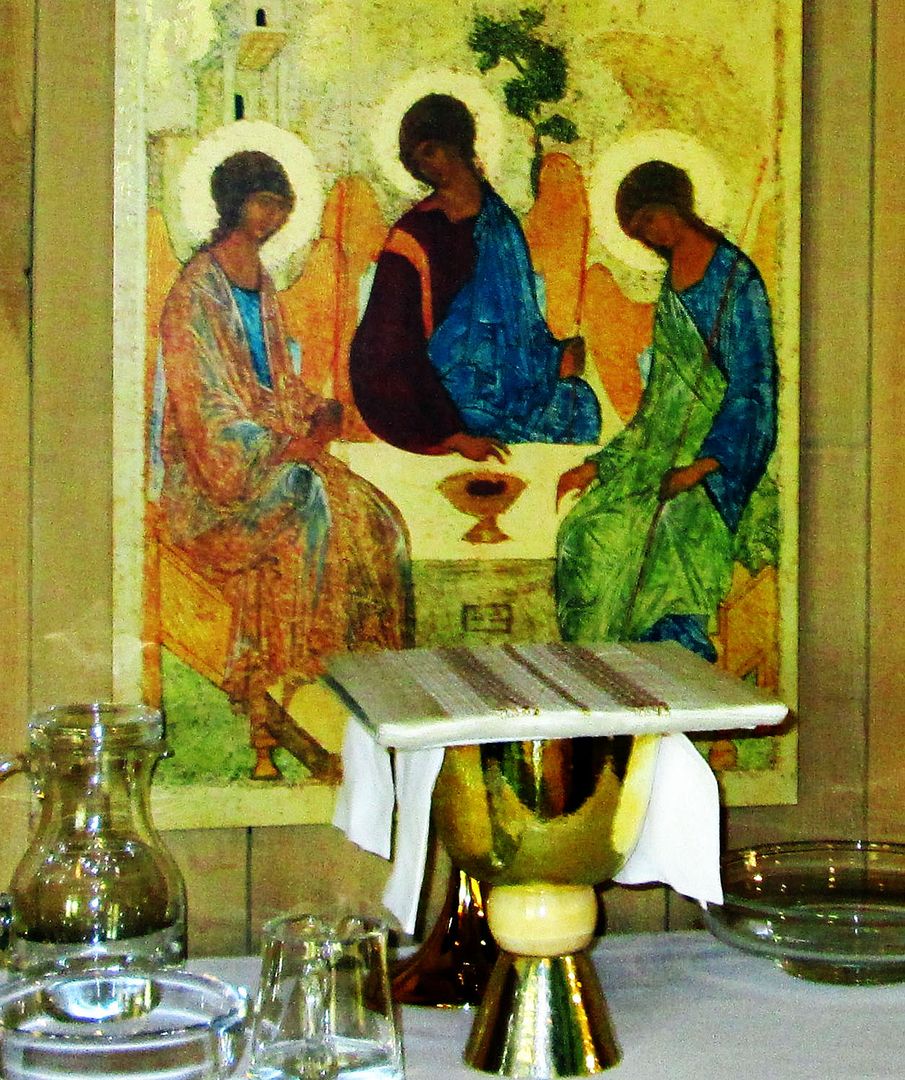
Rublev Trinity icon

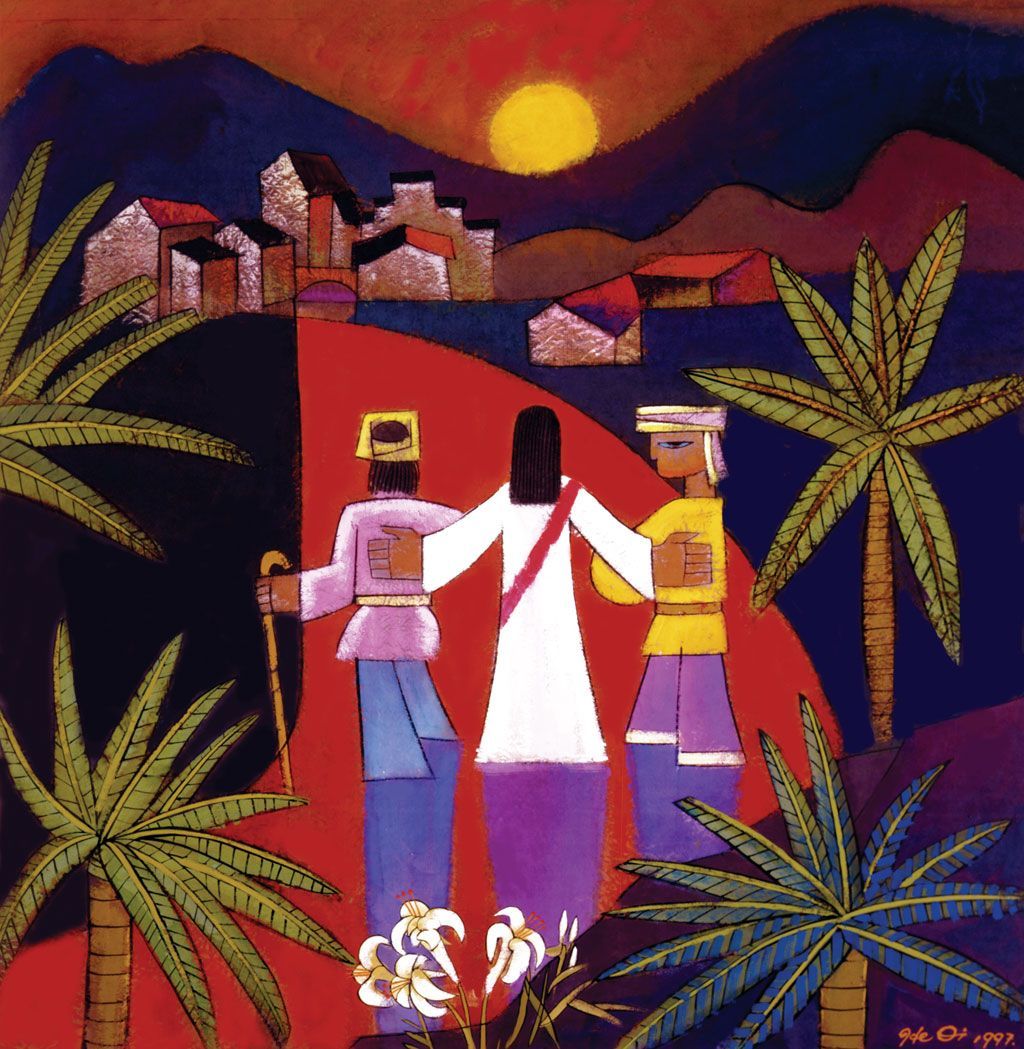
emmaus road

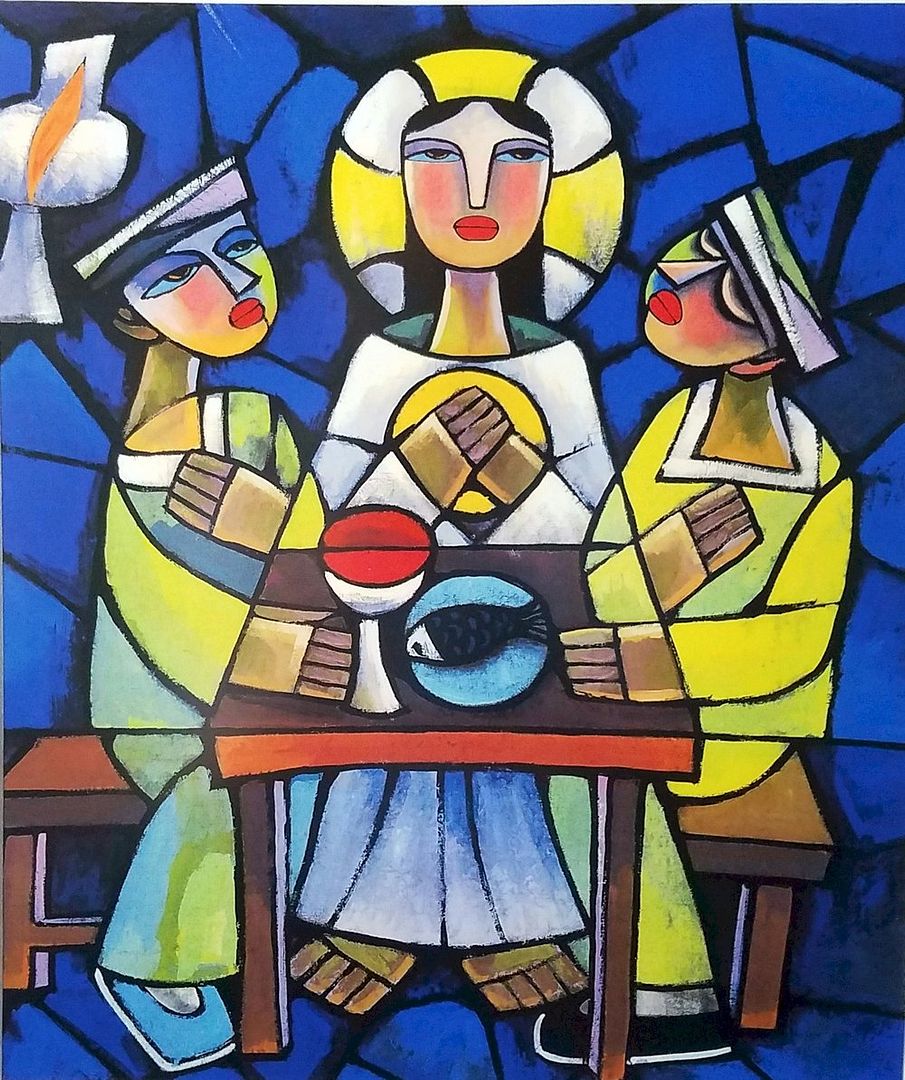
emmaus supper

• First image is The Hospitality of Abraham / Abraham's Visitors. Andrei Rublev drew this trinitarian icon of the Genesis 18:1-15 narrative of Abraham's three visitors. The side of the table closest to us is wide open—a place for each of us at God's table of grace! [A couple hours after posting: I just realized this is my own photo of "Abraham's Visitors" above the credence table at one of my Previous City / San Diego churches. I copied the code from my main blog, but didn't think to look at the entire picture.]

• Next, Emmaus Road by contemporary artist He Qi illustrates the Easter evening conversational encounter along the road from Jerusalem to Emmaus.

• You've probably noticed the third, brightly colored Supper at Emmaus painting by He Qi that moves around the church parish hall accompanied by a photo of Pastor Ittu with the artist? After the two travelers invite Jesus-as-stranger to stay with them for the evening, they meet the risen Christ as simultaneously guest and host. There, also, Jesus welcomes us with an open seat on our side of the table. Art by Rembrandt, Caravaggio, and many others depict this event.


Telling the Story

Easter is a week of weeks, a season of 50 days that fills about 1/7 of the year. This is Day 15, the third Sunday of Easter and we're stuck in a global pandemic, a virus that has affected "all the people" in some way or another. Feels more like death than life. Everything around us seems deadly.

Conversation partners Cleopas and friend had known real-life Jesus; they knew the authorities had sentenced him to death. Jesus had been crucified. Jesus was dead. They'd heard about an empty tomb, and heard rumors an empty grave might mean Jesus no longer was dead, but they hadn't experienced resurrected Jesus themselves. Like most, they'd probably imagined Israel's redeemer would bring lavish opulence of a restored Davidic monarchy, or something similarly ostentatious. So apparently this Jesus was not the promised Messiah, after all? But they "had hoped."

Cleopas and companion once "had hoped" but now despaired because it's already the third day after Jesus' death (their calendar considered a day or part of a day as an entire day, thus the third day). If Jesus of Nazareth was The Redeemer, why would he die? Where was God's promised redemption in all this?

Christianity's Easter faith is about hope. With Cleopas and friend, we've learned to live in hope despite being surrounded by death and destruction. Along with Cleopas and friend, we tend easily to give up hope, to make assumptions based on appearances. In addition, humans don't need to have achieved much chronology to realize Easter doesn't mean the end of loss, disappointment, and death.

• Luke 24:25-27
And then Jesus himself tells the story, including the part about the Messiah needing to suffer before being raised to glory...


Being the Story

Two Sundays ago the church celebrated an Easter unlike any Easter we've known. In early March, the church left the building, but not in our usual way of returning to home and work after gathering around word and sacrament, enjoying a tasty brunch, and then living as Jesus' presence wherever we ventured. The church left the building because the authorities told us to, placing countless restrictions on where and how any non-essential personnel could go. The first Sunday after the first full moon after the vernal equinox came and went. But it never felt like Easter. We didn't gather on Saturday to polish the silver, to hang white bunting from the ceiling, to arrange flowers. Those of us who don't consider it Easter without Easter Vigil and/or Easter Sunrise services (I need both, I really and truly do) didn't get those, either. It didn't feel like Easter. It still doesn't feel like Easter. We keep getting updates of county-wide and worldwide COVID-19 cases and deaths. It feels more like the empty devastation of Friday evening, of all day Saturday, as if death reigns, as if the Day of Resurrection never broke into history with the reality of new life, the death of death.

Every scriptural mention of bread, wine, or water isn't necessarily a sacrament! But every instance of creation's good gifts provides sacramental evidence of God's presence, God's abundance, God's promised future. Like travelers from Jerusalem to suburban Emmaus, we recognize Jesus our invited guest who then becomes our host when he welcomes us by taking, blessing, breaking, and giving the bread that's his body, the sustenance that becomes our lives.

Remember the eighth day we talked about for Easter Sunday? Jesus' resurrection happens on the first day of the week, a first day that's also the eighth day, the (surprise!) first day of a new creation—and it's the third day Cleopas mentions. Two thousand years later, we still live in the eighth day theology of God's redemptive re-creation of all that's been broken, discarded, decayed—everything that's no longer alive. As we continue to wait and watch through this long, long Saturday, God promises Easter will happen.


God Sightings

"God sightings! What? I thought God's presence was hidden."

• Matthew 28
7Then go quickly and tell his disciples, "He has been raised from the dead, and indeed he is going ahead of you to Galilee; there you will see him.' This is my message for you." ... 10Then Jesus said to them, "Do not be afraid; go and tell my brothers to go to Galilee; there they will see me."

• Luke 24
28As they came near the village to which they were going, he walked ahead as if he were going on.

Jesus goes ahead into places and situations before we do. Jesus will meet us when we get there? The women's testimony of the stone rolled away and the empty grave is true. Jesus will meet you when you get there; he'll already be there by the time you arrive. Yes! Jesus went to Galilee before his disciples did—they would see him there because he previously had arrived. A God-sighting?

But I thought God's presence was hidden!

Yes, it often is! Look at the Bethlehem manger. Look at the cross. Isn't Jesus' identity and presence hidden in the stranger Cleopas and friend don't immediately recognize, even though they've previously known Jesus, though they've just recently been talking about him? They (suddenly! an aha! moment God-sighting!) recognize Jesus as he takes bread, blesses it, breaks it, and gives them the bread that's his body, the bread that's basic life sustenance. Jesus, born in Bethlehem, little town of House of Bread.

Like Cleopas and friend, we've learned to recognize Jesus as the guest we invite, the guest who becomes our host when he takes, blesses, breaks, and gives us the bread that's his body, that becomes part of our lives. And then we go out and continue to trust the story, to tell the story! Death is not the end.

• Do you know this song?

I'm gonna sit at the welcome table
I'm gonna sit at the welcome table, one of these days
I'm gonna eat at the welcome table, one of these days!
I'm gonna eat at the welcome table,
I'm gonna feast on milk and honey,
I'm gonna feast on milk and honey, one of these days!

I'm going to eat at the welcome table...

Oh, yes, we did! And we will again!

Saturday, April 18, 2020

Easter 2A

John 20:19-31

19When it was evening on that day, the first day of the week, and the doors of the house where the disciples had met were locked for fear of the Jews, Jesus came and stood among them and said, "Peace be with you." 20After he said this, he showed them his hands and his side. Then the disciples rejoiced when they saw the Lord. 21Jesus said to them again, "Peace be with you. As the Father has sent me, so I send you." 22When he had said this, he breathed on them and said to them, "Receive the Holy Spirit. 23If you forgive the sins of any, they are forgiven them; if you retain the sins of any, they are retained."

24But Thomas (who was called the Twin), one of the twelve, was not with them when Jesus came. 25So the other disciples told him, "We have seen the Lord." But he said to them, "Unless I see the mark of the nails in his hands, and put my finger in the mark of the nails and my hand in his side, I will not believe."

26A week later his disciples were again in the house, and Thomas was with them. Although the doors were shut, Jesus came and stood among them and said, "Peace be with you." 27Then he said to Thomas, "Put your finger here and see my hands. Reach out your hand and put it in my side. Do not doubt but believe." 28Thomas answered him, "My Lord and my God!"

29Jesus said to him, "Have you believed because you have seen me? Blessed are those who have not seen and yet have come to believe." 30Now Jesus did many other signs in the presence of his disciples, which are not written in this book. 31But these are written so that you may come to believe that Jesus is the Messiah, the Son of God, and that through believing you may have life in his name.

COVID-19, still

With #SaferAtHome #StaySafeStayHome effective at least through mid-May, I'll keep emailing my notes on Saturdays. My blogs aren't as interesting or fluid as after our live discussion, but they're better organized. Overall? Not better, not worse—only different.


Prayer

God of resurrection hope,
The gloriously surprising season of Easter continues to weave through the devastating season of global pandemic that surprised all of us.

God of resurrection joy!
Thank you for the responders, healthcare, and other essential workers who make it possible for others to stay safe, stay home. And thank you for providing virtual ways to connect socially in spite of necessary physical distancing.

God of our future,
We know you have gone before us into the frontlines, and into the hidden places of this worldwide uncertainty. Sometimes we imagine we have chosen you, but we know you first chose us and in the power and presence of the Holy Spirit, you show us the path of life is the way of the cross and the empty tomb.

In the name of Jesus, crucified, risen, and with us always.
Amen.

cf: Psalm 16; 1 Peter 1:3-9; John 20:19-31


Easter Day and Bright Week

• Easter is 50 days—a week of weeks (7 x 7). The Day of Pentecost is the fiftieth day of Easter! This year Pentecost will be on May 31st. Where will we be then?

• The day of resurrection is the day after the Sabbath; the first day of the new week also is eighth day of the old week and the beginning of a new creation.

• Many baptismal fonts are octagonal with 8 sides to help demonstrate our baptism as a new creation Into Jesus' death and resurrection.

• Especially Orthodox churches celebrate the seven days from Easter Sunday through Easter Saturday as Bright Week, and consider the entire week a single day, the first day of the new creation.

• As we discussed for Easter Day, the new creation is not pristine, but carries scars from our old, deadly pasts. Today's reading from John shows us Jesus' scars.


The Second Sunday of Easter

Although the gospel according to John doesn't get its own lectionary year, every Sunday during the fifty days of Easter we hear a passage from John. Every Second Sunday of Easter the gospel reading is this 2-part narrative of Jesus coming to his followers through closed doors, bestowing gifts of peace, enlivening them with the Holy Spirit (along with the office of the keys or forgiveness), sending them out, and the famous incident about Thomas.

The word peace occurs 3 times in 12 verses.The peace Jesus brings is not what English language calls irenic peace, or simple absence of conflict. From Jesus we receive the fullness of shalom, a radically grounded, expansive peace that's redemption, integrity, wholeness, for all creation. However, (ironically) we get our English irenic from the Greek word the gospel-writer John uses.

The doors were locked, but even locked doors cannot prevent the risen Christ from entering a space and being with us. Closed, locked: Greek word is the same and means it's hard to get in. Just as Jesus went to find the apostles, Jesus seeks us out and finds us where we are. "Fear of the Jews?" Probably refers to those who killed Jesus, because after all, Jesus' disciples were Jewish.

After speaking peace on the assembly, Jesus breathes on them. The only other biblical occurrence of this Greek word for breathe is in a translation of Genesis 2:7 "And God formed the man (a-dam) of dust of the ground, breathed into his nostrils, and the human became a living being." Humans carry the breath, spirit, wind [words have the same root] of the Divine within them.

John 20:21 "Peace be with you. As the Father has sent me, so I send you."

• How would you react if someone entered a room despite closed or locked doors and windows? Please remember! This is Jesus' physical, bodily presence.
• What about closed, locked doors and gates? Here in the city? In rural areas? Locked churches? Closing the doors of our own lives and hearts?
• What does "peace be with you" mean in the uncertainty and high anxieties of this pandemic?
• Does "I send you" remind you of any other scriptures? ...Moses, Amos, Isaiah, Jeremiah, Jonah, Apostles, Jesus…
• Where does God send us?


Thomas

In today's reading, Jesus' disciples experience the risen Jesus twice: first on Easter evening and then one week later. (Starting with third paragraph), Jesus' disciples gather again at the same place; this time Thomas is with them. This vignette famously gets called "doubting Thomas," but many commentators point out calling him a doubter gives Thomas a bad rap. He simply wants the same experience everyone else has had.

Although in John's gospel Jesus raises Lazarus from the dead prior to his own trial and execution, because Lazarus would die again, it wasn't quite the same as Jesus' resurrection. At the time the community gathered around the beloved disciple John wrote this down, Gnostic trends and influences that denied the reality of the body were making rounds. If physical bodies weren't actually real, they wouldn't be able to actually die. Maybe Thomas doesn't question resurrection from the dead, but cannot imagine the scandal of crucifixion and death?! And burial? His disciples didn't see simply a photograph or a dream-like apparition of Jesus; his followers experienced Jesus of Nazareth in his earthly body, now resurrected.

As we discussed during Lent, theology of the cross is about God's own self-revelation, especially in Christ crucified. Thomas insisted on seeing and feeling the "marks of the nails" of crucifixion and death. Thomas needed Jesus' resurrection – and death – to become part of his own body, his senses, his entire being.

We've discussed that in John's gospel, believing and trusting means abiding (resting, taking safe repose) in Jesus. It's not reciting a creed or confession, "I believe in God…" though doctrine absolutely is important. John is the gospel of abiding presence. In a similar way, sin in John's gospel is not so much transgression of or lack of conformity to the law of God (as the Westminster Catechism describes sin), but a lack of abiding, a lack of trusting relationship with Jesus.

The Pauline epistles have a similar sense of our being "in Christ," in the apostle Paul's terminology.


Philippians 3

9and be found in him, not having a righteousness of my own that comes from the law, but one that comes through faith in Christ, the righteousness from God based on faith. 10I want to know Christ and the power of his resurrection and the sharing of his sufferings by becoming like him in his death, 11if somehow I may attain the resurrection from the dead.

From Graham Kendrick'a paraphrase of this in his song, "Knowing You":
Oh, to know the power of Your risen life,
and to know You in Your suffering,
to become like You in Your death,
My Lord, so with You to live and never die.

• How do you feel about of Thomas' needing or demanding physical evidence?
• What spiritual, physical, or natural expressions of God's presence do we find in our lives?
• What does having the Holy Spirit in your life mean for you every day?

Saturday, April 11, 2020

Holy Saturday 2020

Lamentations 3

1I am one who has seen affliction
      under the rod of God's wrath;
2he has driven and brought me
      into darkness without any light;
3against me alone he turns his hand,
      again and again, all day long.

4He has made my flesh and my skin waste away,
      and broken my bones;
5he has besieged and enveloped me
      with bitterness and tribulation;
6he has made me sit in darkness
      like the dead of long ago.

7He has walled me about so that I cannot escape;
      he has put heavy chains on me;
8though I call and cry for help,
      he shuts out my prayer;
9he has blocked my ways with hewn stones,
      he has made my paths crooked.

19The thought of my affliction and my homelessness
      is wormwood and gall!
20My soul continually thinks of it
      and is bowed down within me.
21But this I call to mind,
      and therefore I have hope:

22The steadfast love of the Lord never ceases,
      his mercies never come to an end;
23they are new every morning;
      great is your faithfulness.
24"The Lord is my portion," says my soul,
      "therefore I will hope in him."

Friday, April 10, 2020

Good Friday 2020

The second part [40-55] of the 66-chapter long book of Isaiah contains four Servant Songs; the church reads backwards and identifies the servant as Jesus Christ, though the original servant may have been the nation Israel, the writer of these words, or someone else. The lectionary schedules these during Holy Week. In these Good Friday readings you will hear music from Handel's Messiah!


• 42:1-9 Monday in Holy Week
• 49:1-7 [8-13] Tuesday in Holy Week
• 50:4-9a Wednesday in Holy Week
• 52:13-53:12 Good Friday

Isaiah 52:13-53:12

13See, my servant shall prosper; he shall be exalted and lifted up, and shall be very high. 14Just as there were many who were astonished at him —so marred was his appearance, beyond human semblance, and his form beyond that of mortals— 15so he shall startle many nations; kings shall shut their mouths because of him; for that which had not been told them they shall see, and that which they had not heard they shall contemplate.

53:1Who has believed what we have heard? And to whom has the arm of the Lord been revealed? 2For he grew up before him like a young plant, and like a root out of dry ground; he had no form or majesty that we should look at him, nothing in his appearance that we should desire him. 3He was despised and rejected by others; a man of suffering and acquainted with infirmity; and as one from whom others hide their faces he was despised, and we held him of no account. 4Surely he has borne our infirmities and carried our diseases; yet we accounted him stricken, struck down by God, and afflicted. 5But he was wounded for our transgressions, crushed for our iniquities; upon him was the punishment that made us whole, and by his bruises we are healed.

6All we like sheep have gone astray; we have all turned to our own way, and the Lord has laid on him the iniquity of us all. 7He was oppressed, and he was afflicted, yet he did not open his mouth; like a lamb that is led to the slaughter, and like a sheep that before its shearers is silent, so he did not open his mouth.

8By a perversion of justice he was taken away. Who could have imagined his future? For he was cut off from the land of the living, stricken for the transgression of my people. 9They made his grave with the wicked and his tomb with the rich, although he had done no violence, and there was no deceit in his mouth. 10Yet it was the will of the Lord to crush him with pain. When you make his life an offering for sin, he shall see his offspring, and shall prolong his days; through him the will of the Lord shall prosper.

11Out of his anguish he shall see light; he shall find satisfaction through his knowledge. The righteous one, my servant, shall make many righteous, and he shall bear their iniquities. 12Therefore I will allot him a portion with the great, and he shall divide the spoil with the strong; because he poured out himself to death, and was numbered with the transgressors; yet he bore the sin of many, and made intercession for the transgressors.

Thursday, April 09, 2020

Resurrection 2020

Matthew 28:1-10

1After the sabbath, as the first day of the week was dawning, Mary Magdalene and the other Mary went to see the tomb. 2And suddenly there was a great earthquake; for an angel of the Lord, descending from heaven, came and rolled back the stone and sat on it. 3His appearance was like lightning, and his clothing white as snow. 4For fear of him the guards shook and became like dead men. 5But the angel said to the women, "Do not be afraid; I know that you are looking for Jesus who was crucified. 6He is not here; for he has come to life again, even as he said. Come, see the place where he lay. 7Then go quickly and tell his disciples, "He has been raised from the dead, and indeed he is going ahead of you to Galilee; there you will see him.' This is my message for you."

8So they left the tomb quickly with fear and great joy, and ran to tell his disciples. 9Suddenly Jesus met them and said, "Greetings!" And they came to him, took hold of his feet, and worshiped him. 10Then Jesus said to them, "Do not be afraid; go and tell my brothers to go to Galilee; there they will see me."

Prayer

This is the feast of victory for all creation, alleluia!

Loving God of earth and heaven—God of resurrection!
We rejoice in this new day you have made and given us.

Jesus has died
Jesus has been buried
Christ has been raised from the grave...
and opened the gates of heaven, alleluia!

You have brought former things to pass
And you have made all things new, alleluia!

God of resurrection!
We know there's more to come!
Easter day is only the beginning.

Praise and glory, endlessly throughout eternity,
In the name of the crucified and risen One,
Alleluia, Amen, Alleluia!!!


COVID-19

Someone on twitter said Lent 2020 had been the Lentiest Lent they'd ever lented. Every year, slow-moving, reflective Lent segues into the Day of Resurrection, a feast so splendiferous the church celebrates it for fifty days. And...? Amidst this ongoing pandemic, the world can bear no more. We think we know "the rest of the story" because we testify to God as God of life, but – for some reason – resurrection always surprises us. Still. There's more to come! Easter day is only the beginning.


The Eighth Day

Matthew 28:2 There was a "great earthquake" at Jesus' resurrection. And Matthew 27:51 tells us there was a great earthquake when Jesus died! The Greek for earthquake is the same seismic word we relate to the earth moving underneath us and around us. What would Earthquake Lady Lucy Jones say? What do we say when life becomes unsettled? When events unsettle us? What do we do?

Matthew 28:1"After the sabbath, as the first day of the week was dawning, Mary Magdalene and the other Mary went to see the tomb..."

Jesus' resurrection happens on the first day of the week, a first day that's also the eighth day. Resurrection on day 8 stretches a week beyond its conventional boundaries to make that eighth day the (surprise!) first day of a new creation. (No little kid would reply "eight!" when we ask how many days are in a week.) Although the NT doesn't mandate a particular day or hour for Christian worship, most churches hold their main services on Sundays, or on Saturdays the vigil of Sunday, because Jesus rose on the 8th day.

Two thousand years later, we still live in the eighth day theology of God's redemptive re-creation of all that's been broken, discarded, decayed—everything that's no longer alive. As we trust God's action of re-creating and redeeming, we live in hope-filled confidence the Holy Spirit will use us to help redeem and recreate.

To be resurrected? Persons, institutions, structures, organizations, ideas, nature, all need to be dead. Jesus shows us the new creation is not pristine. The risen Jesus Christ had scars and he didn't try to hide them. Isn't that incredibly comforting? Jesus had scars in his Eastered life. Isn't that another reason to trust God's apparently impossible future?

There's more to come! Easter dawn is only the beginning.


Easter is 50 Days

Even as we live every day with eighth day hope, excitement, and newness, before long we'll celebrate the 50th day of Easter that completes a week of weeks (7 weeks of 7 days) as the day of Pentecost. Commemorating the Spirit of Resurrection filling the world, Pentecost is the third of the church's great trinitarian festivals.

But two millennia have passed since Jesus' Resurrection and since that first Pentecost recorded in the Acts of the Apostles. We look around and see hatred, poverty, and injustice. We still experience disappointments, sickness, dying, and death. Grief. Tears. We go online or turn on the TV and COVID-19 hits us hard. We know agricultural seasons of fallowness, tilling, planting, growing, and harvest cycle continuously, yet our theology tells us Easter, the historical time and place event of Jesus Christ's resurrection – that eighth day that's also the first day of the new creation – marked the end of death and dying, theoretically concluded ongoing cycles of poverty, illness, injustice.

The angel at the tomb and Jesus both tell everyone not to be afraid. They don't command or demand; they reassure us.

There's more to come! Easter morning is only the beginning.


Jesus Goes Ahead of Us

7Then go quickly and tell his disciples, "He has been raised from the dead, and indeed he is going ahead of you to Galilee; there you will see him.' This is my message for you." ... 10Then Jesus said to them, "Do not be afraid; go and tell my brothers to go to Galilee; there they will see me."

Jesus will go ahead into places and situations before you do. Jesus will meet you when you get there? He'll already be there by the time you arrive. Going before us to prepare for our presence, our ministry there? Yes!

Jesus shows us the new creation is not pristine. The risen Christ had scars and he didn't try to hide them. How about us? Does a reclaimed riverside, neighborhood, or forest show evidence of its past? Yes, but...?

Matthew 28:7 Jesus went to Galilee before his disciples did—they would see him there because he previously had arrived.

Although we need to live – and work – without fear as God's hands, feet, voice, mind, imagination, and heart, we can trust God already has been at work in the world before God leads us to a particular situation—God has been to our future! Exactly as Jesus promises, God always goes before us before leading us there. God waits for us to get there. We call this the previousness of God, of Jesus, of the Holy Spirit: of the Triune God.

There's more to come! Easter evening is only the beginning.

Maundy Thursday 2020

The Apostle Paul recorded the chronologically earliest account of Jesus' Last Supper–Eucharistic Founding Meal.

1 Corinthians 11:23-26

23For I received from the Lord what I also handed on to you, that the Lord Jesus on the night when he was betrayed took a loaf of bread, 24and when he had given thanks, he broke it and said, "This is my body that is for you. Do this in remembrance of me."

25In the same way he took the cup also, after supper, saying, "This cup is the new covenant in my blood. Do this, as often as you drink it, in remembrance of me." 26For as often as you eat this bread and drink the cup, you proclaim the Lord's death until he comes.

Every year for Maundy/Holy Thursday, the gospel reading is John 13:1-17, 31b-35. Here are some excerpts.

John 13:4-8, 14-15; 34-35

4Jesus got up from the table, took off his outer robe, and tied a towel around himself. 5Then he poured water into a basin and began to wash the disciples' feet and to wipe them with the towel that was tied around him. 6He came to Simon Peter, who said to him, "Lord, are you going to wash my feet?" 7Jesus answered, "You do not know now what I am doing, but later you will understand." 8Peter said to him, "You will never wash my feet." Jesus answered, "Unless I wash you, you have no share with me."

14"So if I, your Lord and Teacher, have washed your feet, you also ought to wash one another's feet. 15For I have set you an example, that you also should do as I have done to you."

34"I give you a new commandment, that you love one another. Just as I have loved you, you also should love one another. 35By this everyone will know that you are my disciples, if you have love for one another."

love one another – Paul G. Hammer

Jesus, how common can you get? Foot washing, bread, wine!
If you're going to be religious, at least use something special.
No, my friend, I came not to perform special religious rites
But to touch the daily life of everyone
With God's love in the commonest of things.

O.K., water, bread, wine.
But isn't foot washing a bit ridiculous?
And what about "this is my body"?
And "this cup is the new covenant in my blood"?

Foot washing is the work of the commonest servant—I came to serve.
But it points beyond to the "washing" of the cross—
God's self-giving service in me to cleanse away estrangement
And heal the distortions in people's lives.

The bread points to nourishment in that same self-giving of God
At work in my body, that is in me.
And the cup points to the new community drawn together and nourished
In my blood, that is in God's total self-giving in my death.

Do you mean that this common stuff of water, bread and wine
Becomes in you the very focus of God's love for me and for the world?
That there is no excuse for my not loving my common neighbor?
Because you have shown the depth of God's love for me?

You've got it!
But it isn't a love for special occasions.
It has to be that daily love that's as common as water, bread and wine!

Wednesday, April 08, 2020

Wednesday in Holy Week

The second part [40-55] of the 66-chapter long book of Isaiah contains four Servant Songs; the church reads backwards and identifies the servant as Jesus Christ, though the original servant may have been the nation Israel, the writer of these words, or someone else. The lectionary schedules these during Holy Week.

• 42:1-9 Monday in Holy Week
• 49:1-7 [8-13] Tuesday in Holy Week
• 50:4-9a Wednesday in Holy Week
• 52:13-53:12 Good Friday

4The Lord God has given me
      the tongue of a teacher,
that I may know how to sustain
      the weary with a word.
Morning by morning he wakens—
      wakens my ear
      to listen as those who are taught.
5The Lord God has opened my ear,
      and I was not rebellious,
      I did not turn backward.
6I gave my back to those who struck me,
      and my cheeks to those who pulled out the beard;
I did not hide my face
      from insult and spitting.

7The Lord God helps me;
      therefore I have not been disgraced;
therefore I have set my face like flint,
      and I know that I shall not be put to shame;
8he who vindicates me is near.
Who will contend with me?
      Let us stand up together.
Who are my adversaries?
      Let them confront me.
9It is the Lord God who helps me;
      who will declare me guilty?

Tuesday, April 07, 2020

Tuesday in Holy Week

The second part [40-55] of the 66-chapter long book of Isaiah contains four Servant Songs; the church reads backwards and identifies the servant as Jesus Christ, though the original servant may have been the nation Israel, the writer of these words, or someone else. The lectionary schedules these during Holy Week.

• 42:1-9 Monday in Holy Week
• 49:1-7 [8-13] Tuesday in Holy Week
• 50:4-9a Wednesday in Holy Week
• 52:13-53:12 Good Friday

Isaiah 49:1-7

1Listen to me, O coastlands,
      pay attention, you peoples from far away!
The Lord called me before I was born,
      while I was in my mother's womb he named me.
2He made my mouth like a sharp sword,
      in the shadow of his hand he hid me;
he made me a polished arrow,
      in his quiver he hid me away.
3And he said to me, "You are my servant,
      Israel, in whom I will be glorified."
4But I said, "I have labored in vain,
      I have spent my strength for nothing and vanity;
yet surely my cause is with the Lord,
      and my reward with my God."

5And now the Lord says,
      who formed me in the womb to be his servant,
to bring Jacob back to him,
      and that Israel might be gathered to him,
for I am honored in the sight of the Lord,
      and my God has become my strength—
6he says,
"It is too light a thing that you should be my servant
      to raise up the tribes of Jacob
      and to restore the survivors of Israel;
I will give you as a light to the nations,
      that my salvation may reach to the end of the earth."

7Thus says the Lord,
      the Redeemer of Israel and his Holy One,
to one deeply despised, abhorred by the nations,
      the slave of rulers,
"Kings shall see and stand up,
      princes, and they shall prostrate themselves,
because of the Lord, who is faithful,
      the Holy One of Israel, who has chosen you."

Monday, April 06, 2020

Monday in Holy Week

The second part [40-55] of the 66-chapter long book of Isaiah contains four Servant Songs; the church reads backwards and identifies the servant as Jesus Christ, though the original servant may have been the nation Israel, the writer of these words, or someone else. The lectionary schedules these during Holy Week.

• 42:1-9 Monday in Holy Week
• 49:1-7 [8-13] Tuesday in Holy Week
• 50:4-9a Wednesday in Holy Week
• 52:13-53:12 Good Friday

Isaiah 42:1-9

1Here is my servant, whom I uphold,
      my chosen, in whom my soul delights;
I have put my spirit upon him;
      he will bring forth justice to the nations.
2He will not cry or lift up his voice,
      or make it heard in the street;
3a bruised reed he will not break,
      and a dimly burning wick he will not quench;
      he will faithfully bring forth justice.
4He will not grow faint or be crushed
      until he has established justice in the earth;
      and the coastlands wait for his teaching.

5Thus says God, the Lord,
      who created the heavens and stretched them out,
      who spread out the earth and what comes from it,
who gives breath to the people upon it
      and spirit to those who walk in it:

6I am the Lord, I have called you in righteousness,
      I have taken you by the hand and kept you;
I have given you as a covenant to the people,
      a light to the nations,
7to open the eyes that are blind,
      to bring out the prisoners from the dungeon,
      from the prison those who sit in darkness.

8I am the Lord, that is my name;
      my glory I give to no other,
      nor my praise to idols.
9See, the former things have come to pass,
      and new things I now declare;
before they spring forth,
      I tell you of them.

Saturday, April 04, 2020

Lent 6A

Philippians 2:5-11

5Let the same mind be in you that was in Christ Jesus, 6who, [though he was] in the form of God, did not regard equality with God as something to be exploited, 7but emptied himself, taking the form of a slave, being born in human likeness. And being found in human form, 8he humbled himself and became obedient to the point of death— even death on a cross. 9Therefore God also highly exalted him and gave him the name that is above every name, 10so that at the name of Jesus every knee should bend, in heaven and on earth and under the earth, 11and every tongue should confess that Jesus Christ is Lord, to the glory of God the Father. NRSV

5-8Think of yourselves the way Christ Jesus thought of himself. He had equal status with God but didn’t think so much of himself that he had to cling to the advantages of that status no matter what. Not at all. When the time came, he set aside the privileges of deity and took on the status of a slave, became human! Having become human, he stayed human. It was an incredibly humbling process. He didn’t claim special privileges. Instead, he lived a selfless, obedient life and then died a selfless, obedient death—and the worst kind of death at that—a crucifixion.

9-11Because of that obedience, God lifted him high and honored him far beyond anyone or anything, ever, so that all created beings in heaven and on earth—even those long ago dead and buried—will bow in worship before this Jesus Christ, and call out in praise that he is the Master of all, to the glorious honor of God the Father. MSG

COVID-19 Lockdown

With #SaferAtHome #StaySafeStayHome effective at least through April, I'll keep blogging and emailing my SS class notes to people who previously requested them (and easily can add to my mailing list).

Prayer

cf: Psalm 31:9-16 – Matthew 21:1-17 – Matthew 27:11-26

God of Good Friday, God of Easter Sunday
You've been with us during this surprising Lent
Today we join the excited Palm Sunday crowd
Will we join the crowd demanding crucify?
Will we be silent?

Our intentions and our actions have taken us all of those places
We have been sometimes faithful
      Sometimes not
We have celebrated Jesus our Savior
      And denied Jesus any place

God of Good Friday, God of Easter Sunday
You have been gracious to us
Let us be gracious to you!
Awaken our ears to the cries of this planet
These times are in your hands
Your earth is in your hands

Lover of creation in Christ Jesus
Save us in your steadfast love
Bring us to the surprise of Resurrection
      with new spirits, new hearts
      and the hope of a new earth!

In the name of the One crucified and risen for the life of the world,
Jesus Christ, our Redeemer and Lord,
Amen!


Lent

The season of Lent that leads us to Easter has been different lengths at different times. Churches that follow the lectionary for their scripture readings generally observe Lent during the 40 days – excluding Sundays – from Ash Wednesday through Wednesday in Holy Week.


Triduum / Three Days

The Service(s) of Maundy Thursday – Good Friday – Easter form a single liturgy. One of my favorite activities is creating a resurrection trilogy by attending Saturday evening Easter Vigil, Sunday Sunrise, and mid-to-later morning Sunday services. This year no one will be able to do that.


Palm-Passion Sunday

On the last Sunday in but not of Lent, many churches start worship by reenacting Jesus' triumphal entry into Jerusalem (with palms or locally grown green branches), and continue to his arraignment, trial, conviction, crucifixion, and death. The gospels of Mark and Matthew tell us when Jesus died the temple curtain tore from from top to bottom, symbolizing the reality of the reconciliation of heaven and earth. The word for tore is one that can't be mended; in Matthew, the earth shook, rocks split open. All creation responded!


Philippi and Philippians

Philippi was a long-time Roman colony, so like the apostle Paul himself, the people Paul addressed in this letter were Roman citizens, yet still colonials. They received a lot of freedom and privilege in return for loyalty to the empire; with their immense cultural pride and financial affluence, they would have considered humility degrading.

First Church Philippi may have serendipitously started the way Acts 16 tells the story:

Paul and his ministry sidekick Timothy went to Philippi in Macedonia, then down to the river on the sabbath hoping to find an ad hoc synagogue, because if there was no local synagogue, Jews would gather at the river to form a minyan or at least to pray together. They found Purveyor of Purple Cloth Lydia by the riverbank, and eventually baptized Lydia and her entire family. Anti-imperial heavenly citizenship begins with baptism; the HS of God creates the church out of the assembly of the baptized! So Paul was founding pastor and probably a kind of mission developer. Philippi was the first church on European soil.

Paul wrote this captivity (imprisonment) letter either from Ephesus around 52-56, or more probably from Rome around 61-62. Captivity letter? Philippians has been called the Epistle of Joy and reveals Paul captured by and captive to Jesus Christ.


Empire / Baptism

In Philippians 1:27 Paul tells the Philippian Christians to live out their baptism via their public, political lives "in a manner worthy of the gospel" as witnesses to Jesus' death and resurrection—not to Rome's or any other entity's life-negating death-dealing imperialism. Paul reminds them wherever they are, their real citizenship is in the earthbound reality of God's reign of heaven on this planet. Anti-imperial heavenly citizenship begins with baptism!


gods and God

In the Ancient Near East (ANE), gods were an ordinary part of daily life. Every city, town, and village, (almost every random mound of dirt) had its own deity. People imagined those gods demanded tribute in the form of money, food, shrines, sacrifices—human or animal ones at worst. People pictured gods being full of vanity and pretension. Aside from deities of place and function, you might find yourself interacting with a half-mortal, half-divine being who was offspring of a human and of a god. In Jesus Christ, we have a savior, a redeemer who is fully human and completely divine. Nothing halfway about him!

In The Message translation of this passage from Philippians, Pastor Eugene Peterson says Jesus "set aside the privileges of deity and took on the status of a slave, became human! Having become human, he stayed human." Those divine privileges would have been ones the fake gods people invented would claim. They were not attitudes or actions the God of the bible ever would have assumed. In other words, being in the image of the real God of Earth and Heaven, Jesus took on the real attributes of that God including love, mercy, service, grace, and forgiveness. In addition, being a real human and like us, inevitably subject to death, Jesus died.

In contrast to human ideas about divinity, the God of the bible especially self-reveals in the cross, in Jesus of Nazareth's crucifixion—and resurrection.


Theology of the Cross

• Theology of the cross is about God's own self-revelation, especially in Christ crucified. Theology of the cross is about God's frequently hidden, paradoxical both/and presence in the commonest things, people, and situations.

• Theology of glory is about human ideas and imaginings of how a powerful, all-knowing, sovereign God might act. Taking this further, theology of glory sometimes is about the ways humans wish God would behave? Varieties and variations of the prosperity gospel are theologies of glory.

• Martin Luther reminds us to see the fullness of God's power and sovereignty, look to the Bethlehem manger – look to the Calvary cross.

• Martin Luther, "The God who became small for us in Christ" ... small enough to die.


Philippians 2:5-11

Almost forever scholars have imagined Paul quoted a hymn from another source, but Gordon Fee, professor emeritus at Regent College, Vancouver says:

If it was originally a hymn of some kind, it contains nothing at all of the nature of Greek hymnody or poetry. Therefore, it must be Semitic in origin. But ... It lacks the rhythm and parallelism one might expect of material that is to be sung. And in any case, it fits very poorly with the clearly hymnic material in the Psalter or in Luke 1:46-55, 68-79, or in 1 Timothy 3:16b, to name but a few clear NT examples of hymns.

In any case, it's not an original by Paul but probably had been circulating around Christian circles. It now has become an "early Christian song."

Saturday, March 28, 2020

Lent 5A

Ezekiel 37:1-14

1The hand of the Lord came upon me, and he brought me out by the spirit of the Lord and set me down in the middle of a valley; it was full of bones. 2He led me all around them; there were very many lying in the valley, and they were very dry. 3He said to me, "Mortal, can these bones live?" I answered, "O Lord God, you know." 4Then he said to me, "Prophesy to these bones, and say to them: O dry bones, hear the word of the Lord. 5Thus says the Lord God to these bones: I will cause breath to enter you, and you shall live. 6I will lay sinews on you, and will cause flesh to come upon you, and cover you with skin, and put breath in you, and you shall live; and you shall know that I am the Lord."

7So I prophesied as I had been commanded; and as I prophesied, suddenly there was a noise, a rattling, and the bones came together, bone to its bone. 8I looked, and there were sinews on them, and flesh had come upon them, and skin had covered them; but there was no breath in them. 9Then he said to me, "Prophesy to the breath, prophesy, mortal, and say to the breath: Thus says the Lord God: Come from the four winds, O breath, and breathe upon these slain, that they may live." 10I prophesied as he commanded me, and the breath came into them, and they lived, and stood on their feet, a vast multitude.

11Then he said to me, "Mortal, these bones are the whole house of Israel. They say, "Our bones are dried up, and our hope is lost; we are cut off completely.' 12Therefore prophesy, and say to them, Thus says the Lord God: I am going to open your graves, and bring you up from your graves, O my people; and I will bring you back to the land of Israel. 13And you shall know that I am the Lord, when I open your graves, and bring you up from your graves, O my people. 14I will put my spirit within you, and you shall live, and I will place you on your own soil; then you shall know that I, the Lord, have spoken and will act, says the Lord."

Prayer

From all the corners of the earth, come to us, Spirit of God! Breathing Life of the Divine, descend upon your people and on your land and let us live again! In the Name of the One Spirit-sent to carry new life to the entire world, Christ Jesus, your Son and our Lord, Amen!


The Fifth Sunday in Lent

This has become a strange Lent (understatement). Lent comes from an Old English word for spring, and conveys a similar sense as the music tempo Lento. During this season of lengthening days, we've journeyed to the fifth Sunday in – but not of Lent – because every Sunday celebrates Easter. Next Sunday in church we would have been having(!) a dual observance of Jesus' Triumphant Entry (surrounded by palms and cheering crowds) into Jerusalem, followed by a reading of the Passion Narrative. Los Angeles County originally banned public gatherings through Sunday 19th April, so we definitely won't be together in person for Easter Sunday or for the second Sunday of Easter. However, every moment is Easter and the season of Jesus' resurrection is fifty days long, so hopefully we'll be back on the church campus during the Great Fifty Days.


Prophet / Seer

Sometimes we casually refer to foretelling future happenings as prophecy, but the OT differentiates between seer or visionary (roeh), who peers into the future, and prophet (nabi), who speaks truth to power.

Hebrew scripture uses at least three Hebrew words that translate into the Greek-derived English "prophet" that implies challenging the religious, political, or any establishment. Hospitals? Denominational headquarters? Libraries? County and city administrations? Nabi may be rooted in a word that means to pour down, or spring forth, so imagine the prophetic word as a stream that flows everywhere it goes. Besides roeh and nabi, Hebrew also has hozeh, with a similar feel to nabi.

Like Jeremiah and the 66 chapters of Isaiah, Ezekiel is very much within the classical tradition of Hebrew/Israelite prophecy that brings Spirit-breathed Words from heaven to earth. All three books belong to the writing prophets whose actual words got inscribed on scrolls—contrasted with former prophets whose actions we find in books like Joshua, Kings, Chronicles...


Ezekiel

Like 1st Isaiah (1-39) and like Jeremiah we've heard so much from, Ezekiel prophesied during the last days of Jerusalem before the Babylonian exile; along with Jeremiah and with the prophet we identity as 2nd Isaiah (40-55), Ezekiel also proclaimed the word of God into the exile.

Babylonian invasion of Jerusalem resulted in starvation, disease, and despair. Ezekiel probably began his ministry in 592 BCE; he went to Babylon in 597 BCE in the first wave of exiles. For the next decade, Ezekiel preached sorrow and desperation to the Judeans (Ezekiel 1-24), and to the surrounding nations (Ezekiel 25-32). Ten years later, in 587/6 BCE after Babylonians destroyed Jerusalem and the temple, they deported a second round of Judeans (including the king) to Babylon, and the monarchy ended. For the exiles, being cut off from the J-Temple meant being as good as dead. After news of the destruction of Jerusalem and the temple reached Babylon, Ezekiel began to prophesy hope, revitalization, and restoration (Ezekiel 33-48).

Their world had come to an end. Not too different from our current situation. They wondered if the Babylonian gods had defeated their God. Or had God deserted them? [Consider the theology that literally located God's presence in a special way in the J-Temple.] How about us? Have illness, disease, climate warning, various inept administrations defeated God? Did God abandon us?

With its vivid imagery of new life, today's Ezekiel reading for Lent 5 comes from the time Ezekiel's proclamation shifted from sorrow to hope. Just as we do every year, we're moving toward Jerusalem and toward Jesus' trial, conviction, crucifixion, death—and resurrection! Unlike any year we've known, on this Sunday two weeks before Easter, Ezekiel brings words of hope for our current situation with this global pandemic.


Resurrection

The Revised Common Lectionary (RCL) that provides our scripture readings pairs this famous Ezekiel dry bones passage with Jesus reviving dead Lazarus from John 11:1-45. Throughout the bible, we find countless hints or "types" of resurrection from death that foreshadow Jesus' own resurrection.

All of us everywhere have been exiled from our conventional lives; not yet having an acceptable "new normal," we particularly need resurrection for each of us as individuals, for our communities, and for our structures and institutions. We need to trust the reality of new life despite the reality of death! During this worldwide pandemic, we need to hear, we need to speak God's proclamation that assures us of resurrection from the dead, the word that brings a future.

Only God can perform resurrection; people and organizations will rise up out of their deaths when the Spirit of God restores them. However, in this passage we see how actions of the "Mortal" Ezekiel, (human one in many versions) help God's promise happen.

Divine initiative and human response interweave throughout this text. God leads Ezekiel to the valley, directs his attention and inspires his words. Ezekiel obeys and speaks God's word. As a result (with no help from the bones themselves—what could the dead do?), God gathers them together and breathes life into them. God loves digging up graves and calling forth new life!

Verses 11-14 place this passage in historical context of Israeli land and Israelite people. However, this text is renowned for applying to almost everyone everywhere in a multitude of circumstances. How about us, "mortal human ones" obeying God's command so God's promise of new life out of death's dry bones will come true?

The Word of God with the Spirit of God results in new life! This passage says prophesy/nabi 6 times; spirit/ruach 9 times. In verses 4 and 14, dabar is the word for God's word-action. In your studies you may have learned dabar is simultaneously both speech and action, just as in Hebrew, listen is both hearing and obeying.

We're in an unusual overall, literally deadly situation as we move closer to Easter; how does the story of Ezekiel in the valley of dead bones begin preparing us for the surprise of resurrection?

Cornel West: "We are people of hope. Why do we party on Friday night? Why do we go to church on Sunday?"

This Story Continues

You know the next chapter of the story of Judah and Benjamin: after the seventy-year long exile in Babylon (at the end of which Persia defeated Babylon), the Persian king gave the scribe Ezra permission to return to Palestine to re-establish Yahweh worship, and also to find officers to administer the land. After he arrived back in the land that included the city of Jerusalem, Ezra began that process.

Saturday, March 21, 2020

Lent 4A

Psalm 23

1The Lord is my shepherd, I shall not want.
2He makes me lie down in green pastures; he leads me beside still waters;
3he restores my soul. He leads me in right paths for his name's sake.
4Even though I walk through the darkest valley, I fear no evil; for you are with me; your rod and your staff— they comfort me.
5You prepare a table before me in the presence of my enemies; you anoint my head with oil; my cup overflows.
6Surely goodness and mercy shall follow me all the days of my life,
and I shall dwell in the house of the Lord my whole life long.

NRSV

Psalm 23

1-3God, my shepherd!
I don't need a thing.
You have bedded me down in lush meadows,
you find me quiet pools to drink from.
True to your word,
you let me catch my breath
and send me in the right direction.

4Even when the way goes through Death Valley,
I'm not afraid
when you walk at my side.
Your trusty shepherd's crook
makes me feel secure.

5You serve me a six-course dinner
right in front of my enemies.
You revive my drooping head;
my cup brims with blessing.

6Your beauty and love chase after me
every day of my life.
I'm back home in the house of God
for the rest of my life.

The Message (MSG) Copyright © 1993, 2002, 2018 by Eugene H. Peterson

COVID-19 – almost the same as last week

To maintain a sense of normalcy during the ongoing Corona Virus global pandemic with its social isolation and uncertainties, I'll keep blogging my SS class notes to send to my usuals. Typically I do that Monday or Tuesday after our discussion so I can include ideas from others – or myself – that weren't in my original notes, so I can add interesting details I didn't get to share with the group, so I even can omit anything that feels semi-irrelevant this time around.

The church's year of grace has reached the fourth Sunday in (but not of) Lent. Not belonging to Lent? Because every Sunday is a little Easter. This midway point has several traditional names and practices. In the North American church, Laetare – or "Rejoice" – probably is the best known. Each Sunday in Advent and Lent has a designation taken from the opening of the Latin Introit or entrance prayer: "Laetare Jerusalem" ("Rejoice, Jerusalem") comes from Isaiah 66:10. Similar to the Third Sunday of Advent, Gaudete (that also means rejoice, be glad), the idea is to take a short break to lighten up before the somber season continues. As Steve V told us last year, Lent 4 is Mother's Day in the UK.


Fun One this time – Theological Comfort Food!

"The Lord is my Shepherd"—Psalm 23! Easter 4 is Good Shepherd Sunday every year; during our current Revised Common Lectionary Year A, Lent 4 is a good shepherd day, too. Besides translations and versions of the biblical text, there are countless paraphrases of Psalm 23. "The Lord is like my Probation Officer..." Did one-time shepherd King David write this psalm? That's unknown, but any sheep-tender would have known the words and imagery well.

The psalms or the psalter is the hymnal of the synagogue. The psalter was the hymnbook for John Calvin's Geneva Reform. The psalms probably are the Old Testament book most Christians know best. As we've mentioned, technically each week's psalm is our (ideally sung) response to the first reading that's generally OT, but during the Great 50 days of Easter it's from the Acts of the Apostles.

Many scriptural narratives originated in an agricultural setting.

• Abram/Abraham left Ur in Chaldea because of the land God promised: "Now the Lord said to Abram, 'Go from your country and your kindred and your father's house to the land that I will show you.'" Genesis 12:1
• God commanded Moses, "Go up to a land flowing with milk and honey..." Exodus 33:3a Milk and honey is a sign of the fullness of God's reign in justice and righteousness for all creation
• In the gospel of John, Jesus announces, "I am the Good Shepherd. I know my own and my own know me." John 10:14
• ...but Jesus of Nazareth lived and ministered in a mostly urban, completely colonial context. A well-tended garden or field grows into a city.
• Land is central in both OT and NT; land is central to our existence—well-stewarded land is necessary for our individual and corporate well-being.

We call our church leaders pastor, the Latin word for shepherd. The senior pastor I used to serve with told me whenever he thought of that congregation's founding pastor, he always remembered "pastoral" means "rural." Although green pastures and dark valleys are countrified imagery, we can translate those meadows and canyons into our recent or current psychological and physical realities; sometimes into wonderfully green fields and disappointingly devastated neighborhoods.

Most hymnals have three or four musical settings of Psalm 23. What one do you especially like? My all-time favorite uses the tune Resignation from Southern Harmony; I especially love Randall Thomson's choral arrangement. By the way, I no longer blog YouTube links because videos come and leave YT with the speed of lightning.

How would you express the ideas in this psalm for your current life?

What's in your 6-course dinner?

Please be well and stay well! Stay tuned for Lent 5!

Saturday, March 14, 2020

Lent 3A

John 4:5-42

5So Jesus came to a Samaritan city called Sychar, near the plot of ground that Jacob had given to his son Joseph. 6Jacob's well was there, and Jesus, tired out by his journey, was sitting by the well. It was about noon. 7A Samaritan woman came to draw water,

and Jesus said to her, "Give me a drink." 8(His disciples had gone to the city to buy food.) 9The Samaritan woman said to him, "How is it that you, a Jew, ask a drink of me, a woman of Samaria?" (Jews do not share things in common with Samaritans.) 10Jesus answered her, "If you knew the gift of God, and who it is that is saying to you, "Give me a drink,' you would have asked him, and he would have given you living water." 11The woman said to him, "Sir, you have no bucket, and the well is deep. Where do you get that living water? 12Are you greater than our ancestor Jacob, who gave us the well, and with his sons and his flocks drank from it?"

13Jesus said to her, "Everyone who drinks of this water will be thirsty again, 14but those who drink of the water that I will give them will never be thirsty. The water that I will give will become in them a spring of water gushing up to eternal life." 15The woman said to him, "Sir, give me this water, so that I may never be thirsty or have to keep coming here to draw water." 16Jesus said to her, "Go, call your husband, and come back." 17The woman answered him, "I have no husband." Jesus said to her, "You are right in saying, "I have no husband'; 18for you have had five husbands, and the one you have now is not your husband. What you have said is true!"

19The woman said to him, "Sir, I see that you are a prophet. 20Our ancestors worshiped on this mountain, but you say that the place where people must worship is in Jerusalem."

21Jesus said to her, "Woman, believe me, the hour is coming when you will worship the Father neither on this mountain nor in Jerusalem. 22You worship what you do not know; we worship what we know, for salvation is from the Jews. 23But the hour is coming, and is now here, when the true worshipers will worship the Father in spirit and truth, for the Father seeks such as these to worship him. 24God is spirit, and those who worship him must worship in spirit and truth."

25The woman said to him, "I know that Messiah is coming" (who is called Christ). "When he comes, he will proclaim all things to us."
26Jesus said to her, "I am he, the one who is speaking to you."

27Just then his disciples came. They were astonished that he was speaking with a woman, but no one said, "What do you want?" or, "Why are you speaking with her?" 28Then the woman left her water jar and went back to the city. She said to the people, 29"Come and see a man who told me everything I have ever done! He cannot be the Messiah, can he?"

30They left the city and were on their way to him.

31Meanwhile the disciples were urging him, "Rabbi, eat something." 32But he said to them, "I have food to eat that you do not know about." 33So the disciples said to one another, "Surely no one has brought him something to eat?"

34Jesus said to them, "My food is to do the will of him who sent me and to complete his work. 35Do you not say, "Four months more, then comes the harvest'? But I tell you, look around you, and see how the fields are ripe for harvesting. 36The reaper is already receiving wages and is gathering fruit for eternal life, so that sower and reaper may rejoice together. 37For here the saying holds true, "One sows and another reaps.' 38I sent you to reap that for which you did not labor. Others have labored, and you have entered into their labor."

39Many Samaritans from that city believed in him because of the woman's testimony, "He told me everything I have ever done."

40So when the Samaritans came to him, they asked him to stay with them; and he stayed there two days. 41And many more believed because of his word.

42They said to the woman, "It is no longer because of what you said that we believe, for we have heard for ourselves, and we know that this is truly the Savior of the world."

COVID-19

To maintain a sense of normalcy during the current Corona Virus global pandemic, I'm blogging my SS class notes to send to my usuals. Typically I do that Monday or Tuesday after our discussion so I can include ideas from others – or myself – that weren't in my original notes, so I can add interesting details I didn't get to share with the group, so I even can omit anything that feels semi-irrelevant this time around.

Gospels Review

During most of this year of grace, from Advent through Reign of Christ, we'll hear from Matthew's gospel, but today we take an excursion for a story that's only in John and not in any of the synoptics. As we've learned, synoptic gospels Matthew, Mark, and Luke view Jesus' life and ministry in a similar way: syn=coming together (synagogue, synthesis, synod, synopsis, etc.) + optic=about the eye (optician, optometrist, optimism, etc.). I often refer to John as the "rogue, outlier gospel that almost didn't make the canonical cut." Canon refers to a kind of gold standard or measurement.

John is the latest of the four gospels, most likely written down by a community gathered around John the Beloved Disciple, who probably was the youngest of the 12/13; tradition says John is the one without facial hair in Leonardo's Last Supper painting. The gospel according to John probably brings us the most realized eschatology—the right here and right now of the reign of heaven on earth.

Besides other unique literary material along with a few narratives common to all four gospel writers, John draws upon at least two written sources: Signs and I Am. The "I am" of verse 26 is the “I AM” of the sacred name of God revealed to Moses at the burning bush (Exodus 3:14) and the first instance of I Am in John.

Jesus and the Samaritan Woman at Jacob's Well

This encounter between Jesus and the unnamed woman demonstrates and embodies John 3:16, "God so loved [the entire] world," not solely one particular group. Jesus and the woman both know all the cultural, historical, and religious reasons they should not have anything to do with each other. Gender, ethnicity, cultural conditions, and religion all come together to forbid it; as John 4:9 informs us, "Jews do not share things in common with Samaritans." Pastor Eugene Peterson's The Message reads, "Jews in those days wouldn't be caught dead talking to Samaritans." We know the cultural and social status of Samaritans in the Jewish world from Luke's parable of the Good Samaritan. From the perspective of most Jews, a "good Samaritan" would be a contradiction.

This incident happens during the midday desert heat, when the area probably would be isolated. Water is essential; water is life. The village well was a community gathering place where people went from necessity; a place where they well may have exchanged gossip and scuttlebutt.

For starters, this Samaritan woman is not a prostitute or a hooker or a harlot, not a street walker, a whore or a "lady of the night." She doesn't have a shady past. Jesus does not call her to repentance. We don't have the rest of her story, but she could be living with someone she had to depend on; she may have been in a succession of levirate marriages with a series of brothers after her first spouse died. In those situations, the woman was not always technically considered the brother's wife.

Although Jews and Samaritans shared the same founding history, they didn't share anything else. However, Jesus and the Samaritan woman meet at Jacob's well, a geographical icon of their common heritage. The woman claims kinship when she says to Jesus, "...our ancestor Jacob, who gave us this well, and with his sons and his flocks drank from it."

• Scripture often uses water as a code word and symbol for the Spirit of God flowing out toward us, with God choosing and embracing us first.

• In 4:6 Greek "well of Jacob," is Jacob's spring –  a live spring fed the well with fresh running water.

• John 4:7 "Will you give me a drink?" Jesus didn't ask the Samaritan woman a literal question or directly command her; it was more of a rhetorical question, a polite exchange that recognized the other.

• 4:19 "I see you are a prophet" confesses trust in Jesus; John's gospel connects seeing or vision with faith, with believing. This outsider Samaritan woman is the first witness in John.

• 3:23-24 worshiping God in spirit and truth does away with the idea of a fixed, physical, institutional temple or other gated zone that might exclude individuals based on gender, ethnicity, or behavior. "Truth" here isn't about verifiable data or facts, but about a wide and broad sense of purpose and direction.

• 4:26 Jesus said to her, "I am [he], the one who is speaking to you." Jesus makes this first I Am statement in John not to insiders, but to an outsider: God so loved the world (including God's primal people Israel, of course).

• 4:28 Then the woman left her water jar and went back to the city." Jesus never received the water he asked for, and the woman even leaves her water jar behind!

• John 4:29, "He cannot be the Messiah, can he?" carries the same rhetorical tone as Jesus' asking for a drink of water.

• 4:42 Only instance of the word Savior in John's gospel

• This year on the Day of Pentecost we'll hear a direct and highly resonant connection with today's gospel narrative:
John 7

37On the last day of the Feast of Tabernacles, the great day, while Jesus was standing there, he cried out, "Let anyone who is thirsty come to me, 38and let the one who believes in me drink. As the scripture has said, 'Out of the believer’s heart shall flow rivers of living water.'" 29Now he said this about the Spirit, which believers in him were to receive; for as yet there was no Spirit, because Jesus was not yet glorified.

Stay tuned! Stay safe!