Saturday, February 19, 2022

Epiphany 7C

Genesis 45:1-15

1Then Joseph could no longer control himself before all those who stood by him, and he cried out, "Send everyone away from me." So no one stayed with him when Joseph made himself known to his brothers. 2And he wept so loudly that the Egyptians heard it, and the household of Pharaoh heard it.

3Joseph said to his brothers, "I am Joseph. Is my father still alive?" But his brothers could not answer him, so dismayed were they at his presence.

4Then Joseph said to his brothers, "Come closer to me." And they came closer. He said, "I am your brother, Joseph, whom you sold into Egypt. 5And now do not be distressed, or angry with yourselves, because you sold me here; for God sent me before you to preserve life. 6For the famine has been in the land these two years; and there are five more years in which there will be neither plowing nor harvest. 7God sent me before you to preserve for you a remnant on earth, and to keep alive for you many survivors. 8So it was not you who sent me here, but God; he has made me a father to Pharaoh, and lord of all his house and ruler over all the land of Egypt. 9Hurry and go up to my father and say to him, 'Thus says your son Joseph, God has made me lord of all Egypt; come down to me, do not delay. 10You shall settle in the land of Goshen, and you shall be near me, you and your children and your children's children, as well as your flocks, your herds, and all that you have. 11I will provide for you there—since there are five more years of famine to come—so that you and your household, and all that you have, will not come to poverty.'"

12"And now your eyes and the eyes of my brother Benjamin see that it is my own mouth that speaks to you. 13You must tell my father how greatly I am honored in Egypt, and all that you have seen. Hurry and bring my father down here." 14Then he fell upon his brother Benjamin's neck and wept, while Benjamin wept upon his neck.

15And Joseph kissed all his brothers and wept upon them; and after that his brothers talked with him.

So Far

The church's year of grace has reached the seventh Sunday after Epiphany; this exceptionally long epiphany season will conclude next Sunday with Transfiguration. And then? Ash Wednesday followed by six Sundays in (but not of) Lent.

This time I'm only blogging a brief consideration of the Old Testament/Hebrew Bible first lesson that's a small slice of the story of patriarch Jacob's son Joseph and his brothers. The Joseph narrative spans Genesis 37 through 50; this summary includes wonderful contemporary illustrations. You'll notice some backtracking and repetitions because Genesis was compiled from different separate sources.

This segment aligns well with the overall Epiphany theme of revelation, unveiling, clarification of God's presence in Jesus, light of the world, and also in us, as we reveal Jesus' ongoing presence in the world. Please feel Joseph's and Benjamin's joy-filled tears! This story often brings up the fact it's always possible to forgive, though forgiveness frequently is a process. In many cases, we humans need to have some clue about why the other person behaved as they did. Joseph's story frequently starts discussions concerning whether or not it's healthy to reconcile with an individual, situation, or organization in the wake of forgiveness. Sometimes it is; sometimes it's not. At least in this particular vignette, life again is healed and whole between Joseph and his brothers.


Joseph as a Type of Christ

This passage is about forgiveness, reconciliation, and new beginnings. Joseph's behavior and attitude is similar to Jesus' charge to us in his sermon on the mount (in Matthew) and his sermon on the plain (in Luke). We often refer to scriptural characters as "types" or images/icons of Jesus Christ. For example:

• Adam is firstborn of the old Creation // Jesus is firstborn of the new creation

• Moses with Exodus from Egyptian slavery; Ten Commandments on Mount Horeb/Mount Sinai // Jesus with a new Exodus of liberation from several types of bondage; Sermon on the Mount

• David the shepherd who later becomes king // Jesus the new shepherd, new king

• Jeremiah the weeping prophet // Jesus weeping over Jerusalem

• And there are more! Martin Luther read Jesus into almost every sentence of the OT!


Joseph – God – Resurrection

Joseph's brothers had intended serious harm (as in killing him) to Joseph, but Joseph was wise enough to recognize the action of God's Spirit of life in redeeming an incredibly bad situation. in today's reading, Joseph keeps giving God the credit; in fact, in the last chapter of Genesis, chapter 50, Joseph again credits God.

In spite of us, in spite of other people, in spite of circumstances, God ultimately heals, mends, renews, resurrects. Today's second reading from 1 Corinthians 15:35-50 includes the apostle Paul's formal theological assurance of resurrection from the dead. For Paul, the gospel is death and resurrection!


Living in Empire

The story of Joseph and his brothers also is about living well under empire (in this case Egypt). We've discussed Ezra, Nehemiah, and the people they served living purposefully under imperial Persia when they returned to Jerusalem after Babylon. For the past few millennia It's been impossible to avoid the influence of empires, whether they're national governments (Babylon, Persia, Rome, Spain, Great Britain) or transnational corporations (Bayer, Walmart, GE, Nestle… entities like Hyundai and Samsung aren't much different). Because we can't escape into a bubble or to a remote island, we need to find ways to live and maybe even thrive, whether by resisting or even some degree of cooperation. At the start of Joseph's story, with famine all around, they had no choice but to go to a place where crops would grow and they could be fed.

Final note: God even redeems (literally takes back, buys back) death into new life!

Saturday, February 12, 2022

Epiphany 6C

Luke 6:12-26
12Now during those days Jesus went out to the mountain to pray; and he spent the night in prayer to God. 13And when day came, he called his disciples and chose twelve of them, whom he also named apostles: 14Simon, whom he named Peter, and his brother Andrew, and James, and John, and Philip, and Bartholomew, 15and Matthew, and Thomas, and James son of Alphaeus, and Simon, who was called the Zealot, 16and Judas son of James, and Judas Iscariot, who became a traitor.

17Jesus came down with them and stood on a level place, with a great crowd of his disciples and a great multitude of people from all Judea, Jerusalem, and the coast of Tyre and Sidon. 18They had come to hear him and to be healed of their diseases; and those who were troubled with unclean spirits were cured. 19And all in the crowd were trying to touch him, for power came out from him and healed all of them.

20Then Jesus looked up at his disciples and said: "Blessed are you who are poor, for yours is the kingdom of God. 21Blessed are you who are hungry now, for you will be filled. Blessed are you who weep now, for you will laugh. 22Blessed are you when people hate you, and when they exclude you, revile you, and defame you on account of the Son of Man. 23Rejoice in that day and leap for joy, for surely your reward is great in heaven; for that is what their ancestors did to the prophets.

24"But woe to you who are rich, for you have received your consolation. 25Woe to you who are full now, for you will be hungry. Woe to you who are laughing now, for you will mourn and weep. 26Woe to you when all speak well of you, for that is what their ancestors did to the false prophets."

Beatitudes

Comparing Matthew's Sermon on the Mount (Matthew 5:1-12) and Luke's Sermon on the Plain or a Level Place (pasture, meadow, savannah, farmland) is a classic move that helps us understand differences between Luke's and Matthew's gospels. Jesus' "Blessed" list often is called The Beatitudes. The Greek almost always translated as "Blessed" approximately means happy, well-off, content, fortunate, but not quite, because there's no exact English equivalent.

Matthew's Jesus goes (trudges?) up the mountain and from there he proclaims a series of prophetic if/then possibilities. Among other emphases, Matthew's gospel brings us Jesus of Nazareth as a new Moses. Moses went up Mount Sinai (or Horeb, same place, different name) to receive the Ten Commandments or Words.

Luke's Jesus and his disciples come down the mountain before Jesus gives this talk; that's also like Moses who came down Mount Sinai or Horeb to deliver the Ten Words/Decalogue he'd received from God.


The Gospel According to Luke

Unlike Matthew, Luke parallels four blessings with four "woe" statements. Woes disrupt and disturb our comfortable complacency, tell us to pay attention, to listen up! They're exactly like diamond-shaped warnings along a roadway: it's important to know about falling rocks, dead end, slippery when wet, because if you have the information you can avoid the negative consequences of those dangers. These woes aren't about misery, pain, sorrow, or distress. Luke's Jesus doesn't line out blessings versus curses – these aren't Divine favor versus God's judgment – not realm of heaven versus depths of hell.

Matthew's Sermon on the Mount includes only blessings (no woes or warnings) that result from certain human attitudes and behaviors. In Matthew, these blessings are strongly spiritual; in contrast, Luke reports earthbound, physical benefits.

Earlier in Luke we've seen social and economic leveling in Mary's Magnificat as she celebrates news of God's arrival in our midst (Luke 1:39-55). In his first act of public ministry when he reads Torah in synagogue on the Sabbath (Luke 4:14-24), Jesus picks up Mary's theme; he reads from Isaiah and promises jubilee good news (gospel) to the poor, liberty to imprisoned and oppressed, economic and social justice.

Consistent with Luke's focus on distributive (who gets what, when, where, how, and even "why") justice, common-wealth, and our neighbors' well-being, in Luke's gospel Jesus gives this talk from the same level or elevation as the listening people.

Jesus almost definitely gave many different versions of this homily in many different places, so there's no need to ask which version is more accurate. People back then probably memorized more easily than most of us do now, and for sure Jesus and his peers had committed huge chunks of scripture to memory, but particular events from Jesus' ministry got recorded by the gospel writers because news of those significant actions and encounters constantly made rounds because they were such "gospeled" great news.

I especially love that Luke records the time Jesus offered these promises after he'd been praying with his disciples (taught people) and from a larger group chose twelve apostles (sent people). Notice that he spoke to many persons all told; each one would have understood to a different degree and grasped a somewhat different perspective.


Where we Live: Blessings & Woes

Without a doubt Jesus' Beatitudes were very different from ways most political and religious leaders usually behaved; they subverted the status quo most regular people routinely experienced, too. You know where I'm going?! What blessings and woes can we announce? COVID mostly could have been history by now if only more people and the leaders of those people… If. Only.

I'll insist blessed are those who take their own health and the well-being of their neighbors seriously enough to get vaccinated, to mask up whenever they venture out, and *even* to avoid sizable gatherings whenever possible. Blessed are those who realize every facet of existence intertwines, so the overall economy can't thrive if the individuals who move and shake the goods and the legal tender through the system can't be there to do their things.

Woe to those who don't and won't acknowledge my freedom limits yours – yours limits mine and if I test positive, your cohorts are more likely to do so, and each social and economic move impacts a few hundred in its path.

*Even* from someone (me, your blogger!) who loves worshipping with the people called church in the building we also call church:

Blessed are those ecclesiastical leaders who trust science enough and love their people enough to navigate previous unknowns of Zoom and live streaming, who are more than willing to give up their druthers for everyone's future.

Woe (be careful, people) to those who correctly explain Christianity is embodied and incarnational and sensory, so digital electronic versions cannot ever be faithful. Alternatives?

What Blessings and Woes do you declare?

Saturday, February 05, 2022

Epiphany 5C

Isaiah 6:1-8

1In the year that King Uzziah died, I saw the Lord sitting on a throne, high and lofty; and the hem of God's robe filled the temple. 2Seraphs were in attendance above him; each had six wings: with two they covered their faces, and with two they covered their feet, and with two they flew. 3And one called to another and said: "Holy, holy, holy is the Lord of hosts; the whole earth is full of God's glory." 4The pivots on the thresholds shook at the voices of those who called, and the house filled with smoke.

5And I said: "Woe is me! I am lost, for I am a man of unclean lips, and I live among a people of unclean lips; yet my eyes have seen the King, the Lord of hosts!" 6Then one of the seraphs flew to me, holding a live coal that had been taken from the altar with a pair of tongs. 7The seraph touched my mouth with it and said: "Now that this has touched your lips, your guilt has departed and your sin is blotted out."

8Then I heard the voice of the Lord saying, "Whom shall I send, and who will go for us?" And I said, "Here am I; send me!"

Epiphany 5

The Epiphany season continues with its focus on revelation, light, and Jesus for all people and all creation. God self-reveals in many different ways—scripture, circumstances, dreams we have when we sleep, dreams and visions when we're awake, memories, hopes, creation, sacraments… Epiphany also is about God's people in turn revealing God's ways of inclusive grace to the world, which makes stories of God calling people so appropriate to the season.

Isaiah is 66 chapters long; it spans at least two centuries with writings from at least three different people. Today's passage is from early in the first section of the book from the writer we refer to as Isaiah of Jerusalem or First Isaiah. Like Jeremiah's call we discussed last week, Isaiah's call is mostly about God's action.


Today's Reading

Seraphs or seraphim are snaky creatures with wings; elsewhere in the bible, cherubs or cherubim have lion faces. Neither one is the chubby baby angel figure of Renaissance and other paintings, of Christmas and Valentine's Day greeting cards.

Although this is one of the texts for Trinity Sunday, Holy, holy, holy in this passage is not trinitarian—it's an artifact of Hebrew and other semitic languages. English adjectives have basic, comparative, and superlative forms, so we say good-better-best, pretty-prettier-prettiest. If I were speaking Hebrew or Aramaic and really enjoyed a meal, I might say it was good-good-good or tasty-tasty-tasty; In English I'd tell the chef or my lunch companion today's menu was the best or the tastiest. In the first reading for today, God is holy-holy-holy or The Holiest.

This scripture outlines some essentials of worship:

• Proclamation of God's holy and glorious presence throughout creation: "Holy, holy, holy is the Lord of hosts; the whole earth is full of God's glory."
• Isaiah's confession of sin: "Woe is me! I am lost; yet my eyes have seen the King, the Lord of hosts!"
• Absolution: "The seraph touched my mouth with a live coal and said: 'Your guilt has departed and your sin is blotted out.'"
• Invitation/call: "Then I heard the voice of the Lord saying, "Whom shall I send, and who will go for us?'"
• Response: "Here am I; send me!"


COVID. The Future.

As COVID_19 remains a thing worldwide, like all people and every organization, the church needs to trust God with the future God has been preparing for us. Jesus Christ's life, death, resurrection, and ascension along with the witness of scripture are our main guides as we pray and hope into the unknown. In exactly the same way a holy God met Isaiah in the temple in linear time – "the year that King Uzziah died" – God meets us in particular longitude and latitude, year, month, day, and hour. Right now it's "In this name of place in the beginning of the third(!!!) year of the worldwide COVID pandemic." God self-reveals in scripture, circumstances, dreams, memories, hopes, creation, sacraments… How is God calling the church into the future?

At the start of Leviticus we hear, The Lord spoke to Moses, saying: "Speak to all the congregation of the people of Israel and say to them: You shall be holy, for I the Lord your God am holy." Holy people? Holy God? Leviticus 19 then outlines the Ten Commandments, with added details. The baptismal hymn in 1 Peter announces to us:
You are a chosen race, a royal priesthood, a holy nation, people of God's possession,
So that you may proclaim the mighty acts of God who called you out of darkness into marvelous light.
Once you were not a people, but now you are God's people;
Once you had not received mercy, but now you have received mercy.
1 Peter 2:9-10

Epiphany reveals Jesus as light of the world, Jesus as savior of all. Epiphany is about us in turn revealing God's inclusive grace to the world. For us as holy people of a holy God, holiness means being baptized, set apart, and called; holiness means being pure or forgiven; holiness means responding with loving, merciful, justice-seeking lives.

Saturday, January 29, 2022

Epiphany 4C

Do you remember when "Covid" wasn't even in our vocabulary? Back in those remote pre-COVID days, our choir sang an exquisite setting of this week's second reading from 1 Corinthians 13 composed by Alfred Fedak. Here's an excerpt from A Song of Paul:

Should I rehearse with human voice
the words which angels make their choice,
devoid of love, my song resounds,
magnificent but empty.

In love is patience always found,
for love kind hearts make common ground,
from love, conceit and pride take flight
and jealousy is banished.

Love keeps no score of what's gone wrong
nor sings a pessimistic song
nor lets regret or guilt prolong,
for love expects tomorrow.

Paraphrase by John Bell; copyright 1988 Iona Community, Scotland.

Jeremiah 1:4-10

4Now the word of the Lord came to me saying, 5"Before I formed you in the womb I knew you, and before you were born I consecrated you; I appointed you a prophet to the nations." 6Then I said, "Ah, Lord God! Truly I do not know how to speak, for I am only a boy." 7But the Lord said to me, "Do not say, 'I am only a boy'; for you shall go to all to whom I send you, and you shall speak whatever I command you, 8Do not be afraid of them, for I am with you to deliver you, says the Lord."

9Then the Lord put out his hand and touched [strike, jolt, shock: not gentle] my mouth; and the Lord said to me, "Now I have put my words in your mouth. 10See, today I appoint you over nations and over kingdoms, to pluck up and to pull down, to destroy and to overthrow, to build and to plant."

Jeremiah

The church's year of grace is in a fairly short segment of green and growing Ordinary Time as we count Sundays after the feast of the Epiphany. After the Festival of Pentecost, we'll be in Ordinary Time again, with a six month long Season of the Spirit, Time of the Church. Ordinary refers to structured, organized, patterned, arranged: "in order." With an emphasis on Jesus as light of the world and redeemer of all creation, Epiphany focuses on God's self-revelation from many angles.

Today's first reading is a biblical call story—this time it's the prophet Jeremiah. Section title could be "God Calls Jeremiah," and throughout this passage God is the main actor. Remember the calls of Moses, of Isaiah, of Jesus' mother Mary? Jesus' earthly father Joseph? Ezekiel, Amos, Hosea? Jesus calling his original followers? Narratives of the gift of the Holy Spirit to individuals and communities? As the main agent behind every call, the Holy Spirit or Paraclete – called-alongside One – enables us to hear, act upon, and fulfill God's callings. Like many throughout the centuries, Jeremiah feels less than adequate because he doesn't believe he can speak well, because he doesn't feel old or mature enough. But God has known, consecrated, and appointed Jeremiah; God will send, instruct, and be with Jeremiah.


Call and Response

Like Jesus' call narratives, the story of Jeremiah's call or vocation (same word from different languages) fits our lives well. We sometimes think of calling or vocation as a profession, job, or series of different more or less major work opportunities. People often feel strongly "called to" direct service professions like pastor, teacher, and nurse, though anyone assessing their interests, talents, and opportunities and putting the pieces together has discerned a call from God.

Those big ones are important, but God calls, sends, and enables everyone to hundreds of smaller jobs, ministries, or acts of service. Locally for our families, in our communities, in or on behalf of the church, in the workplace besides our main employment there. God sometimes calls and directs us to locations and work we hadn't dreamt of. Have you ever felt "this had to be a God thing, because I wouldn't and couldn't have thought of it?" Just as God did for Jeremiah, God leads us to every mega or micro opportunity, ministry, or task (all the same thing), enables us to do it, and stays with us through it. Like Jeremiah, we sometimes feel unqualified…

The season of Epiphany focuses on God's revelation from many perspectives. The Epiphany symbol of light feels highly appropriate in terms of God revealing continued or new involvements to us.


This Week's Questions

• Do you feel the endless pandemic has opened even more doors for meaningful service than it has closed off? Or maybe not?
• Can you think of an especially surprising time God has called you into a particular situation?
• Has God ever called you to a volunteer setting or maybe paid employment you initially felt unqualified for, but when you assessed your background you realized you'd fit the calling well, though maybe with some additional training?
• Have you every dived head first into something that intrigued you, but you had zero experience with? If so, did you sense a direct call from God or did you simply have a feeling it might be for you?

Saturday, January 22, 2022

Epiphany 3C

Psalm 19

1The heavens tell of the glory of God;
And their expanse declares the work of God's hands.

2Day to day pours forth speech,
And night to night reveals knowledge.

7The law of the Lord is perfect, restoring the soul;
The testimony of the Lord is sure, making wise the simple.

8The precepts of the Lord are right, rejoicing the heart;
The commandment of the Lord is pure, enlightening the eyes.

10They are more desirable than gold, yes, than much pure gold;
Sweeter also than honey and drippings of the honeycomb.

New American Standard Bible (NASB), Copyright © 1960, 1971, 1977, 1995, 2020 by The Lockman Foundation.

Nehemiah 8:1-12

1All the people gathered together into the square before the Water Gate. They told the scribe Ezra to bring the book of the law of Moses, which the Lord had given to Israel. 2Accordingly, the priest Ezra brought the law before the assembly, both men and women and all who could hear with understanding. This was on the first day of the seventh month.

3Ezra read from it facing the square before the Water Gate from early morning until midday, in the presence of the men and the women and those who could understand; and the ears of all the people were attentive to the book of the law.

4The scribe Ezra stood on a wooden platform that had been made for the purpose; and beside him stood Mattithiah, Shema, Anaiah, Uriah, Hilkiah, and Maaseiah on his right hand; and Pedaiah, Mishael, Malchijah, Hashum, Hash-baddanah, Zechariah, and Meshullam on his left hand.

5And Ezra opened the book in the sight of all the people, for he was standing above all the people; and when he opened it, all the people stood up. 6Then Ezra blessed the Lord, the great God, and all the people answered, "Amen, Amen," lifting up their hands. Then they bowed their heads and worshiped the Lord with their faces to the ground.

7Also Jeshua, Bani, Sherebiah, Jamin, Akkub, Shabbethai, Hodiah, Maaseiah, Kelita, Azariah, Jozabad, Hanan, Pelaiah, the Levites, helped the people to understand the law, while the people remained in their places. 8So they read from the book, from the law of God, with interpretation. The interpreters gave the sense, so that the people understood the reading.

9And Nehemiah, who was the governor, and Ezra the priest and scribe, and the Levites who taught the people said to all the people, "This day is holy to the Lord your God; do not mourn or weep." For all the people wept when they heard the words of the law. 10Then he said to them, "Go your way, eat the fat and drink sweet wine and send portions of them to those for whom nothing is prepared, for this day is holy to our Lord; and do not be grieved, for the joy of the Lord is your strength."

11So the Levite priests stilled all the people, saying, "Be quiet, for this day is holy; do not be grieved." 12And all the people went their way to eat and drink and to send portions and to make great rejoicing, because they had understood the words that were declared to them.

Torah

Today's post-exilic Hebrew text from the book of Nehemiah writes Torah for every instance of the English translation "law." Torah is the Pentateuch, the first five books of the Old Testament; Torah is all of the spoken and written history, poetry, songs, liturgies, and sagas God used to call and claim a people, to shape a common life to the fullest extent possible before Jesus Christ. Torah includes the ten words or commandments of the Sinai Covenant—Exodus 20:2-17; Deuteronomy 5:6-21.


Ezra-Nehemiah

Ezra and Nehemiah originally were a single book on one scroll. Similar to the books of Samuel, Kings, and Chronicles, they got separated because available scrolls weren't large enough to write all the text onto only one. Some of Ezra-Nehemiah probably belongs to early on when some of the people who'd been exiled to Babylon returned to their former home turf in Judah; some may reflect centuries later. Babylon had been cultural, geographic, religious (probably culinary, too) displacement.

By the time of the New Moon Event in Nehemiah 8, they'd rebuilt the city walls (safety) and the temple walls (identity), yet the people found themselves subjects of Persia—another empire. During this general time period scribes and scholars assembled, edited, and codified much of the current Old Testament. Nehemiah and Ezra both were employees of Persia that actually sent them to provide spiritual and political leadership to God's people.

Ezra 7 tells us Ezra (who traced his heritage back to Moses' brother the high priest Aaron!) was a "scholar of the text of the commandments of the Lord" and "had set his heart to study the law of the Lord, and to teach the statues and ordinances in Israel." As priest and scribe, Ezra would have been among the approximately 3% of the people who could read and write. Ezra's heart for scripture and his position as spiritual advisor to those he'd known from exile would have qualified him to interpret Torah to the community.

Today's reading is the only time the Revised Common Lectionary (RCL) features Nehemiah in its 3-year cycle, though the Anglican Communion (that sometimes differs slightly) has two additional ones.


History

You know the story! After God's people left slavery in Egypt they technically were free and on their way to the place God first promised Abraham. As they wandered across the desert they needed to trust God's daily provision because (without technology) no one could build, manufacture, count, or stockpile anything in any desert. Along the way they received God's gift of the ten words or commandments with guidelines and boundaries for continuing together in freedom. Scholars consider both the nomadic desert lifestyle and the commandments of the Sinai Covenant constitutive events, similar to how the constitution of an organization or a country defines individuals and communities.

You may remember there were several water features along the way to the Land of Promise, starting with the sea that overwhelmed the enemy, finally arriving at the river they had to cross. Water is life!


Today's Scripture

Around this time of Nehemiah 8 previously spoken or orally transmitted texts were starting to be written down. Around this time of Nehemiah 8, most of those who asked Ezra to read Torah had returned from exile in imperial Babylon; though they'd had some familiarity with scripture and carried their devotion with them, very few could read or write, and we know how forgetful humans can become, especially when engulfed by a different culture and religion.

At the start of today's account everyone (men, women, children) gathered at the Water Gate. Near Gihon Spring? On the way to the pool at Siloam? Water is life! Almost definitely many of Ezra's listeners had forgotten Torah because they'd been exiled from the Exodus' identity-forming embrace of the Sinai Covenant. As Ezra read, "The interpreters gave the sense, so that the people understood the [interpreted] reading."

Every time I've read and loved this passage, I've imagined "all the people wept when they heard the words of the law" must have been tears of joy, yet the half-dozen commentaries I read all said tears of grief from being convicted of their sins and wrong-doings. Yet again… although we know the commandments as gifts of grace; we sometimes talk about the bitterness of the law, the sweetness of the gospel.

Could those tears have come from mixed feelings of sorrow and joy? Nehemiah and Ezra both told the people don't weep! Celebrate with rich food and extravagant drink! In a preview of Jesus' welcoming and feeding all comers, the governor and the priest charged them to provide festive food for everyone who didn't have any.

This interactive communal experience of reading, hearing, interpreting, understanding, and living the words of scripture was very much the same as we do in preaching, teaching, and in our own individual study. Hebrew Bible scholar Walter Brueggemann talks about being "fully texted people" who know and who live scripture: People of the Book who interpret scripture for their own context.


Keep On Reading!

Immediately they celebrated the Feast of Booths or Sukkoth, a festival of double thanksgiving for the exodus and for the commandments. Sukkoth re-enacted the exodus in tents that offered some shelter yet stayed somewhat open to weather and elements. Scholars consider both the nomadic desert lifestyle and the commandments of the Sinai Covenant experiences that formed Israel as God's people.

At this Sukkoth, former exiles who likely had forgotten a whole lot claimed trust and obedience in God of the Exodus, God of the commandments, in the same way as people of the original exodus. In a real, physical, tangible sense they became People of the Book! Read, heard, interpreted, and lived.

14They found it written in the law, which the Lord had commanded by Moses, that the people of Israel should live in booths during the festival of the seventh month. 17And all the assembly of those who had returned from the captivity made booths and lived in them. … And there was very great rejoicing. 18And day by day, from the first day to the last day, Ezra read from the book of the law of God. They kept the festival seven days; and on the eighth day there was a solemn assembly, according to the ordinance.


Where We Live: Keep On Reading!

The interactive experience of reading, hearing, interpreting, understanding, and living the words of scripture is exactly what we do in preaching, teaching, and in our own individual study. I've mentioned the gospel in one word? "Remember!" When they heard Ezra read, some within the assembly gathered at the Water Gate started to remember; some probably learned for the first time because the community had been exiled a long time. Contrary to many popular purveyors of self-improvement, instead of forgetting the past, rather than concentrating solely on the future, scripture tells us remember, remember, remember. Recall and recollect by telling the stories of liberation and resurrection—re-enact, them, too. Bring them to life!

Fully texted People of the Book? Read, heard, interpreted, known, and lived!

God called and claimed Ezra's listeners by the Water Gate. God called and claimed Israel amidst seas, springs, streams, and rivers. How about us?

Saturday, January 15, 2022

Epiphany 2C

MLK Day Prayer

Holy God,

Today, we remember Rev. Dr. Martin Luther King Jr.’s struggle for equality, justice, and dignity for African Americans that inspired so many other reform movements that seek to highlight the plight of the oppressed in society.

We pray that all of those in civil and religious authority be reminded that we all have been created in your image, and that there is an intrinsic dignity in each of us that calls for uplifting every man and woman, young and old.

We pray that your Holy Spirit remind us all that you show no partiality with regards to nationality, race, ethnicity, or gender, and to do so is to go against your great commandment of love toward one another.

We pray that the church will not be complicit of injustice by being silent, but that it can rise up with a prophetic voice that speaks truth to power and advances the values of your Kingdom.

We pray these things in the name of our blessed redeemer, Jesus Christ.

Amen.

From Bread for the World

1 Corinthians 12:1-13

1Now concerning spiritual gifts, brothers and sisters, I do not want you to be uninformed. 2You know that when you were pagans, you were enticed and led astray to idols that could not speak. 3Therefore I want you to understand that no one speaking by the Spirit of God ever says "Let Jesus be cursed!" and no one can say "Jesus is Lord" except by the Holy Spirit.

4Now there are varieties of gifts, but the same Spirit; 5and there are varieties of services, but the same Lord; 6and there are varieties of activities, but it is the same God who activates all of them in everyone. 7To each is given the manifestation of the Spirit for the common good.

8To one is given through the Spirit the utterance of wisdom, and to another the utterance of knowledge according to the same Spirit, 9to another faith by the same Spirit, to another gifts of healing by the one Spirit, 10to another the working of miracles, to another prophecy, to another the discernment of spirits, to another various kinds of tongues, to another the interpretation of tongues. 11All these are activated by one and the same Spirit, who allots to each one individually just as the Spirit chooses.

12For just as the body is one and has many members, and all the members of the body, though many, are one body, so it is with Christ. 13For in the one Spirit we were all baptized into one body—Jews or Greeks, slaves or free—and we were all made to drink of one Spirit.

Epiphany: the Season

We're in the season of Epiphany with its emphasis on light and revelation. In Advent we wait for, hope for, and expect Jesus' arrival as God-with-us. Advent begins as nights grew longer, days became shorter. We celebrate Jesus' nativity just after the Winter Solstice; increasing daylight, decreasing night promise spring's fresh new life soon will be on the way. Depending on which lectionary year we're in, Epiphany Sundays reveal (uncover and show us) a different aspect of Jesus. Lent happens next in the Christian year; the word "lent" refers to lengthening days and literally means Spring in old-fashioned parlance.

The church's year of grace follows Jesus' birth, life, death, resurrection, and ascension, and then for about six months after the fifty-day long season of Easter, we count Sundays after the day of Pentecost. During the Pentecostal Season of the Spirit, the church year tracks ministries we accomplish in Jesus' name through the Holy Spirit.


Today's Epistle

Maybe surprisingly, today's second reading for this Second Sunday of Epiphany isn't about revelations of Jesus; instead it reveals characteristics and gifts of people who follow Jesus. That's us!

This week of Epiphany 2 happens not long after many of us engaged in gift-giving on Christmas Eve or Christmas Day. For some cultures and church traditions, the Feast of Epiphany on January 6th is the day to give gifts because that's when Visitors from the East brought gifts to young Jesus. Writing to the Church at Corinth, apostle-pastor-theologian Paul discusses particular gifts within the church itself, gifts the Spirit grants the people of God for the well-being of everyone. Either Unity in Diversity or Unity and Diversity could be the buzz-phrase for this scripture. This passage follows instructions on worship and sacraments in chapter 11 and comes before the love chapter 13. In his Message translation of verse 7, the late pastor Eugene Peterson succinctly describes the purpose of all God's gifts—including the gifts of Jesus and of the Spirit: "everyone gets in on it; everyone benefits." Not only those who consider themselves God's people, but all humans everywhere. Because of these gifts, humanity flourishes, and so does all creation.


Gifts of the Spirit

One commentator clarified that verse 1, "Now concerning spiritual gifts," more accurately reads "matters related to the Spirit," with gifting a subset of that Spirit-related category. Every ability God graces us with is a gift in the Spirit and of the Spirit, so that would include skills like carpentry, cooking, music, accounting, caregiving, and farming. However, today's Pauline list (the apostle Paul LOVES to make lists!) is about ones that can't easily be measured or quantified. This is about more clearly spiritual rather than tangible, physical abilities. However, none of those gifts is free-floating; every one of these gifts of grace is embodied. This weekend we especially remember Dr. Martin Luther King, Jr. who used his amazing spiritual gifts for the good of the church and for the world.

Friday, January 07, 2022

Baptism of Jesus C

Isaiah 43:1
But now thus says the Lord, he who created you, O Jacob,
he who formed you, O Israel: "Fear not, for I have redeemed you;
I have called you by name; you are mine."
Isaiah 43:1-7
Luke 3:15-17; 21-22

15As the people were filled with expectation, and all were questioning in their hearts concerning John, whether he might be the Messiah, 16John answered all of them by saying, "I baptize you with water; but one who is more powerful than I is coming; I am not worthy to untie the thong of his sandals. He will baptize you with the Holy Spirit and fire. 17His winnowing fork is in his hand, to clear his threshing floor and to gather the wheat into his granary; but the chaff he will burn with unquenchable fire."

21Now when all the people were baptized, and when Jesus also had been baptized and was praying, the heaven was opened, 22and the Holy Spirit descended upon him in bodily form like a dove. And a voice came from heaven, "You are my Son, the Beloved; with you I am well pleased."

Intro

Baptism of Jesus initiates the season of Epiphany, a variable length segment of green and growing Ordinary (ordered, structured) Time. Every year during after the Great 50 Days of Easter we have a long stretch of Ordinary Time when we count Sundays after the Day of Pentecost that's the 50th day of Easter. The Epiphany season begins and ends with a trinitarian theophany—a showing-forth, manifesting, displaying divinity. Today we celebrate the first theophany with the Baptism of Jesus; three days before Lent begins with Ash Wednesday, we'll experience Jesus' Transfiguration.

Very few events are in all four gospels; surprisingly, all of the gospels don't even have a birth story or a resurrection narrative. But we find John baptizing Jesus in all four. Sit up and take notice!

• Mark 1:9-11
• Matthew 3:13-17
• Luke 3:21-22
• John 1:29-34


Trinity

The word and concept of Trinity – Tri-Unity, three in one – is not in the bible, but scripture implies a Triune God—maybe especially in scenes like today's Baptism of Jesus and in the Transfiguration we'll celebrate to conclude the Epiphany season before Lent begins. Early on with the epistles and later when the four gospels were compiled, questions of Jesus' divinity hadn't yet started circulating. Because those concerns belong to a couple of centuries later, no one would have drawn upon "our" baptismal theology and wondered why the sinless Son of Heaven needed to be baptized.

The Council of Nicaea convened in the year 325 and gave us the Nicene Creed, the council of Chalcedon in 451 wrote the Definition of Chalcedon. Both statements affirm Jesus' full humanity and complete divinity.


"John's Baptism"

Inevitably we read a whole lot backwards when we interpret scripture. We've been living the rest of the story, so that's only natural. We interpret scripture in the same way we look back and then understand (or maybe not) our own experiences. Sometimes the pieces finally start to fit together. (And sometimes they really don't.)

After God's people left imperial Egypt and trekked through the desert, they had to cross the Jordan River in order to enter Promised Land Canaan. The Jordan formed a border and boundary between their old existence as Pharaoh's slaves, decades of desert wanderings, and new lives of freedom, obedience, and grace in covenanted community.

Like God's people Israel before him, Jesus stepped into the Jordan River that was border and boundary between his earlier, more private life and his public life of obedience, grace, and keeping righteous covenant. John's baptism wasn't as much about individuals as it was another political, religious, and economic new beginning. Jesus' baptism continued the Jewish practice of the bath – washing, mikvah – that may have started at Mount Sinai during the Exodus from Egypt, before Moses went up the mountain to receive the Ten Commandments: Exodus 19:10-14

Twenty-first century Jews still have a practice of mikvah that's a cleansing bath or immersion.


Our Baptism

Although it has similarities to Jesus' baptism by John, our trinitarian baptism is into the death and resurrection of Jesus Christ. Jesus was not baptized a Christian! God's affirmation of Jesus as beloved son is mostly about Jesus' call and purpose rather than about Jesus' nature. Jesus did not begin his public ministry until his baptism with God's call and claim on him.

God's claim on each of us as beloved daughters and sons also is about God's call and purpose for us. For us also, living waters form a border and a boundary between our more private lives and our public lives of obedience, grace, keeping covenant with creation, and advocating for justice. In the same way the Holy Spirit filled Jesus at his baptism, the heavens open at our baptism and fill us with the Holy Spirit. In his Small Catechism Martin Luther asks, "How can water do such great things?" It is not only water, but water combined with the Word of God…

My header illustration from Isaiah 43, the traditional OT reading for this day announces, "But now thus says the Lord, he who created you, O Jacob, he who formed you, O Israel: 'Fear not, for I have redeemed you; I have called you by name; you are mine.'" God has Created – Formed – Redeemed – Called – Named – Claimed us.

Friday, December 24, 2021

Nativity 2021

Nativity 2021 candles
Intro

The pastor asked three of us to share our testimony of Christmas for the proclamation on the Sunday after Christmas: where do we find Jesus, the Christ child? Here's approximately what I plan to say.

During this time of the year the northern hemisphere experiences more night than it does day, we first observe the advent season of waiting for, hoping for, and expecting the birth of Jesus, light of the world. We don't know the actual month or day of Jesus' birth, but the early church wisely calendared it at the winter solstice that also coincided with the Mithric Feast of the Unvanquished Sun. Jesus, Son of Righteousness spelled with an "o" also is the Sun of Righteousness spelled with a "u" who is Light of our Lives. After Advent and Nativity, the day and then the season of Epiphany continue with Jesus as light to all.

Martin Luther particularly loved the New Testament book of Titus. The anonymous author tells us, "The grace of God has appeared, bringing salvation to all." [Titus 2:11a] Jesus is that light-filled grace, our grace-filled light.


Nativity Prayer

Root of Jesse, Son of Heaven, Mary's Child.
Cradle of Joy, Word in the Manger, Astonishing Gift.
Lord of Creation, Abundant Promise, Dayspring of Peace.
Be with us here in this place; make us shepherds of your grace.
May our lives season the world with salt;
Nurture our neighbors with leaven;
Light a path to show your way.
In your name we pray—
Amen!


Valley Winter Song – excerpt

You know the summer's coming soon
Though the interstate chokes under salt and dirty sand
And it seems the sun is hiding from the moon
And late December can drag a person down

[While] the snow is falling down
In our New England town
What else is new?
What could I do?

I wrote a Valley Winter Song
To play for you.

by Chris Collingwood and Adam Schlesinger


Christmas in this Valley 1

So sang Fountains of Wayne in a song LL Bean gave lots of airplay to in a commercial during 2008. In these days of endless pandemic in a different valley on the other coast, besides Jesus light of the world and the created lights of sun, moon, and stars, what brightens our days better than music? Music in church and on the street is a huge part of December's identity and festivities. Even people with no experience of clinical depression typically have a lower mood during the winter months. Have you ever heard a song or a symphony that instantly gave you hope? I'll mention two major pieces of music and a recurring event that always bring the grace and hope of Jesus into my world.

Along with a few million others across the centuries, Handel's oratorio The Messiah is a December perennial for me. Especially the opening solo for tenor from Isaiah 40 with its announcement, "Comfort Ye, My People – Every Valley Shall be Exalted." Our God. God's people. My second concert-type composition that takes a trained university or professional choir is the Christmas Cantata by Daniel Pinkham, a Boston area composer and church musician who lived during the mid-twentieth century.

My recurring event is [Scripture] Lessons and Carols that can take many forms. We had a participatory Lessons and Carols here on Christmas Eve; this morning on the first Sunday of Christmas it's Lessons, Testimony, and Carols. When I lived on the east coast, as an undergrad at Boston University I sprung for the free tickets people needed to enjoy Lessons and Carols at Harvard's Memorial Church. I believe they presented it three times each year back then, but it was so popular you still needed a ticket. Later on when I was a seminarian across the river from Boston University, at Lessons and Carols I often ran into classmates or friends I hadn't seen in a long time due to our schedules and because days and months pass so fast. That became a time we'd resolve to get together first of the new year, which virtually always happened.


Christmas in this Valley 2

In addition to music, as we celebrate the nativity with God born in Bethlehem as a baby formed out of created stuff from the earth, what is Christmas without all that special yummy food? What you enjoy depends somewhat on your current place on the planet along with traditional winter holiday foods of your home country or home region, or maybe what your grandparents and great grands considered necessary for Christmas.

Besides feasts with friends and families, food also has got to be the best ever Christmas present because in itself it's a gift of creation. From my perspective, giftable foods ideally are things like home baked cookies or quick breads or homemade jam, preserves, or pickles. Maybe home brew, if there's a brewer in your household. These days supermarkets, specialty shops, and farmer's markets offer a whole lot of tasty food. They're a live option if you won't or don't bake or can or brew.


Outro

What else can we do but sing and play valley winter songs to brighten lives and remind us of Jesus in our midst? We can create and enjoy culinary gifts of creation. Grace has come to the entire world in Jesus; many of us know grace and glory and joy through music and edible gifts from the earth.

• What's your favorite Christmas music?

• What Christmas food is absolutely a necessity?

Friday, December 17, 2021

Advent 4C

Luke 1:46b-55

And Mary said,
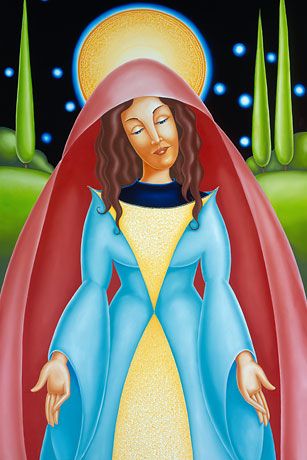
magnificat mary icon by Scott WardI'm bursting with God-news;
I'm dancing the song of my Savior God.
God took one good look at me, and look what happened—
I'm the most fortunate woman on earth!

What God has done for me will never be forgotten,
the God whose very name is holy, set apart from all others.
God's mercy flows in wave after wave
With a bare arm God showed strength,
scattered the bluffing braggarts.
Knocked tyrants off their high horses,
pulled victims out of the mud.

The starving poor sat down to a banquet;
on those who are in awe before this God.
the callous rich were left out in the cold.
God embraced the chosen child, Israel;
God remembered and piled on the mercies, piled them high.
It's exactly what God promised,
beginning with Abraham and right up to now.

The Message (MSG), alt. Copyright © 1993, 2002, 2018 by Eugene H. Peterson

Magnificat icon by Scott Ward Art

Magnificat

Both the responsive psalm and the gospel for Advent 4 feature Mary/Miriam's Magnificat we sing every day at Evening Prayer/ Vespers; in addition, the appointed gospel reading begins with Mary's visit to her cousin Elizabeth—pregnant with John the Baptist. When churches use the Magnificat as the response in place of an OT psalm, they sometimes omit the Magnificat section of the gospel, though it's so glorious, why not read it or sing it twice?

Although we have words Luke wrote, it's very likely Mary sang a very similar song because this passage closely evokes Hannah's song in 1 Samuel 2:1-10. Mary would have been familiar with large chunks of scripture, so she'd have been able to recite and paraphrase them, making those texts her own.

Magnificat is Latin for making larger, magnifying, making greater, like a magnifying glass does. It has the same root as "magnificent." The office of Vespers/Evening Prayer in the liturgy of the canonical hours always includes a spoken or sung Magnificat.


Mary

Coming out of the theological traditions of the Reformation, I need to remember that Martin Luther had a great devotion to Mary, though I still haven't learned how to have an attitude of devotion and reverence toward a person or place without making it more central in my life than Jesus Christ. In my previous city of San Diego I served on the Ecumenical Council's Faith, Order and Witness committee, and moderated one of our discussions of the Anglican-Roman Catholic agreed statement Mary: Grace and Hope in Christ, though when I checked my blog archives I realized that was one I didn't blog. I think Mary is awesome… and as a model for us to follow Mary said, "Yes! I will, yes!"

• What are your thoughts and feelings about Mary, Mother of Jesus?


Musical Settings

Sometimes speech simply isn't enough. Consider how pale "And His Name shall be called, "Wonderful! Counselor! The Mighty God, Everlasting Father, Prince of Peace," comes across on the printed page or read aloud once you've heard "For Unto us a Child is Born" from Handel's Messiah!

I've quit blogging links to YouTube videos because they don't necessarily have a long shelf life, but I'm happy to list three musical settings of the Magnificat that fully capture its promise:

• J.S. Bach, Magnificat in D Major, BWV 243 for 5-part (2 sopranos, alto, tenor, and bass) chorus and orchestra that includes trumpets and timpani.

• Dale Wood, "My Soul Proclaims the Greatness of the Lord" from Evening Prayer in the Lutheran Book of Worship. I'll never be able to comprehend why this powerful setting didn't get into the denomination's most recent generic hymnal, Evangelical Lutheran Worship.

• Rory Cooney, "Canticle of the Turning," set to a traditional Irish tune – Star of the County Down – is in almost all recent English language hymnals. YOU NEED TO DANCE to this song!
Advent 4 Candles

Thursday, December 09, 2021

Advent 3C

Advent 3 Candles
Zephaniah 3:14-20

14 So sing, Daughter Zion!
    Raise your voices, Israel!
Daughter Jerusalem,
    be happy! celebrate!
15God has reversed judgments against you
    and sent your enemies off chasing their tails.
From now on, God is Israel’s king,
    in charge at the center.
There's nothing to fear from evil
    ever again!

16Jerusalem will be told:
    "Don’t be afraid.
Dear Zion,
    don't despair.
17Your God is present among you,
    a strong Warrior there to save you.
Happy to have you back, God will calm you with love
    and delight you with songs.

18 "The accumulated sorrows of your exile
    will dissipate.
I, your God, will get rid of them for you.
    You've carried those burdens long enough.
19At the same time, I'll get rid of all those
    who've made your life miserable.
I'll heal the maimed;
    I'll bring home the homeless.
In the very countries where they were hated
    they will be venerated.

20On Judgment Day
    I'll bring you back home—a great family gathering!
You'll be famous and honored
    all over the world.
You'll see it with your own eyes—
    all those painful partings turned into reunions!"
    God's Promise.

The Message (MSG) Copyright © 1993, 2002, 2018 by Eugene H. Peterson

Advent 3

The third Sunday of Advent historically takes a break from the somber, penitential tone of the first two Sundays. This Sunday receives the designation Gaudete or "Rejoice," from the first words of the introit or entrance prayer that's derived from the second reading from Philippians, "rejoice in the Lord always." If you've sung in choirs, you probably know Henry Purcell's anthem, "Rejoice in the Lord alway."

Although Advent now mostly emphasizes waiting, hope, and expectation, the season that initiates a new church year still retains some sense of judgment and repentance. Aside from the gospel reading from Luke with John the Baptist's call to repentance and his rude comments to onlookers, today's scriptures all focus on the joy that gives the day its traditional gaudete or "rejoice" designation that comes from the opening of the prayer of the day or collect.


Zephaniah

Scholars don't know a lot about Zephaniah or even if someone by that name actually wrote these writings that bear his name. From the Book of the Twelve that's sometimes referred to as "Minor Prophets," much of Zephaniah conveys a feeling of judgment and near-despair. Because of that, parts of the whole may have originated in the southern kingdom Judah before the exile of many leaders to Babylon, or it could have been composed retrospectively during the exile itself.

As another option, Zephaniah could have been assembled from assorted documents after the exile as Jerusalem was being rebuilt and restored, during the time existing scrolls were being edited, codified, and canonized into a coherent body of texts that led to Jews becoming a People of the Book. Yet another possibility? The burst of optimism and joy in the first reading for today makes a case for this poetry coming from the actual exilic period as it parallels the hope for a future we find in Isaiah 40-55, who's sometimes called Second Isaiah or the exilic Isaiah.


COVID-19 – COVID-21

Claiming a scripture as God's Word to you because it sounds good and you want it to apply to your situation can be "downright irresponsible," but providentially the lectionary recently has featured quite a few passages that give us hope for a restored future despite the pandemic and its many related restrictions continuing. I live in the city of Los Angeles that recently mandated showing your vaccination card if you wanted to eat inside a restaurant. How inconvenient—or is that "how bureaucratic?"

Because of a high rate of unvaccinated immigrants in my particular area, some fast food places have reverted to takeout only. Yet I know how far we've come because I even included my first time lunching inside a restaurant during early July in my monthly summary pictorial blog—it was a true milestone, yet I realize some people have been understandably cautious and haven't returned to indoors dining (except at home, of course).

The church has made today's reading a Messianic prediction of God's loving, healing embodied presence in the midst of God's people that we know in Jesus of Nazareth, born in Bethlehem, the Little Town of House of Bread. When you love someone, you want to be with them, and being with those you love makes you happy: it really is that simple. Glancing backwards over the various iterations of denominational lectionaries and later common ones shared across traditions, the image of a creator, redeemer, sustainer God's joy in being with the people and journeying alongside them becomes irresistible.

Immigrants and exiles would glory in God's promise of homecoming in verse 20, but those of us who haven't been physically displaced by the pandemic still have been exiled and displaced from our usual normal and even our expectations for a future. This has gone on so long and to such an extent it's hard to trust in the future scripture tells us God is preparing for us.

Zephaniah's Day of the Lord that Pastor Gene Peterson renders "Judgment Day" (in continuity with some others) becomes a time of human joy, of ingathering and homecoming so intense that people actually are able to forget the bad stuff. Christmas is two weeks away! Rejoice!

Saturday, December 04, 2021

Advent 2C

Advent 2 All Earth is Hopeful
Prayer

God of all creation, again this year we anticipate your Holy Presence among us in the Bethlehem manger. We also find you in our neighbor next door, the homeless family in the park, the clerk at the convenience store, frontline medical and municipal workers, scientists studying COVID, and conflicts across the world, may we bring to all of these the joy of the Bethlehem baby. We pray in the name of the Bringer of hope and Author of peace, amen!

© Leah Chang, 2006, 2021

Luke 3:1-16

1In the fifteenth year of the reign of Emperor Tiberius, when Pontius Pilate was governor of Judea, and Herod was ruler of Galilee, and his brother Philip ruler of the region of Ituraea and Trachonitis, and Lysanias ruler of Abilene, 2during the high priesthood of Annas and Caiaphas, the word of God came to John son of Zechariah in the wilderness. 3He went into all the region around the Jordan, proclaiming a baptism of repentance for the forgiveness of sins, 4as it is written in the book of the words of the prophet Isaiah:
"The voice of one crying out in the wilderness:
'Prepare the way of the Lord, make his paths straight.

5Every valley shall be filled,
and every mountain and hill shall be made low,
and the crooked shall be made straight,
and the rough ways made smooth;

6and all flesh shall see the salvation of God.'"

7John said to the crowds that came out to be baptized by him, "You brood of vipers! Who warned you to flee from the wrath to come? 8Bear fruits worthy of repentance. Do not begin to say to yourselves, 'We have Abraham as our ancestor'; for I tell you, God is able from these stones to raise up children to Abraham. 9Even now the ax is lying at the root of the trees; every tree therefore that does not bear good fruit is cut down and thrown into the fire."

10And the crowds asked John, "What then should we do?" 11In reply he said to them, "Whoever has two coats must share with anyone who has none; and whoever has food must do likewise." 12Even tax collectors came to be baptized, and they asked him, "Teacher, what should we do?" 13He said to them, "Collect no more than the amount prescribed for you." 14Soldiers also asked him, "And what should we do?" John said to them, "Do not extort money from anyone by threats or false accusation, and be satisfied with your wages."

15As the people were filled with expectation, and all were questioning in their hearts concerning John, whether he might be the Messiah, 16John answered all of them by saying, "I baptize you with water; but one who is more powerful than I is coming; I am not worthy to untie the thong of his sandals. He will baptize you with the Holy Spirit and fire."

Prophetic Predictions

For this second Sunday of Advent I've included verses from the gospel for next Sunday, Advent 3. Here we catch the famous scene of Jesus' unconventional cousin John the Baptist alongside the Jordan River. Far removed from the Holy City Jerusalem and its temple that people believed connected heaven and earth, John offers a baptism of repentance for new beginnings. After John more or less quotes the prophet Isaiah who wrote hope and a future to the exiles in Babylon, a future that would happen because everyone – "all flesh"– would see God's salvation, onlookers (waiting for their turn to be baptized?) asked John what they needed to do to get ready for the inversion and subversion of the status quo that would happen with God's arrival in their midst.


Preparing for Christmas

In response to people asking how on earth they could get ready for God's wrathful judgment, John says, "If you have two coats—share. If you have food—share." The root of the Greek word translated share means "gift giving." To religious types (like us?), this is astounding! Foretelling God's fiery arrival, John didn't say, "run and hide" or "go and pray," nor did he remotely suggest, "make costly sacrifices to atone for your sins."

John the cousin of Jesus the forthcoming Messiah said, "Share, give a gift." Go beyond yourself and get beyond yourselves! If you have more than you really need, share it with the have-nots. If you have two coats, give one to someone who has no coat. If you have more than enough food (how much do we really need?), give food to the hungry—and there are many ways to do that. Because when you share, if you give gifts, you prepare for the coming of God, our Judge and Redeemer by being a bearer of gracious gifts. When you give your excess (how much of everything do we really need?) to others, you help create a kindred community of equals. You become a big part of making God's reign happen right here, right now.


Getting Ready to Give

Be givers of gifts? Be the gift? Yes! But first, before we can be gifts or give gifts, we need to receive. No one can give what they don't have, and God never asks us to part with what we need in order to be well.

With almost two years of COVID-19, everyone has lost time and opportunities. Some have lost family and friends, or their own physical health has taken a big hit. In addition, I doubt if anyone is as emotionally and mentally whole as they'd like to be (note: but when are we ever?). We can celebrate and take advantage of the resources for mental health and emotional wellbeing that happily have circulated the interwebs. Despite the pandemic, let's still give gifts. If our wardrobe is minimal or our food budget is so stretched we truly can't donate any or share a simple meal, we still can give our neighbors the gift of our gracious, un-condemning presence.

Back in the days of John the Baptist, people believed the Jerusalem temple connected heaven and earth. These days God's people help bring heaven to earth like Jesus did. We can show everyone we are an inclusive rather than an exclusive community. We can listen to them and hear their stories. We even can invite them to Advent or Christmas worship. Amidst so many consumer-focused days like Black Friday, Cyber Monday, Giving Tuesday (maybe originally an afterthought, but an excellent one), how counter-cultural would that be to show and tell them how Jesus still is the reason for this season?

Friday, November 26, 2021

Advent 1C / Luke

Advent 1 Candles

Advent Family Prayer

God of Love,
Your son, Jesus, is your greatest gift to us.
He is a sign of your love.
Help us walk in that love during the weeks of Advent,
As we wait and prepare for his coming.
We pray in the name of Jesus, our Savior.

Author unknown; from Xavier University, Cincinnati: Jesuit Resources–check them out!

Advent

On the first Sunday of Advent the church begins a new year of grace. Happy New Year!

From the Latin Ad + Venire, Towards Coming of Jesus, every lectionary year Advent opens with a splash of apocalyptic, signaling the end of the world as we know it, the beginning of a new way of living and being—the world is about to turn. Many churches sing Canticle of the Turning that's based on Mary's Magnificat at least once during Advent.

Blue, the color of hope, has become the official color for Advent. Advent is especially about hope, although it also includes a theme of repentance. In Spanish esperar/espero means wait, hope, and expect. We hope for and anticipate not a Merry Christmas or Happy Holidays as the rest of the world sincerely wishes us; we hope for the incarnation of mercy, grace, and love. Instead of the rest of the world's irenic peace that's not much more than a temporary cease fire, we hope for, wait for, and expect the fullness of shalom the Prince of Peace brings us. We hope for the dawn of the new creation the death and resurrection of the Prince of Peace will initiate. Advent light shines amidst all kinds of darkness, including a seemingly endless pandemic, injustices that don't or won't quit, an earth that grieves its own losses. Come, Lord Jesus!


The Gospel According to Saint Luke

This is Revised Common Lectionary Year C, Luke's year. Luke is a synoptic gospel that views Jesus' life and ministry in a similar manner to Matthew and Mark. Luke is the only Gentile, non-Jewish writer in the entire New Testament. Luke was a highly educated physician, but think "bronze age" in terms of sophistication. Luke wrote a two-volume account consisting of this gospel and the Acts of the Apostles. Luke's distinctives:

• world history and Jewish history

• Jesus' genealogy in Luke ends with "Adam, son of God."

• the Holy Spirit has been prominent throughout scripture's witness, but Luke-Acts brings a fulfillment of God's reign in the Spirit

• prayer

• women

• marginalized people of every class and type, the underclass

• table fellowship

• neighborology: the word about the neighbor! During Year C the lectionary has quite a few readings from Jeremiah and Deuteronomy that also emphasize the neighbor, the other, living together faithfully in covenantal community despite differences.

• Starting with John the Baptist counseling people to share what they have with others in order to prepare for the arrival of God in their midst, we find a lot of "social gospel" in Luke. However, this isn't let's see how many good works we humans can accomplish on our own; it's always about the indwelling and outgoing power of the Holy Spirit.

Luke includes three psalm-like songs or canticles based on Old Testament sources:

• Mary's Magnificat, "My soul magnifies the Lord; he has put down the mighty from their thrones and lifted up the lowly…" – Luke 1:46-55

• Zechariah's Benedictus, "Blessed be the Lord God of Israel; he has visited his people." This is John the Baptist's father Zechariah—not the one from the OT Book of the Twelve or Minor Prophets. – Luke 1:67-79

• Simeon's Nunc Dimittis: "Lord, now let thy servant depart in peace; mine eyes have seen they salvation, which thou hast prepared…" – Luke 2:29-32

Uniquely in Luke:

• Sermon on the Plain – Luke 6:17-49, which emphasizes re-distributive justice and material well-being. Matthew's parallel Sermon on the Mount is more about spiritual well-being.

• Good Samaritan – Luke 10:25-37

• Prodigal Son – Luke 15: 11-32

• Stones cry out Luke – 19:37-40

• Emmaus Road in Luke's post-resurrection account takes us back to the Maundy Thursday Upper Room and to Luke's many accounts of Jesus' table fellowship with all comers – Luke 24:13-35


The Gospel for Advent 1C

Rather than coming from the beginning of Luke's gospel, in the gospel reading for this first Sunday of Advent Jesus speaks toward the end of his public ministry. We hear about signs and symbols coming alive in nature/creation; we'll soon celebrate the birth of Jesus who is not a god in nature, but God and Lord of nature. Look at creation; consider what's not manufactured or engineered.
Luke 21:25-28

25"There will be signs in the sun, the moon, and the stars, and on the earth distress among nations confused by the roaring of the sea and the waves. 26People will faint from fear and foreboding of what is coming upon the world, for the powers of the heavens will be shaken. 27Then they will see the Son of Man coming in a cloud with power and great glory. 28Now when these things begin to take place, stand up and raise your heads, because your redemption is drawing near."

Saturday, November 20, 2021

Reign of Christ 2021

Prayer in Response to the Verdict in the Kyle Rittenhouse Trial
"I hate, I despise your festivals,
and I take no delight in your solemn assemblies.
But let justice roll down like waters,
and righteousness like an ever-flowing stream." Amos 5:21, 24

I lift my eyes to the hills, Holy God, from where will our help come? We pray for those confused and demoralized by our system of justice. We pray for those who can't keep from hoping and praying for justice, yet who also can't forget our history.

We pray also for those with the luxury of forgetting history, those whose privilege protects them from the pain of this moment, those whose lives need not be interrupted by controversial trials or an urgent need to work for a more equitable world.

Embolden us all, Holy God, to interrogate our systems and structures, to risk creative change, to listen to people long silenced and to work for peace. Hear us as we pray that justice will roll down like waters and righteousness like an ever-flowing stream.

Amen.

by Teri McDowell Ott

John 18:33-38

33Then Pilate entered the praetorium again, summoned Jesus, and asked him, "Are you the King of the Jews?" 34Jesus answered, "Do you ask this on your own, or did others tell you about me?"

35Pilate replied, "I am not a Jew, am I? Your own nation and the chief priests have handed you over to me. What have you done?" 36Jesus answered, "My kingdom is not from this world. If my kingdom were from this world, my followers would be fighting to keep me from being handed over to the Jews. But as it is, my kingdom is not from here."

37Pilate asked him, "So you are a king?" Jesus answered, "You say that I am a king. For this I was born, and for this I came into the world, to testify to the truth. Everyone who belongs to the truth listens to my voice."

38Pilate asked him, "What is truth?"

So Far

About nine months into pandemic awareness and mandated measures to help stop the spread, late November 2020 we began a new year of grace with Advent anticipation and hope. Since then we've welcomed the newborn Jesus, followed him to baptism by the river whose waters still interconnect all waterways and all peoples, experienced his ministries and his teachings, journeyed to Jerusalem, been in the upper room on Maundy Thursday, grieved at his trial, death, and burial, met the risen Christ at the dawn of resurrection day, trusted his promise to be with us forever, and started to follow him into our futures.

Today the church concludes another year of grace as we celebrate the sovereignty of Jesus Christ who reigns from a cross of shame.


Today's Scripture

John's gospel uniquely brings us a dialogue between Jesus and Roman procurator Pontius Pilate, who had sole authority to sentence a person to death. Earlier in this gospel Jesus rejected the title "king" and all four gospels frequently call him Son of Man or the Human One that in Mark is Jesus' favorite title for himself. However, in today's short account, Jesus evades Pilate's, "are you the King of the Jews," yet announces his kingdom or reign is not from this world – not from here, which sets Jesus' subversive ways of justice, love, mercy, and inclusion at right angles to conventional human rules of injustice, hatred, violence, and exclusion. Particularly that of Rome two millennia ago? Especially that of many authorities in this twenty-first century?

Jesus lived fully engaged here in this world—wherever he found himself, yet he revealed a different kind of power – whether elected or hereditary – than most of the world sees most of the time. Jesus announces to Pilate that he came into the world to testify to the truth, and those who belong to the truth will listen to him. Jesus' truth is not necessarily verifiable data or observable events. Jesus embodies God's truth that will redeem ("buy back") and restore all creation as we follow his way. Jesus' own life, death, and resurrection was just the beginning; now it's our turn!


COVID Continues

Raise your hand if you even remember when COVID-19 wasn't part of our vocabulary? Next week on the first Sunday of Advent a brand new year of grace opens wide and mostly will feature the gospel according to Luke. Please join me in hope as we again prepare for Jesus of Nazareth's birth in Bathlehem as God among us!

Saturday, November 13, 2021

Pentecost 25B

Mark 13:1-8

1As he came out of the temple, one of his disciples said to him, "Look, Teacher, what large stones and what large buildings!" 2 Then Jesus asked him, "Do you see these great buildings? Not one stone will be left here upon another; all will be thrown down."

3 When he was sitting on the Mount of Olives opposite the temple, Peter, James, John, and Andrew asked him privately, 4 "Tell us, when will this be, and what will be the sign that all these things are about to be accomplished?"

5 Then Jesus began to say to them, "Beware that no one leads you astray. 6 Many will come in my name and say, 'I am he!' and they will lead many astray. 7 When you hear of wars and rumors of wars, do not be alarmed; this must take place, but the end is still to come. 8 For nation will rise against nation, and kingdom against kingdom; there will be earthquakes in various places; there will be famines. This is but the beginning of the birth pangs."

• Overview of the gospel according to Mark from November 2020


Today's Scripture

The church's year of grace will end next Sunday with Reign of Christ / Christ the King, After that, Advent begins Revised Common Lectionary (RCL) Year C, Luke's year. Although the current Year B mostly has belonged to Mark, for Reign of Christ we'll hear from John, the Fourth Gospel; today is the last time we'll consider a passage from the gospel according to St. Mark.

In verse 4, Peter, James, John and Andrew beg Jesus for a sign related to the destruction of the built environment he has predicted. Jesus' reply in verses 5-8 includes some apocalyptic related to the badly labeled "end times." Apocalyptic writing and art incorporates symbols and words that don't mean what they initially look like or sound like: they need to be interpreted. In scripture, those symbols often come from nature such as fires, floods, skies, and earthquakes. Similar to a sign, a symbol points to something beyond itself.


COVID-19

Mark maybe especially brings us the end of the world as we've known it, but all four gospels reveal God's newness in Jesus of Nazareth. Although Jesus shows us a way of being that's in radical (at the root of) continuity with God's self-revelation and salvific actions from the dawn of time, God's revelation in Jesus is ultimate and definitive! Jesus also refers to birth pangs of the new creation that's constantly in progress and process, that won't be complete until planet earth's last day.

Beginning late February / early March 2020, life as we'd known it and expected to continue albeit with usual disruptions and disappointments slowed down and ended with COVID-19. A once in a century pandemic caused countless deaths (will we ever have an accurate count?) and devastated families. It shut down businesses and affected the worldwide economy. COVID led to even more political divisions, maybe particularly in the USA.

Mark probably was written down around the time of the destruction of the Jerusalem temple. Scholars suggest a range of dates and there are no extant source documents Mark might have drawn upon, but in any case the temple still was standing during Jesus' earthly life. Consider how central the J-temple was to economic, political, and religious life. People believed it was a conduit between heaven and earth. In today's scripture Jesus' followers gaze awestruck at the ginormous building! They imagined the temple actually contained and protected the God who never asked for and never wanted a physical structure to call "home!"


Into a Future?

Mark has no birth narrative and no resurrection account (in the earliest manuscripts), but strongly implies Jesus' ministry continues in his followers who have received their second birth and first death in baptism. Beyond those who formally belong to the church, God doesn't mind being anonymous and delights in using people who don't acknowledge him to help meet the world's needs.

Even more than the other three gospels, Mark asks, "Where do we look for God? Where do we find God?" Mark shows us we find God not in religious, economic, or political institutions–but in the vulnerability of a human dying on a cross. Do we find God in loss and devastation? Have we been finding the divine presence hidden in the COVID-19 pandemic? Do we recognize God in health care workers, police and fire professionals, delivery drivers and retail personnel, all those "frontliners" who keep us safe and keep our homes and businesses stocked with essentials? Do we find God in the sick and in the dying?

Our earthbound lives need houses, schools, religious buildings, stores, offices. We've learned to design safe buildings and to construct them out of stuff of the earth. The sight and size of the J-Temple wowed Jesus' disciples; humanly built and divinely inspired structures like Saint Patrick's Cathedral and the WTC Memorial impress and awe us in the twenty-first century. Without a doubt God indwells places people gather to pray and celebrate sacraments, where we remember and give thanks for those who have gone before us.

In the earliest manuscripts, Mark has no resurrection account, but implies Jesus' ministry continues in his followers who live and serve as Jesus' presence. Then again, all the gospel accounts are about God-with-us, God-among-us, God-for-us in Jesus and in the church that's Jesus' presence in the world…

And we find God in other temples. Not in Large Stone Structures that might contain and protect God, but in defenseless, imperfect humans God has created in the divine image. In the people God chooses to inhabit. In us!