Saturday, December 31, 2022

Christmas 1 / Name of Jesus

Nativity Tree 2022
Isaiah 63:7,9

7 I will recount the gracious deeds of the Lord,
the praises of the Lord,
because of all that the Lord has done for us
and the great favor toward the house of Israel
that God has shown them according to his mercies,
according to the abundance of his loving kindnesses.

9 in all their distress.
It was no messenger or angel
but God's presence that saved them;
in love and mercy it was God who redeemed them;
lifted them up and carried them all the days of old.

Word of the Father, Now in Flesh Appearing

…in all their distress … God's presence saved them!

Now all this took place to fulfill what was spoken by the Lord through the prophet [Isaiah 7:14]. "Behold, the virgin shall be with child and shall bear a son, and they shall call his name Immanuel, which translated means 'God with us.'"

Mary will bear a son, and you shall call his name Jesus, for he shall save the people from their sins. Matthew 1:21-23

"And lo, I am with you always, even until the end of the age." Matthew 28:20

Friday, December 23, 2022

Nativity 2022

Titus 2 Grace has appeared
Titus 2:11-14

11 For the grace of God has appeared, bringing salvation to all, 12 training us to renounce impiety and worldly passions and in the present age to live lives that are self-controlled, upright, and godly, 13 while we wait for the blessed hope and the manifestation of the glory of our great God and Savior, Jesus Christ. 14 He it is who gave himself for us that he might redeem us from all iniquity and purify for himself a people of his own who are zealous for good deeds.

The Epistle to Titus

For all three years, the lectionary schedules readings from Titus for Christmas Eve (Titus 2:11-14) and day (Titus 3:4-7).

Titus is another letter the apostle Paul almost definitely didn't write; it bears his name because of the common practice of regular people attributing their writing to a famous person. Titus was one of Paul's ministry companions, and probably a pastor-mission overseer for house churches in Crete.

The letter to Titus was one of reformer Martin Luther's favorites. He described it as, "…a short epistle, but a model of Christian doctrine, in which is comprehended in a masterful way all that is necessary for a Christian to know and to live." I'm sure he loved the reference to Jesus as "grace" with appeared and manifestation that describe an epiphany, a bright revelation of the Divine.

The strong sense of paranaesis or exhortation to good works in this short passage happens because its strong declaration of God's gracious presence and action inspire– compel – us to loving mercy, service, justice, and compassion. God's people, with zeal for good deeds? Yes! Remember, this was one of Luther's favorites!


From Gian-Carlo Menotti's one-act opera, Ahmal and the Night Visitors:

The child we seek holds the seas and the winds on his palm.
The child we seek has the moon and the stars at his feet.
Before him, the eagle is gentle the lion is meek.

On love, on love alone will he build his kingdom…
His might will not be built on your toil.
Swifter than lightning he will soon walk among us.
He will bring us new life and receive our death.
And the keys to his city belong to the poor.

Saturday, December 17, 2022

Advent 4A

summer garden with welcome sign
Summer Garden with welcome sign in Van Nuys, Los Angeles, California

Isaiah 7:10-16

10 Again the Lord spoke to Ahaz, saying, 11 Ask a sign of the Lord your God; let it be deep as Sheol or high as heaven. 12 But Ahaz said, I will not ask, and I will not put the Lord to the test. 13 Then Isaiah said: "Hear then, O house of David! Is it too little for you to weary mortals, that you weary my God also? 14 Therefore the Lord himself will give you a sign. Look, the young woman is with child and shall bear a son, and shall name him Immanuel. 15 He shall eat curds and honey by the time he knows how to refuse the evil and choose the good. 16 For before the child knows how to refuse the evil and choose the good, the land before whose two kings you are in dread will be deserted.

The Fourth Sunday of Advent

Almost Christmas, the supreme festival of creation, the birth of God in our midst in Jesus of Nazareth, the baby in the Bethlehem manger. Although by this Sunday we're usually already into or seriously planning Nativity treats, food, decorations, music, and evoking memories, to round out Isaiah in Advent, a few comments on the first lection. This Isaiah passage is from the Old Testament, First Testament, or Hebrew Bible; it wasn't originally Christian scripture.

Over the past three Sundays I've described the frightening and precarious overall political, social, religious, and economic situation Isaiah of Jerusalem addressed. Long ago, the church identified...

14"Therefore the Lord himself will give you a sign. Look, the young woman is with child and shall bear a son, and shall name him Immanuel."

...as a Messianic text that anticipated the arrival of Emmanuel, Jesus, God-With-Us. The librettist for Handel's Messiah also chose this, but Isaiah did not have Christmas in mind. In these very political verses, King Ahaz of the southern kingdom Judah is very concerned about military and political threats from Samaria [Ephraim] in the northern kingdom of Israel, from Damascus in Syria. The baby in these verses may be Isaiah's own soon to be born offspring.

Similar to Martin Luther, Matthew's community that produced the featured gospel readings for this year A had a habit of discovering and uncovering Jesus Christ in every passage of the Old Testament. No, I have that backwards: similar to Matthew's community, the Reformer Martin Luther loved to discern and explain the presence of Jesus in almost every phrase of the OT.

When we read scripture, our first question needs to be the historical when, where, who, why, what. But we know scripture is a living perennial word! Every verse won't apply to our here and now, but still we can ask about contextualizing (making alive) God's Word into our current when, where, who, why, and what.


Gifts of Creation

With Christmas being the church's major Trinitarian Festival of Creation (Easter – Redemption, Pentecost – Sanctification), gifts of food are especially appropriate. It's not uniquely my opinion about giving food and homemade delicacies, because why else would home-baked cookies or a commercial close approximation be so popular this time of year? Food as gift also gives the recipient permission to indulge in unneeded calories.

What are your favorite and/or must-have Christmas foods?


Gifts of Music

Advent and Christmas may be the most musical seasons of the year. Many churches and other groups offer Lessons and Carols to the community, typically early in Advent before the busy-ness gets too overwhelming. When Advent begins in the northern hemisphere, days are short, nights long. I believe it originally was for Epiphany, but I love everything about the hymn Rise, Shine, You People (by Ron Klug to Dale Wood's tune, Wojtkiewiecz) and the line, "Come, celebrate, your banners high unfurling, your songs and prayers against the darkness hurling" is exactly one of the reasons music feels so good and is so necessary during winter.

What are your essential Advent-Christmas songs, hymns, chorales and other music? It's also not specifically Christmas, but one of mine is Phillip Phillip's Home...

The trouble it might drag you down
If you get lost, you can always be found
Just know you're not alone
'Cause I'm going to make this place your home

...always moves me. Most likely I associate it with Christmas because the first time I heard it was at a Blue Christmas service in Previous City.

Friday, December 09, 2022

Advent 3A

Isaiah 35 desert in bloom purple crocus
Isaiah 35:1-2, 5-7, 10

1 The wilderness and the dry land shall be glad, the desert shall rejoice and blossom; like the crocus 2 it shall blossom abundantly, and rejoice with joy and singing. The glory of Lebanon shall be given to it, the majesty of Carmel and Sharon. They shall see the glory of the Lord, the majesty of our God.

5 Then the eyes of the blind shall be opened, and the ears of the deaf unstopped; 6 then the lame shall leap like a deer, and the tongue of the speechless sing for joy. For waters shall break forth in the wilderness, and streams in the desert; 7 the burning sand shall become a pool, and the thirsty ground springs of water; the haunt of jackals shall become a swamp, the grass shall become reeds and rushes.

10 And the ransomed of the Lord shall return, and come to Zion with singing; everlasting joy shall be upon their heads; they shall obtain joy and gladness, and sorrow and sighing shall flee away.

The Third Sunday of Advent

We continue the counter-cultural practice of waiting for Jesus' arrival into a world that wants and expects everything delivered yesterday. Mid-Lent breaks from repentance with the brighter mood of Laetare Sunday to encourage us "rejoice"; similarly, the third Sunday of Advent is Gaudete or rejoice Sunday, named after the opening of the traditional collect or gathering prayer for the day. The blue of hope is the new color for Advent; when churches have them, rose paraments replace blue for the third Sunday of Advent and the fourth Sunday in Lent.

This third Sunday celebrates Mary, Jesus' mother. Mary's Magnificat, "My soul magnifies the Lord, and my spirit rejoices in God My Savior" from Luke 1:46-55 is the appointed psalm for all three lectionary years. Mary singing "God has brought down the powerful from their thrones and lifted up the lowly; God has filled the hungry with good things and sent the rich away empty," foresees a world where humanity has become a common-wealth that flourishes the way the desert blooms.

Like last week's, today's first reading, Isaiah 35, follows chapter 34 about horrendous environmental devastation. All three sections of Isaiah are super-clear that the natural creation is not an incidental backdrop to God's activity, but lives and breathes as an integral part of God's story on earth. Scripture as a whole witnesses to the redemption, ransom, integrity, wholeness, restoration, and resurrection of the natural world—not only human creatures. "God writes the gospel not in the bible alone, but on trees and flowers and clouds and stars," is attributed to Martin Luther. However, our frequent emphasis on humanity may be valid, because for the most part creation needs redemption because of human sin and greed.


Today's First Reading

As last week's blog noted, Isaiah's inspired words came into the southern kingdom at a time of political, economic, and cultural violence and uncertainty. Against God's constant scriptural counsel "do not fear," everyone had plenty of reasons to be frightened. Like last week's Isaiah 11:1-9, this week we receive pure promise, sheer proclamation of grace, mercy, healing, and a shalom-filled future. This announcement is gospel: it is very good news!

With springs of water, rivers of grass, flowers in blossom and bloom, the desert itself rejoices and sings. In this scripture, water is womb of re-creation. Have you ever visited the desert (Anza-Borrego, maybe?) in spring bloom? Water makes the difference; water restores life. Water is life!


Today's Gospel

In Isaiah 35:5-6, the blind will see, deaf will hear, lame will walk, speechless people won't only speak, they will sing! Today's gospel reading from Matthew echoes Isaiah:
Matthew 11

2 When John heard in prison what the Messiah was doing, he sent word by his disciples 3 and said to him, "Are you the one who is to come, or are we to wait for another?" 4 Jesus answered them, "Go and tell John what you hear and see: 5 the blind receive their sight, the lame walk, those with a skin disease are cleansed, the deaf hear, the dead are raised, and the poor have good news brought to them.

Saturday, December 03, 2022

Advent 2A

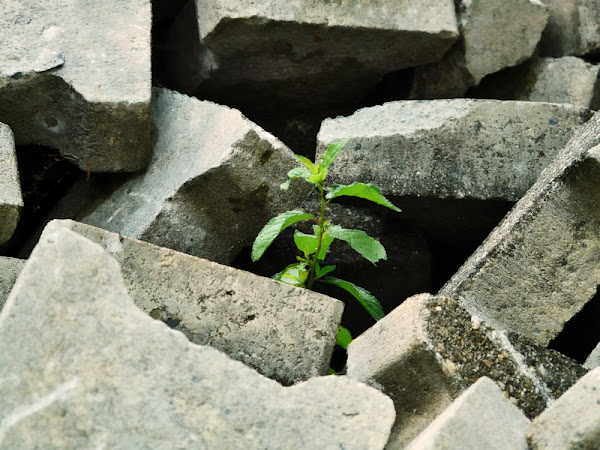
greenery sprouting through hard rock
Isaiah 11:1-10

1 A shoot shall come out from the stump of Jesse, and a branch shall grow out of his roots. 2 The spirit of the Lord shall rest on him, the spirit of wisdom and understanding, the spirit of counsel and might, the spirit of knowledge and the fear of the Lord. 3 His delight shall be in the fear of the Lord.

He shall not judge by what his eyes see, or decide by what his ears hear; 4 but with righteousness he shall judge the poor, and decide with equity for the meek of the earth; he shall strike the earth with the rod of his mouth, and with the breath of his lips he shall kill the wicked. 5 Righteousness shall be the belt around his waist, and faithfulness the belt around his loins.

6 The wolf shall live with the lamb, the leopard shall lie down with the kid, the calf and the lion and the fatling together, and a little child shall lead them. 7 The cow and the bear shall graze, their young shall lie down together; and the lion shall eat straw like the ox.

8 The nursing child shall play over the hole of the asp, and the weaned child shall put its hand on the adder's den. 9 They will not hurt or destroy on all my holy mountain; for the earth will be full of the knowledge of the Lord as the waters cover the sea. 10 On that day the root of Jesse shall stand as a signal to the peoples; the nations shall inquire of him, and his dwelling shall be glorious.

Advent II

Last Sunday on the first Sunday of Advent, linear time and the scriptures opened to the world a new Year of Grace.

Jesus of Nazareth first arrived in Roman occupied territory after 700 years of enemies—Assyria, Babylon, Persia, Greece, Syria, Rome. Advent imagery and reality subverts our current status quo of enemies, violence, injustice, hatred, hunger, and fear. As days grow shorter, nights longer in the northern hemisphere, advent music is one of the highlights of the season.

There's a strong advent emphasis on turning around into the direction of God's gracious leading—the gospel reading on this second advent Sunday traditionally is Jesus' cousin John the Baptist telling everyone the time for God's arrival is now, and therefore now is the time to repent. However, as important as repentance is year-round, hope has become an even greater advent accent, with blue paraments, vestments, and sanctuary appointments. We must repent, we must obey, but what a gift first to hear it won't always be like this, we will know the fullness of shalom, and it will come about by God's action, intervention, and presence. But hope can't bear fruit if humans don't repent and change their ways, right?


Today's First Reading

During this lectionary year A, all of the first readings during Advent are from Isaiah of Jerusalem; today we'll look at Isaiah 11:1-9. Notice how in this passage creation is central with earth sprouting new growth, animals behaving in uncharacteristic ways. The entire witness of scripture consistently interlinks natural, political, economic, and social endeavors in the fractured world of the first creation, in the transformed world of the new creation.

Chapter 11 of Isaiah comes right after… chapter 10, that tells about a clearcut forest, so we start out today with a shoot (branch, scepter, rod) growing from a tree stump. Commentaries aren't sure what historical event lies behind the "stump" image, but it works well when we look at Israel's and Judah's history, other world history, and when we consider our own lives.

Although eventually we need to contextualize it for our place and time, when we read scripture we first ask about the original setting. Isaiah of Jerusalem (sometimes referred to as First Isaiah, who wrote most of chapters 1 through 39) experienced what has been called the first holocaust of the Jews: five times during the 40 years between 740 and 700 BCE the Assyrian army invaded Israelite territory. But notice how this entire reading proclaims, announces, promises grace, newness, healing, gospel, the reign of heaven so extensive God's presence fills everywhere!


Art, Music, Books

Today's first reading brings us a vision sometimes called the Peaceable Kingdom [11:6-7]. American artist Edward Hicks created at least 50 Peaceable Kingdom paintings. Three Sundays ago, our scripture for Pentecost 23 was from Isaiah 65 that's substantially from the post-exilic restoration in Jerusalem and promises the same reality. I illustrated that week's blog with one of Hicks' Peaceable Kingdoms.

Jesse was the father of King David. Since the birth of Jesus of Nazareth, the church has claimed some of the book of Isaiah and words of other Hebrew Bible prophets as Messianic, meaning they can be interpreted in a Christological manner. "Jesse" in Isaiah 11:1 refers to King David's father Jesse; in the genealogy that opens his gospel, Matthew lists Jesse and David as ancestors of Jesus. For this year's lectionary year A, Matthew's gospel emphasizes Jesus as the new King David. The carol anthem "Lo, How a Rose" sings about Jesus' descent "Of Jesse's lineage" in Isaiah 11:1.

If you've sung in choirs or listened to much choral music, you may know the Peaceable Kingdom American composer Randall Thompson wrote for double mixed choir with texts from all three parts of the book of Isaiah.

Do you know "God is Working his Purpose Out," Geoffrey Ainger's hymn that's often set to Martin Shaw's tune Purpose? It hasn't been widely included in hymnals, yet it's strongly missional and could be an excellent Advent choice; each stanza ends with God's promise via Isaiah, the earth shall be filled with the glory of God as the waters cover the sea. A place and a time of shalom integrity, where justice, grace and love have the final word.

As a messianic text, Isaiah 11:4b "…he shall strike the earth with the rod of his mouth, and with the breath of his lips he shall kill the wicked" can be interpreted as the Word of God that creates, redeems, and sanctifies, the word that is incarnate, embodied as living word in Jesus of Nazareth. The title of one of Hebrew bible scholar Walter Brueggemann's books is The Word that Redescribes the World —draws it over, gives it a makeover, re-creates creation, reconciles and redeems it. The promised new David will reorder creation by speaking—speech that's also action.


Resurrection Hope

Everyone loves the amazement of a green sprig or sprout growing out of what looks like a truly dead tree stump. There's life there? Most city dwellers have noticed verdant life pushing through streets and sidewalks, into an existing crack, even making a way for itself by itself and rupturing baked earth or cured concrete. Pushing back the tombstone?!

The reality of new life coming out of the death, the end of the old. God redeems and recreates our failures, our disappointments, losses, illnesses. Particularly here in southern California, new green growth from the ashes of a wildfire amazes me every time. In spite of what we've seen and otherwise experienced, we humans have a habit of deciding new life could not come from here, from over there, this situation literally is hopeless, death must be final. The new creation is not pristine, but builds on the ruins of the old.

The end of today's reading promises "On that day the root of Jesse shall stand as a signal to the peoples…" A literal vision of security and peace, of God's presence in spite of. A sign, standard, signal, icon, ensign: the cross of Jesus Christ.

Saturday, November 26, 2022

Advent 1A

Isaiah 2:1-5

1 The word that Isaiah son of Amoz saw concerning Judah and Jerusalem.

2 In days to come the mountain of the Lord's house shall be established as the highest of the mountains, and shall be raised above the hills; all the nations shall stream to it. 3 Many peoples shall come and say, "Come, let us go up to the mountain of the Lord, to the house of the God of Jacob; that he may teach us his ways and that we may walk in his paths."

For out of Zion shall go forth instruction, and the word of the Lord from Jerusalem. 4 He shall judge between the nations, and shall arbitrate for many peoples; they shall beat their swords into plowshares, and their spears into pruning hooks; nation shall not lift up sword against nation, neither shall they learn war any more.

5 O house of Jacob, come, let us walk in the light of the Lord!

Advent

Last Sunday we concluded the church's year by celebrating Jesus Christ,

…the image of the invisible God, the firstborn of all creation; in him all things in heaven and on earth were created, things visible and invisible, whether thrones or dominions or rulers or powers—all things have been created through him and for him. Colossians 1:15-16

As the northern hemisphere approaches the time of year with least daylight and inches toward the winter solstice, the first Sunday of Advent opens wide a new year of grace. We light candles at home and at church; glowing warmth from a fireplace or wood burning stove brings a lot of comfort in some homes. We ended the old year with a splash of apocalyptic (uncovering, revealing, signs and wonders in creation and in the everyday world along with coded speech or art that needs to be interpreted); we start the new year with apocalyptic, too. The unfamiliar, upside down, inside out, strangeness of apocalyptic literature or art signals "look! listen! the end of the world as we've known it!"

This new lectionary Year A features the Gospel according to Matthew for most of the gospel readings; today's apocalypse is a parable from Matthew 24:36-44. However, for these Advent Sundays I expect to blog about the first readings that all come from the first section of Isaiah (chapters 1 through 39) that's mostly from Isaiah of Jerusalem who ministered before the Babylonian exile.

Advent imagery and scripture subverts the status quo of violence, injustice, hatred, hunger, disease, and fear as the world anticipates God's arrival in our midst as a human baby. God in the manger? How counter-intuitive is that?

As we await and expect God on earth, close to us as one of us, advent is a season of hope. Blue, the color of hope, is the contemporary liturgical color for advent. With its emphasis on light that continues through epiphany along with its theme of hope, Advent is the favorite season for many people.


Advent 2022

Immediately before today's reading, Isaiah chapter 1 rants about the vision he saw concerning violence, bribery, injustice, empty religious festivals, sacrifices, and extravaganzas. In Isaiah 1:17 God charges us, "Learn to do good, seek justice, rescue the oppressed, defend the orphan, plead for the widow."

The first advent, ad-venire, coming, or arrival of Jesus of Nazareth happened in Roman occupied territory after 700 years of enemies—Assyria, Babylon, Persia, Greece, Syria, Rome. Advent imagery and reality subverts the status quo of violence, injustice, hatred, hunger, and fear as the world anticipates God's arrival as a human baby. Reformer Martin Luther insisted to see the fullness of God's power and the style of God's reign—"look to the Bethlehem manger! Look to the Calvary cross!"

During Advent 2022 we wait for Jesus' arrival into territory already occupied by: Covid? Armed conflict, maybe particularly the Russian Federation's (mostly President Putin's) war on the sovereign nation of Ukraine that has grieved Western hearts, though worldwide at least a couple dozen wars continue to rage? Competitive consumerism, especially during the gift-giving December holidays? Wall Street, the DOW and the NASDAQ? Crypto currency? Social media? Ethnic conflict? It seems as if stabbing has become the new shooting? What other death-dealing, life-negating entities and activities overwhelm our living spaces?


Today's Reading

Isaiah 2:1 "The word Isaiah…saw." A visible word! Hebrew here is dabar that denotes both speech and action. Visible words? How about us? Sacraments, visions, dreams, paintings… advertising art! Do you know Tom Wolfe's book, The Painted Word?

Isaiah 2:4, "…they shall beat their swords into plowshares, and their spears into pruning hooks; nation shall not lift up sword against nation, neither shall they learn war any more." Isaiah's 8th century contemporary Micah 4:1-3 also included this life-giving promise.

Paradox in this passage is Zion was not the highest mountain, and "the nations" were not caravanning to Jerusalem and Mount Zion. Also, God's people were not unique in considering their capital city the center of the world. Imagine!

Isaiah 2:3 "God of Jacob" – Genesis 28:13-15, Jacob's dream, Jacob's ladder: land; offspring; God's constant, abiding presence; homecoming.

All of Isaiah conveys an expansive worldview with a universalism that insists Yahweh is God of all, God for all. No more us and them!

Psalm 122:1-2 for today: I was glad when they said to me, "Let us go to the house of the Lord!" Our feet are standing within your gates, O Jerusalem.

Friday, November 25, 2022

Matthew's Gospel

Here's a highlights summary of the Gospel According to Matthew outside of my reflections on one of today's scriptures so I easily can link back to it.


Matthew's Gospel

Every year on the first Sunday of Advent that's always the Sunday closest to Saint Andrew's Day on November 30th, the church begins a new year of grace. Gospel readings for this formally designated Revised Common Lectionary (RCL) Year A are mostly from Matthew. During the great 50 days of Easter, all three lectionary years feature John's gospel.

Along with Luke and Mark, Matthew is one of the three synoptic gospels that view Jesus with a similar perspective, despite each having a markedly different personality. Syn=together (synthesis, synod, synagogue, synopsis, synergy, synonym); optic=related to vision (optician, optical, optometrist, optimistic, optimum, optimal)


Overview

• Date and Author

circa 80 - 90

There's no historic indication of "Matthew" as author until the second century, but we can assume followers of the apostle and tax collector Matthew similar to the way we consider the community that surrounded John the beloved disciple authored John's gospel.

• Sources

Matthew contains 90% of the verses in Mark, the earliest canonical gospel. (Luke contains about 50% of Mark.) Matthew and Luke both contain parallel, sometimes identical passages not found in Mark. Scholars still speculate there might have been a no longer extant written collection of Jesus' sayings, sometimes referred to as "Q", from the first word of the German Quelle—river or source.

• Language

Scholars still aren't certain, but suggestions include Semitic Greek, or possibly Aramaic that was the vernacular Hebrew Jesus spoke.

• Setting

Greek-speaking Jewish Christians in Antioch in Syria, where they first called Jesus' followers Christian – Acts 11:28. That particular Antioch's part of present-day Turkey. There's also an Antioch, Ohio, USA.


World View / Content

• Book of Beginnings, Book of Origins = biblios geneseos. Matthew presents a new Genesis, a New Creation as he tells the story of Jesus of Nazareth's birth, life, death, resurrection, and ascension.

• Matthew's genealogy goes back to Abraham, Father of the Jewish nation, in whom all nations would be blessed. Matthew's Jesus is Son of Abraham, who blesses all people everywhere. Matthew's Jesus is Son of David, not a temporary, short-term monarch like the old David, but this new David reigns for all eternity, embracing all creation.

• Matthew's Jesus is the ultimate Rabbi – "teacher" – who wants students, pupils, learners.

• Concern about fulfilling Hebrew Bible prophecies and predictions

• Kingdom of Heaven rather than Kingdom of God because of the Jewish proscription against saying G-d's name aloud.

• Angel's visit to Jesus' stepfather Joseph; Joseph's dream to flee to Egypt. Possibly an echo of Joseph the dreamer in Genesis? (Luke tells us more about Mary.)

• Visit of the Magi at Epiphany in response to a dream: ethnic foreigners from a different religion reveal God for the world. Scripture does not say how many kings there were, but tradition says three because the text lists three gifts.

• Jesus as the New Moses – "a prophet like me," as Moses himself predicted in Deuteronomy 18:15
* Flight into Egypt – Jesus as refugee
* New Exodus out of Egypt with Jesus as freedom-giver, liberator, like the first Moses
* Five discourses that parallel the Torah/Pentateuch or Five Books of Moses: Jesus as a new Moses, the gospel as a new Torah. The Sermon on the Mount explicates ten commandments/ten words God gave the people through Moses at Mount Sinai.

(1) chapters 5–7
(2) chapter 10
(3) chapter 13
(4) chapter 18
(5) chapters 24–25

• Matthew 16:18; 18:17 – the only gospel that uses the word "ecclesia," and has some instructions related to church order and structure. Ecclesia is the Roman city council, New England town meeting. Ecclesiology, ecclesiastical are words about the church. In southern California there are quite a few mostly Spanish-speaking assemblies that style themselves iglesia.

• Before Jesus' resurrection Matthew calls God's people "Israelites"; after the resurrection he calls them Jews.

• Concluding Great Commission in 28:16-20 positions the Good News as salvation (integrity, wholeness, shalom) for everyone everywhere.

Saturday, November 19, 2022

Reign of Christ / Christ the King

Colossians 1:11-20

11May you be made strong with all the strength that comes from his glorious power, and may you be prepared to endure everything with patience, while joyfully 12giving thanks to the Father, who has enabled you to share in the inheritance of the saints in the light. 13He has rescued [exodus, a new deliverance, a new freedom from slavery] us from the power of darkness and transferred us into the kingdom of his beloved Son, 14in whom we have redemption, the forgiveness of sins.

15Christ is the image of the invisible God, the firstborn of all creation; 16for in him all things in heaven and on earth were created, things visible and invisible, whether thrones or dominions or rulers or powers—all things have been created through him and for him.

17He himself is before all things, and in him all things hold together. 18He is the head of the body, the church; he is the beginning, the firstborn from the dead, so that he might come to have first place in everything. 19For in him all the fullness of God was pleased to dwell, 20and through him God was pleased to reconcile to Godself all things, whether on earth or in heaven, by making peace through the blood of his cross.

Christ the King / Reign of Christ

Every year the church's year of grace concludes by celebrating Jesus Christ as Lord of all. Pope Pius XI instituted the Solemnity of Our Lord Jesus Christ, King of the Universe in 1925.

The language of Christ the King – a male monarch with single, singular authority – trips up some people. Once again explaining circumstances as cultural (ways people relate and create meaning) sometimes feels tired or too persistent, but the two millennia ago Greco-Roman culture would not have taken a female redeemer seriously, nor would a woman connect with Old Testament passages about a coming savior and a messianic age. As we've discovered, Jesus son of David, child of Mary and son of heaven, inverts and subverts the way it's always been – the endless recycling of the same thing that always ended in death – in almost every detail, including his inclusion and affirmation of women.

As I've mentioned several times on this blog, in Saxon English the Lord provided the loaf or the sustenance for the citizens of his realm.

You may have come across kindom of heaven. For sure we all are close kin to each other in Jesus, our elder brother; we absolutely are interconnected with a high degree of responsibility and accountability to one another (as Jesus counseled, to be saved, keep the commandments, keep covenant with all creation). However, "kindom" erases the reality of Jesus' power and the wisdom of his rule; it comes close to obliterating our need of a Savior who is both fully human and also God in our midst. It even removes Jesus as sovereign!


Cosmic Christ

Particularly this chapter of the letter to the church at Colossae brings us the pre-existent and still regnant Christ who fills and rules the entire cosmos, who subverts empire, inverts the political, social, economic, and religious status quo, who is the image and the reality of God parallel to In the beginning was the word, and the word was with God, and the word was God. (John 1:1) Colossians 1:15 announces, "Christ is the image of the invisible God"; in John 14:19 Jesus tells us, "If you have seen me, you have seen the Father."

Everything I blogged during July on Colossians 1:15-20 for Pentecost 6 works well for today. I mostly wrote about resisting empire and overcoming in general; there's no need to say it all over again, except my last paragraph:

If – because! – Jesus rules the cosmos and us as individuals, then Samsung, BP, and Shell don't. If – because! – Jesus is our ultimate authority, then the Russian Federation and the United States government aren't. Because Jesus is Lord, national flags and corporate logos aren't our central symbols. The cross of Calvary is.

The reign of the crucified and risen Lord has no limits, no checks and balances. It is comprehensive. Notice the repeated word all in today's scripture!

Luke 23:33-43 is the gospel for this Sunday. You might be interested in reading through Luke 23. Notice how many non-israelites, non-Jews, "outsiders" say something about Jesus' kingship. The king whose throne is a cross of shame!

Luke's lectionary year ends today. Next week the first Sunday of Advent begins a new year that features the gospel according to Matthew.

Saturday, November 12, 2022

Pentecost 23C

Isaiah 65:17-18, 21-22, 25

17 For I am about to create new heavens
and a new earth;
the former things shall not be remembered
or come to mind.
18 But be glad and rejoice forever
in what I am creating,
for I am about to create Jerusalem as a joy
and its people as a delight.

21 They shall build houses and inhabit them;
they shall plant vineyards and eat their fruit.
22 They shall not build and another inhabit;
they shall not plant and another eat,
for like the days of a tree shall the days of my people be,
and my chosen shall long enjoy the work of their hands.

25 The wolf and the lamb shall feed together;
the lion shall eat straw like the ox,
but the serpent—its food shall be dust!
They shall not hurt or destroy
on all my holy mountain,
says the Lord.


Edward Hicks, Peaceable Kingdom
So Far

The witness of scripture ranges from the First Creation in Genesis 1 and Genesis 2, to bondage and liberation, gifts of covenant and land, exile and homecoming, to incarnation, death, resurrection, and the New Creation at the end of Revelation. Scripture gives human creatures a place within the created order and a call to steward, maintain, treasure, and support the rest of creation; the Ten Words or Commandments that relate human creatures one to another and to all creation are critical for the planet's survival. The Creator God covenants with all creation, and as creatures in God's image, so do the people of God.

This is the next to last Sunday of the Christian year. Next Sunday we celebrate Reign of Christ, and then the hope-filled season of Advent begins a new year. For the past three months the lectionary has focused on experiences of uncertainty, exile, and homecoming to a place that has been almost totally destroyed, and no longer could support anything resembling life as they'd known it—and probably assumed it always would continue. Habakkuk, Haggai, and Jeremiah's latest writings brought realism about the people's past and most recent situations along with God's promises of future restoration.

Today's first reading is from the third part of the long book of Isaiah that's in three main sections. Chapters 1-39, "First Isaiah" mostly written by Isaiah of Jerusalem (with a few insertions of passages from others) ministered before the Babylonian exile. Isaiah of Jerusalem was the subject of God's dramatic call we find in Isaiah 6. Addressed to people exiled to imperial Babylon, chapters 40-55 comprise Second Isaiah that opens with "Comfort Ye – Every Valley Shall be Exalted." Almost everyone knows those words and music well from Handel's Messiah that has become an icon of Advent hope for Christians as we anticipate Jesus' birth in our midst. Scholars don't know much about Third Isaiah, whose inspired words form chapters 56-66, but evidence says the writer was active during the time the city of Jerusalem was being restored, the temple being rebuilt.


New Creation

Today's scripture starts with God's promise of New Heavens and a New Earth. In a very practical sense, that newness will include houses and fertile land. This assigned reading ends with friendship and reconciliation among all creatures in all creation. You've probably seen at least one Peaceable Kingdom painting by Edward Hicks? I did realize he'd painted more than one, but several websites said 62 versions! A Society of Friends or Quaker minister, Hicks lived from 1780-1849. Quakers are one of the historic peace churches, and it's interesting Hicks chose this passage to illustrate. It's also clear the writer of Third Isaiah knew and drew upon a similar passage from Isaiah of Jerusalem that's widely considered a reference to Jesus of Nazareth as a descendant of Jesse:
From Isaiah 11

1 A shoot shall come out from the stump of Jesse,
and a branch shall grow out of his roots.
4a With righteousness he shall judge for the poor
and decide with equity for the oppressed of the earth;

6 The wolf shall live with the lamb;
the leopard shall lie down with the kid;
the calf and the lion will feed together,
and a little child shall lead them.

7 The cow and the bear shall graze;
their young shall lie down together;
and the lion shall eat straw like the ox.

9 They will not hurt or destroy
on all my holy mountain,
for the earth will be full of the knowledge of the Lord
as the waters cover the sea.

Apocalyptic

Apocalyptic is a genre found in literature and in the visual arts. Although it means revealing or unveiling, it has achieved a popular connotation of devastating destruction. Several Old Testament prophets use apocalyptic imagery; in the New Testament, the gospels of Mark and Luke and the book of Revelation include sections of apocalypse. Every year Advent opens with a splash of scriptural apocalyptic because God in our midst will signal the end of the world as we've known it, but definitely not in a negative sense.

Scripture moves from the waters of the old creation to the rivers of the new; the narrative of scripture moves from the garden of the first creation to the city of the new creation. That "end time" of the no more of cycles of war, violence, famine, hatred, deceit, and deprivation will be a time of the fullness of redemption for all creation, not solely human creatures. The wolf shall live with the lamb … the calf and the lion will feed together… The apocalyptic, eschatological, "final things" feast of the Eucharist is sign, symbol, realization, and reality of the answer to the apostles' question to Jesus, "will you at this time restore the Kingdom to Israel?"

Are we ready to celebrate Reign of Christ / Christ the King? Are we ready for Advent 2022? Are all of us ready to explore and trust that uncertain post-Covid new normal? Are we ready for the end of the world as we've known it?

Saturday, November 05, 2022

Pentecost 22C

Haggai 1:15b-2:9

1
15 In the second year of King Darius,

2
1 in the seventh month, on the twenty-first day of the month, the word of the Lord came by the prophet Haggai, saying: 2 "Speak now to Zerubbabel son of Shealtiel, governor of Judah, and to Joshua son of Jehozadak, the high priest, and to the remnant of the people, and say: 3 'Who is left among you who saw this house in its former glory? How does it look to you now? Is it not in your sight as nothing?'

4 "Yet now take courage, O Zerubbabel," says the Lord; "take courage, O Joshua, son of Jehozadak, the high priest; take courage, all you people of the land, says the Lord; work, for I am with you," says the Lord of hosts, 5 "according to the promise that I made you when you came out of Egypt. My spirit abides among you; do not fear."

6 For thus says the Lord of hosts: "Once again, in a little while, I will shake the heavens and the earth and the sea and the dry land, 7 and I will shake all the nations, so that the treasure of all nations will come, and I will fill this house with splendor," says the Lord of hosts. 8 "The silver is mine, and the gold is mine," says the Lord of hosts. 9 "The latter splendor of this house shall be greater than the former, says the Lord of hosts, and in this place I will give prosperity, says the Lord of hosts."

Haggai

Another writer from the Book of the Twelve or minor prophets whose words and work may be relatively minor in length, yet major in import and influence, Haggai ministered after the Babylonian exile. "Back home" in Jerusalem, leaders and regular people sought to rebuild a semblance of life as they'd known it, a tenuous new normal that included a new temple. Haggai was especially concerned about the physical temple with the liturgical and revelatory cult surrounding it; "house" refers both to the first temple the Babylonians had destroyed and to the new one on the way.

Two decades into return to Judah, through Haggai God promises restoration so full and complete this new House of the Lord would be even more splendid than the previous one. Given that the second temple never was as opulent as the first, this sounds contradictory, but for Haggai, the overall well-being of the people, of their political, social, and economic life together was closely tied to acknowledging God's primacy and ownership of everything.

Putting God first by looking after the needs of our neighbors means to know God in the biblical sense of caring for what the late Robert Farrar Capon describes as the least, last, little, and lost. (And isn't every individual and every group in those categories now and then?) Post-resurrection followers of Jesus extended God's charge to loving neighborology by creating egalitarian communities. Although we follow Jesus by affirming every individual, group, and aspect of creation a neighbor, it's usually best to start with those who are physically and geographically nearest us. Who wants to be like an ultra-rich who sends millions to overseas causes and concerns they've never met or maybe even seen pictures of, yet who ignores obvious needs next door?

"…all you people of the land, says the Lord; work, for I am with you," says the Lord of hosts, "according to the promise that I made you [the word that I covenanted] when you came out of Egypt. My spirit abides among you; do not fear." vv.4-5

The temple is gone, yet God is with the people. God is never confined to a particular place. Referring to "out of Egypt" reminds the returned exiles that despite precarious wilderness conditions, God provided for their real needs and will continue to do so.


Where We Live

Two more Sundays, and we'll have walked, prayed, studied, and worked through another year of grace. Bringing its words alive in our own context is one of the outcomes we seek from scripture, yet every passage won't apply to every contemporary situation.

The past few months of Jeremiah, Lamentations, Habakkuk, and now Haggai have been about people in fear of exile, then actually displaced to a strange country, later back in the land God first promised Abraham and Sarah. But the place they returned to was very unlike the turf that had yielded plentiful crops amidst fairly healthy political, religious, economic, and social life.

As concerned and prayerful as we must be for situations like those in Syria, Ukraine, and other countries around the world, just as when we seek care for our neighbor, we need to begin with the nearby and closest at hand.

Covid has caused changes, displacement, disappointment, and unexpected outcomes worldwide. Our old normal is gone; we're chasing after a future new normal. Will we know it when we see it?

Every scripture doesn't necessarily apply to where we are, but can Israel's and Judah's experience of exile and homecoming, hope for rebuilding and the reality of God's presence be instructive for us? Can some of the texts we've recently looked at help us move forward? I don't know.

However, in three weeks, on 27 November, Advent begins again with songs and scriptures specifically addressed to people who feel homeless, have been exiled from old normals, who long for and need meaning, structure, and stability. God is God of History, and not a distant deity who vaguely observes the endless recycling of the same thing. God is involved in history, in our lives and our dreams as we seek to rebuild a semblance of life as we'd known it, that tenuous new normal.

Saturday, October 29, 2022

Pentecost 21C / Reformation

Habakkuk 1:1-4, 2:1-4

1
1 The oracle that the prophet Habakkuk saw.
The Prophet's Complaint

2 O Lord, how long shall I cry for help,
and you will not listen?
Or cry to you "Violence!"
and you will not save?
3 Why do you make me see wrongdoing
and look at trouble?
Destruction and violence are before me;
strife and contention arise.
4 So the law becomes slack,
and justice never prevails.
The wicked surround the righteous;
therefore judgment comes forth perverted.

2
1 I will stand at my watchtower
and station myself on the rampart;
I will keep watch to see what God will say to me
and what God will answer concerning my complaint.
2 Then the Lord answered me and said:
Write the vision;
make it plain on tablets,
so that a runner may read it.
3 For there is still a vision for the appointed time;
it speaks of the end and does not lie.
If it seems to tarry, wait for it;
it will surely come; it will not delay.
4 Look at the proud!
Their spirit is not right in them,
but the righteous live by their faithfulness.

Reformation / Pentecost 21

Reformation Day is October 31, the same day as Halloween or All Hallows' Eve. Martin Luther reportedly nailed his 95 Theses to the door of the Wittenberg church because the church door was the town bulletin board, and with All Saints on November 1st being a holy day of obligation when people were required to attend Mass, he knew everyone would notice his list of grievances against the Roman branch of the church. When October 31 isn't a Sunday, the church celebrates Reformation on the last Sunday of October.

Synchronicity is so fun! Since I'd recently blogged about Jeremiah 31:31-34 that's the first reading for Reformation every year, I decided to visit the first reading for Pentecost 21—from Habakkuk. One of the twelve books sometimes referred to as Minor Prophets because of their length, and not because of their content or import, it doesn't feel as familiar as Amos or Hosea. However, Habakkuk 2:4 contains a primary Reformation text and concept. The Apostle Paul included it in Galatians 3:11 and Romans 1:17; Martin Luther claimed faith or dynamic trust as the key to our relationship with God. Given that the Revised Common Lectionary is a 3-year cycle, it was providential and synchronous to find this passage scheduled for this Sunday.


Reformation

It doesn't take long on earth to learn how important communication is to any relationship. We're very familiar with God speaking to us through scripture; most of us have more than one hard copy of the bible, and many visit different bible versions online, but easy access to scripture hasn't always been the case. Although presses with static type had been in existence at least since the ninth century (the history of type is three millennia long, but you need to define and describe each step along the way), Johannes Gutenberg's innovation of moveable type made it possible to quickly print bibles, tracts, catechisms, and other "print media."

In this ecumenical twenty-first century, it may feel unfriendly to observe the Reformation that split the church and restored the gospel, but despite differences and distinctions, contemporary theology and practice of most Christian traditions and denominations – including the Roman Catholic – align with Luther's insights and demands for change and renewal, so why not a special day for the Reformation, and also for a church that's always reforming? The phrase Ecclesia semper reformanda attributed to Karl Barth, became one of the catch-phrases of Vatican II.

But let's not celebrate Martin Luther! Don't celebrate Jan Hus, the Czech reformer whose life bridged 14th and 15th centuries (Luther said he stood "on the shoulders of Jan Hus"). Don't celebrate renewers of the church John Wesley and Pope John XXIII. Celebrate God's grace and freedom in the love of Jesus Christ. Celebrate the church's mission and future. Celebrate the first fruits of the new creation in the reign of the Pentecostal Spirit of Life.


Today's First Reading

I've heard Habakkuk pronounced with accent on the first syllable, and with accent on the second. Take your pick. Researchers haven't yet unearthed much of anything about this prophet.

At ease with God and deeply trusting God, Habakkuk begins with complaints to God against God! Notice he "saw" the oracle. In 2:2 God instructs Habakkuk to "write the vision." Words usually can be read aloud and heard, but before that happens, we first need to see them. And dense as humans sometimes can be, we often need to see the word writ large enough that someone running past them still will notice and read (and heed?) them.

Habakkuk becomes a sentinel at the lookout point that starts chapter 2; he has decided, "I will keep watch to see what God will say to me and what God will answer concerning my complaint." Watching to see God's words. What do you make of that?

In continuity with much of Isaiah, similar to Jeremiah's new covenant promise, God answers Habakkuk's How Long? complaint with counsel to wait for the newness that will arrive (4:3 "at the appointed time" – what we'd call kairos rather than chronos time), because death, violence, and injustice never lasts; God's final answer always is resurrection and newness.


Where We Live

These days few people obsess about sin the way Luther and his contemporaries did, but in many ways our context is similar to the Reformers'. New science and technology, social change, tumultuous secular and church politics, natural disasters, *even* a pandemic that killed more people than Covid has (so far). Since the Reformation the Western world has experienced the Enlightenment, American and French Revolutions, a production-related industrial revolution, an ongoing digital revolution … a comprehensive list probably doesn't exist.

We may not take sin and hell to heart as seriously as Luther did, yet in this ultra-rationalized world, even those of us active in church and synagogue make careers of adding up our achievements, comparing ourselves to others (or to our own potential), chasing the best life and technology upgrades. Wondering if there's any way we can help even a little to heal creation even a little.

We may not take sin and guilt as seriously as Luther did, but at least as much as Luther and his cohorts, we can trust the word of righteousness and life in Jesus Christ God declares to us and for us before God does anything in us: it's assuring to know the faith that saves us first belongs to Jesus Christ and not to us. And then, good works of service and of presence, generated by grace, become our response. Like all people everywhere, we need to know life first as gift, existence as graced.

To paraphrase a commentary I read, today's reading from Habakkuk is about God in the long run, God in the longest run. As it was for Abraham, for all of us it's about the journey. To walk by faith means trusting God as we keep on keepin' on putting one foot in front of the other even though we can't see the destination.

Saturday, October 22, 2022

Pentecost 20C

Jeremiah 14:8-9, 21-22

8 O hope of Israel,
its savior in time of trouble,
why should you be like a stranger in the land,
like a traveler turning aside for the night?
9 Why should you be like someone confused,
like a mighty warrior who cannot give help?
Yet you, O Lord, are in the midst of us,
and we are called by your name;
do not forsake us!

21 Do not spurn us, for your name's sake;
do not dishonor your glorious throne;
remember and do not break your covenant with us.
22 Can any idols of the nations bring rain,
or can the heavens give showers?
Is it not you, O Lord our God?
We set our hope on you,
for it is you who do all this.

Jeremiah

Next week for Reformation I won't blog Jeremiah because I wrote about his New Covenant passage last week; I don't know if I'll reflect on another Reformation scripture or on one of the texts for Pentecost 21. That means today is the last Jeremiah for this lectionary year and calendar year.

Over the past couple of months we've studied only a very small portion of a very long, extremely dense book that Jeremiah and his scribe Baruch began writing before imperial Babylonian armies and authorities wrecked the city and the temple. Jeremiah continued with letters and oracles to the Judean (mostly) leaders exiled in Babylon (some of the "regular people" stayed behind). When we started what became a Jeremiah series in mid-August for Pentecost 10, via Jeremiah we heard God's reassuring, "Am I a God near by, says the Lord, and not a God far off? … Do I not fill heaven and earth? says the Lord." (Jer 23:23-24) That first Jeremiah post also included a little of what scholars know about Jeremiah's background and ministry.

We've observed similarities among Deuteronomy, Jeremiah, and Luke. All three books emphasize living out God's call to distributive and procedural justice, and to loving kindness within the community in order to create a true common-wealth where no one has too much or too little. All of them are all about showing helpful (don't just tell me, please show me!) compassion to those who have only a little, especially to widows and orphans, who in that culture were particularly vulnerable in every sense. All have examples of treating strangers – whether passing through, displaced from their homeland, or otherwise recent arrivals – as if they were native-born, whatever their religion or ethnicity.

The lectionary readings have skipped around Jeremiah in a crazily random way, but as we wrap up this week, in chapter 13 verse 9 the people remind God of what chapter 23 later echoes, "…you, O Lord, are in the midst of us, and we are called by your name."

In Deuteronomy, Jeremiah, and Luke to know God is to act in ways that fulfill the ten words or commandments of the Sinai covenant and embody the divine image God created us in. To know God means acting to create the reign of heaven on earth: to demonstrate to the world that God is a God near by and not far off—God indeed is in the midst of us, God is present in the people called by God's name.

Saturday, October 15, 2022

Pentecost 19C

Jeremiah 31:27-28, 31-34

27 The days are surely coming, says the Lord, when I will sow the house of Israel and the house of Judah with the seed of humans and the seed of animals. 28 And just as I have watched over them to pluck up and break down, to overthrow, destroy, and bring evil, so I will watch over them to build and to plant, says the Lord.

31 The days are surely coming, says the Lord, when I will make a new covenant with the house of Israel and the house of Judah. 32 It will not be like the covenant that I made with their ancestors when I took them by the hand to bring them out of the land of Egypt—a covenant that they broke, though I was their husband, says the Lord.

33 But this is the covenant that I will make with the house of Israel after those days, says the Lord: I will put my law within them, and I will write it on their hearts, and I will be their God, and they shall be my people. 34 No longer shall they teach one another or say to each other, "Know the Lord," for they shall all know me, from the least of them to the greatest, says the Lord, for I will forgive their iniquity and remember their sin no more.

More Jeremiah

Amidst destruction of their homeland/promised land, in the midst of exile to a strange land, through Jeremiah God assures people of both the southern kingdom Judah (location of Jerusalem and the J-Temple) and the long-defunct northern kingdom Israel that future life will emerge from death.

On the last Sunday of October, we'll celebrate Reformation Sunday. Texts for Reformation are the same every year and include Jeremiah 31:31-34. Luther and other theologians very accurately found God's incarnate Word Jesus Christ throughout the Spirit-breathed Hebrew scriptures we share with our Jewish siblings. The apostle Paul assured us, "…in Jesus Christ every one of God's promises is a 'Yes.'" (2 Corinthians 1:20)

Martin Luther famously discovered and uncovered Jesus Christ in almost every Old Testament passage, and we often refer to Jesus as bringer of a new covenant, as the fulfillment of all God's promises, yet God announced this particular hope for a living future to Israel and Judah, not to the church.

To some extent we cannot help but interpret scripture through the perspective of twenty-first century individualism with its assumption of autonomous individual actors. As much as this passage is about the God who covenants with each of us in baptism, the culture where it originated could not have imagined a solitary person unbound and unresponsive to a community, along with a community that was protection and refuge for the individuals that formed it.


New Covenant

Over the past few years this blog has talked about neighborology: the word about the neighbor, the other than us. I've mentioned strong similarities in worldviews of Deuteronomy, Jeremiah, and Luke; theologies of all three books insist our love of God best becomes embodied in service to our neighbors. Despite the Common Lectionary being compiled a half century ago, it's no surprise they included quite a few readings from Jeremiah and Deuteronomy for this year C, Luke's year.

Very loosely, a biblical or ancient near eastern covenant is an agreement or pact; biblical covenants all are covenants of grace. Creation itself was the first covenant recorded in scripture; then covenants with Noah, with Abram/Abraham and Sarai/Sarah, ten words – a decalogue – at Sinai via Moses, later on with King David.

However, in substance this suddenly new form of the law is no different from the good news of the ten commandments of the Sinai Covenant. The new covenant God promises through the prophet Jeremiah was (and still is!) a deeper, more internalized, more fully responsive way of living with the covenant of promise that binds God to people, the covenant of obedience that binds people to God and to each other.


Where We Live

Our modern tendency to equate heart with emotion and feelings is another difference between Jeremiah's world and ours. Because in Hebrew biology the heart is the seat of will and intention rather than emotion, a covenant inscribed on hearts would lead everyone to obey instinctively. Our scripture even claims, "No longer shall they teach one another or say to each other, 'Know the Lord,' for they shall all know me." In short, people won't need to think so hard about their next move.

If "no longer shall they teach … for they all shall know me," does that mean no more God-talk? Not exactly! In that day we'll absolutely continue to proclaim and re-enact salvation history in liturgy and sacraments. If we don't keep remembering, for sure we'll forget. We'll also keep on keepin' on reading and studying scripture, but for everyone "in those [future] days" it will be reminder more than instruction.

Saturday, October 08, 2022

Pentecost 18C

Jeremiah 29:1, 4-7

1 These are the words of the letter that the prophet Jeremiah sent from Jerusalem to the remaining elders among the exiles and to the priests, the prophets, and all the people whom Nebuchadnezzar had taken into exile from Jerusalem to Babylon.

4 Thus says the Lord of hosts, the God of Israel, to all the exiles whom I have sent into exile from Jerusalem to Babylon:

5 "Build houses and live in them; plant gardens and eat what they produce. 6 Take wives and have sons and daughters; take wives for your sons, and give your daughters in marriage, that they may bear sons and daughters; multiply there, and do not decrease. 7 But seek the welfare of the city where I have sent you into exile, and pray to the Lord on its behalf, for in its welfare you will find your welfare."
Jeremiah 29 Build Houses Seek the Well-being
Covid-induced Exile

The entire bible witnesses to God's way of being and living together, but (maybe particularly) the books of Deuteronomy, Jeremiah, and Luke emphasize what we've referred to as "neighborology," or the word about the neighbor.

Covid Is Not Over, but there are many signs (1) Covid probably will stay with us for longer than the foreseeable future; and (2) now that many social and other restrictions have been modified or lifted, it's time to imagine, explore, and try on for size necessarily different and updated … everything.

Aspects of our current situation aren't very different from the dislocation God's people felt when Jeremiah wrote to them. They'd literally been picked up and relocated from their promised homeland onto turf of yet another empire. When "life happens" unexpectedly, it's not necessarily negative to simultaneously focus on where and how we'd been, along with imagining the future we'd wanted or expected.

However, like exiles in Babylon, we still need to live right now, and in Wendell Berry's famous words, Jeremiah basically advises them to "practice resurrection," to live as if the disapora already was producing and enjoying fruits of the new creation. Our interdependent global community keeps showing us if we're thriving and healthy where we live, that well-being will ripple and radiate around the world.

The ongoing pandemic has taken us from the expected familiar, removed a lot of the expected from our everydays. As absolutely everyone encounters frustrations and probably some elations during this phase of rebuilding and revival, my Five Minute Friday free write this week on the prompt "become" reflects on living together into wellness.

Here's the complete Manifesto: The Mad Farmer Liberation Front by Wendell Berry.